Quan Cong Temple Hoi An: History & Architecture Guide | Vietnam Purple Travel Guide
(map, reviews)
This is Premium Content! To access it, please download our
Backpack and Snorkel Purple Travel GuideTo enter, you need to have purchased the Hoi An Ancient Town Ticket.
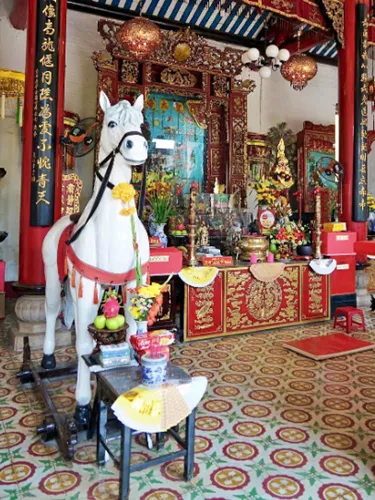
One of the most colorful and spiritually resonant landmarks in Hội An Ancient Town, Quan Công Temple (also known as Chùa Ông) is a beautiful example of Vietnam’s fusion of religion, folklore, and Chinese heritage. The temple was built in the 17th century and is dedicated to General Quan Công (Guan Yu), a revered historical figure from China’s Three Kingdoms period.

Who Was Quan Công?
Quan Công (known in Chinese as Guan Yu) was a legendary general renowned for his unwavering loyalty, integrity, and martial prowess. Though a real historical figure, he was later deified and became a powerful symbol of righteousness, especially among Chinese communities across East and Southeast Asia.
In Vietnam, he is not only worshipped by ethnic Chinese but also respected by the broader population, including traders, soldiers, and business owners, who pray to him for protection, honor, and success in commerce.
Here is an overview of Quan Công and his significance:
1. Historical Figure (Late Eastern Han Dynasty, Three Kingdoms Period in China):
Military General: Guan Yu (died 220 AD), was a real-life Chinese military general who served under the warlord Liu Bei. Liu Bei would later become the founding emperor of the state of Shu Han during the chaotic Three Kingdoms period (220-280 AD).
Sworn Brotherhood: He is famously known for his ‘sworn brotherhood’ with Liu Bei and Zhang Fei, an allegiance often romanticized as the ‘Oath of the Peach Garden’ in popular culture, symbolizing unwavering loyalty and fraternity.
Key Achievements: Historically, Guan Yu was a formidable warrior. One of his most notable real-life feats was slaying the enemy general Yan Liang at the Battle of Boma while serving briefly under Cao Cao (Liu Bei's rival). He also played a significant role in defending Jing Province for Liu Bei for several years.
Death: He was eventually captured and executed by Sun Quan, another warlord and former ally of Liu Bei, in 219 CE.
2. Transformation into a Cultural Hero and Deity:
‘Romance of the Three Kingdoms’: While historical records (like the Records of the Three Kingdoms) provide the factual basis, much of Guan Yu's immense popularity and the specific details of his legends come from the 14th-century historical novel, Romance of the Three Kingdoms by Luo Guanzhong. This novel greatly romanticized his deeds, emphasizing his moral qualities and exaggerating his military prowess.
Deification: His deification began during the Sui Dynasty (581–618 AD) and grew steadily over centuries. Emperors bestowed increasingly higher titles upon him, culminating in the Ming Dynasty when he was elevated to the status of an ‘Emperor’ (Guān Dì, or ‘Emperor Guan’). By the Qing Dynasty, his prestige arguably surpassed even that of Confucius in some respects.
Titles and Epithets: He is reverentially called Guān Gōng (‘Lord Guan’) or Guān Dì (‘Emperor Guan’). He is also sometimes referred to as ‘Magnificent Beard Lord’ (Měi Rán Gōng) due to his iconic long, lush beard.
Iconic Appearance: He is traditionally depicted with a red face (symbolizing loyalty and righteousness, possibly from opera makeup or a famous description), a long, flowing beard, and often wearing green robes while wielding his legendary weapon, the Green Dragon Crescent Blade (Guandao). He is also often associated with his loyal and legendary horse, famed for its incredible speed, strength, and endurance. Its name literally means ‘Red Hare Horse’, suggesting its fiery red color and swiftness akin to a hare.
Red Hare Horse originally belonged to the powerful, but often treacherous, warlord Lü Bu, who was renowned as one of the fiercest warriors of his time. After Lü Bu's downfall, Red Hare came into the possession of Cao Cao who was Liu Bei's rival. Knowing Guan Yu's reputation and seeking to win him over, Cao Cao gifted Red Hare to Guan Yu. Guan Yu deeply cherished Red Hare, not just for its speed and power, but because he saw it as a means to quickly return to his sworn brother Liu Bei, demonstrating his unwavering loyalty. The horse is often seen as a symbol of loyalty, mirroring Guan Yu's own steadfastness. After Guan Yu's death, legend claims Red Hare starved itself to death out of grief and loyalty to its master, further cementing this connection. Just as Guan Yu is inseparable from his Green Dragon Crescent Blade, he is almost always depicted or imagined riding Red Hare. This iconic pairing is deeply ingrained in Chinese and Vietnamese popular culture, appearing in art, opera, literature, and modern media like video games.
3. Significance and Worship:
Guan Yu is one of the most widely worshipped figures across various Chinese belief systems and beyond:
Chinese Folk Religion: He is a prominent deity in Chinese folk religion.
Popular Confucianism: Revered as a ‘sage’ who embodies virtue.
Taoism: Worshipped as ‘Holy Ruler Deity Guan’, a powerful protector and exorcist.
Chinese Buddhism: Adopted as Sangharama Bodhisattva, a guardian of the Buddhist dharma.
Patron God: He serves as the patron god of many different groups, symbolizing:
Loyalty and Righteousness: This is perhaps his most central and universal attribute, making him a model for interpersonal relationships and integrity.
Bravery and Military Prowess: Revered by soldiers, martial artists, and even police (e.g., in Hong Kong).
Wealth and Prosperity: Ironically, given his warrior background, he also became associated with fortune and is worshipped by many merchants and businessmen, who see his integrity and trustworthiness as key to successful ventures.
Justice and Protection: Often invoked to bring justice, settle disputes, and protect against evil.
History of Quan Cong Temple (Chùa Ông)
Quan Cong Temple was established in 1653 by the Fujian (Phúc Kiến) Chinese community in Hoi An during the port town’s golden era of maritime trade. As the city attracted merchants from China, Japan, and beyond, the local Chinese diaspora built places of worship that preserved their traditions and honored revered deities.
Over the centuries, the temple has been carefully preserved and restored, maintaining its original design and spiritual purpose.
What to See at Quan Cong Temple
Ornate Architecture
The temple features Chinese-Fujian architectural elements, with a double-tiered roof, dragon motifs, ceramic tiles, and red-and-gold lacquered woodwork that symbolize prosperity and honor.
The structure includes a front hall, central sanctuary, and inner altar arranged along a symmetrical axis—a layout influenced by Confucian spatial planning.
Main Altar of Quan Cong
At the heart of the temple sits a majestic statue of Quan Công, depicted with a red face, long black beard, and wearing a general’s armor. His solemn gaze reflects his role as a moral guardian.
Flanking him are his loyal aides: Châu Xương (the general) and Quan Bình (his adopted son), both of whom represent martial protection and filial piety.
Offerings and Rituals
Local residents and businesspeople frequently stop in to burn incense, make offerings, and seek blessings for honesty in trade and protection in life.
On special days such as Quan Công’s birthday (24th day of the sixth lunar month), the temple hosts vibrant ceremonies with traditional music and symbolic rituals.
Historical Artifacts and Calligraphy
Inside, you will find antique wooden altars, ceremonial drums, and Chinese calligraphy panels praising loyalty, virtue, and strength, values central to Confucian and Vietnamese moral codes.
Visitor Information
Opening Hours: 8:00am – 5:00pm daily
Entry: Included in the Hoi An Ancient Town ticket
Recommended Visit Duration: 30–45 minutes
Here at Backpack and Snorkel Travel Guides, we promote self-guided walking tours.
But we realize that not everybody likes to walk by themselves in a foreign city. So, just in case that you rather go with ab guide: NO PROBLEM! Please see the Viator tours below.
paid Viator tours
Where do you want to go now?









Author: Rudy at Backpack and Snorkel
Bio: Owner of Backpack and Snorkel Travel Guides. We create in-depth guides to help you plan unforgettable vacations around the world.

Other popular Purple Travel Guides you may be interested in:
Like this Backpack and Snorkel Purple Travel Guide? Pin these for later: