Cam Pho Communal House: Hoi An's Oldest 15th-Century Vietnamese Temple | Vietnam Purple Travel Guide
(map, reviews)
This is Premium Content! To access it, please download our
Backpack and Snorkel Purple Travel GuideTo enter, you need to have purchased the Hoi An Ancient Town Ticket.
Built in the early 19th century within one of the city’s oldest neighborhoods, Cam Pho Communal House (Đình Cẩm Phô) is one of the oldest and most historically significant communal houses in Hoi An.
A Center of Community Life in Hoi An
Communal houses, or đình, were once the spiritual and administrative heart of traditional Vietnamese villages. Cam Pho Communal House was built by the residents of the Cam Pho ward, one of Hội An’s earliest residential communities. It served as a place to worship the tutelary deity, pay tribute to local ancestors, and honor national heroes.
During the Nguyễn Dynasty, the communal house hosted everything from village meetings and seasonal festivals to agricultural rituals and ceremonies that celebrated historical events. Though it no longer plays a political role, the house is still actively used for cultural and religious ceremonies, especially during Lunar New Year (Tết) and Mid-Autumn Festival.
A Crossroads of Cultures: Vietnam and Japan in Hội An
Cam Pho Communal House preserves traces of Hội An’s deep historical ties with Japan. In the late 16th and early 17th centuries, then known as Hoai Pho, Fayfo, or Faifo, Hội An became a major trading port and rest stop for Japanese merchants traveling along the Southeast Asian maritime route.
According to Japanese historical records, the Shuinsen (Red Seal Ship) trade period, beginning in 1592, allowed licensed Japanese merchants to travel abroad. Many of them arrived in Hội An from Nagasaki, exchanging crystals, metalware, weapons, housewares, and jewelry for Vietnamese silks, precious woods, amber, lacquer, agarwood, and cinnamon. At the height of this era, Japanese ships accounted for 22.7% of all trade ships docking in Hoi An — an incredible testament to the port’s global importance.
Due to seasonal monsoons, many Japanese merchants stayed for extended periods, with some settling permanently. By the early 1600s, nearly 1,000 Japanese residents and families lived in Hội An. They were granted permission by the Nguyễn Lords to form a self-governing Japanese Town, adjacent to the Chinese community. These merchants played a vital role in shaping Hoi An’s economy and culture, with one of them, Araki Sotaro, marrying a Nguyễn princess.
Today, the Japanese Covered Bridge, nearby Japanese-influenced homes, tombs, Hizen ceramics, and even Khoan Vinh copper coins found in archaeological sites and private collections all stand as reminders of this rich cross-cultural exchange. Visitors to Cam Pho Communal House may also notice lingering influences of Japanese architecture and iconography inside nearby historic buildings.
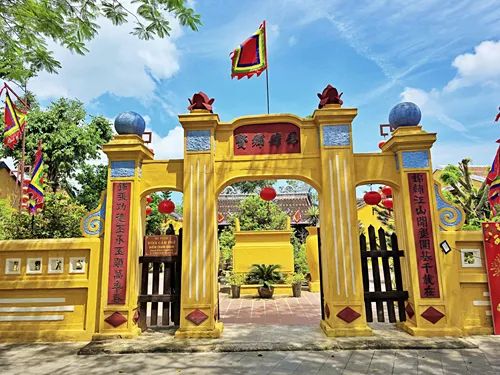
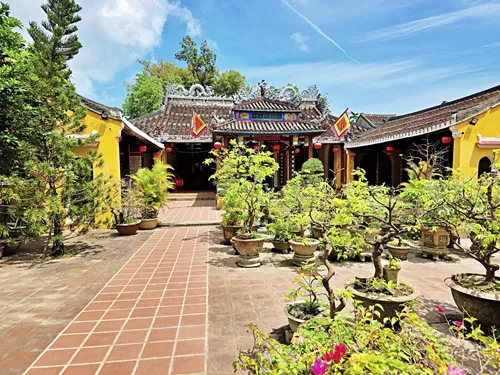
Here are some photos that we took:
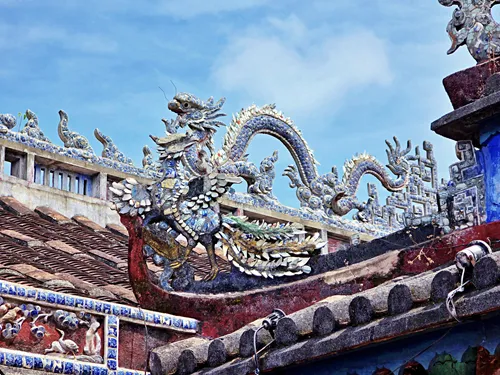
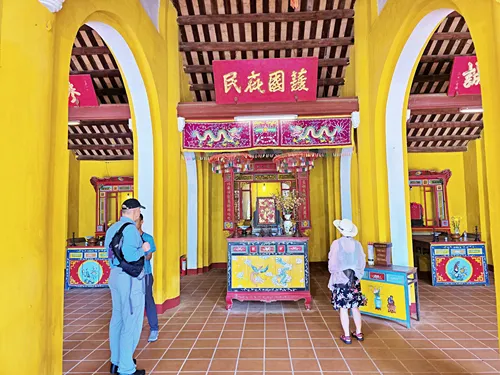
Architectural Highlights
The Cam Pho Communal House is a beautiful example of Vietnamese architectural design, influenced by Chinese decorative motifs and Confucian spatial planning. The structure is built mostly from wood and brick, with a traditional three-part layout: the ceremonial hall, the middle hall, and the front hall, all aligned along a central axis.
Key features include:
Curved rooflines with stylized dragons and phoenixes
Intricately carved wooden beams and altars adorned with gold leaf
A peaceful courtyard surrounded by bonsai trees and incense urns
Altars dedicated to founding ancestors, military heroes, and local spirits
Despite its understated exterior, the interior is rich in symbolic detail. You will find traditional red and gold lacquerwork, hanging lanterns, and calligraphy scrolls that embody Confucian ideals of loyalty, righteousness, and filial piety.
What Makes It Special
Unlike the more tourist-frequented assembly halls of Hoi An, the Cam Pho Communal House is less commercialized and often very quiet, allowing for a more introspective visit. It is one of the few places in the Ancient Town where you can experience the ambiance of a local place of worship without the crowds.
Because it remains active in community life, you may encounter local ceremonies, ancestor worship rituals, or incense offerings during your visit, especially around the Lunar New Year (Tết) or the Mid-Autumn Festival.
Practical Information
Opening hours: Typically from 7:00am to 5:00pm, daily
Entry: Included in the Hoi An Ancient Town ticket, which grants access to multiple cultural sites
Here at Backpack and Snorkel Travel Guides, we promote self-guided walking tours.
But we realize that not everybody likes to walk by themselves in a foreign city. So, just in case that you rather go with ab guide: NO PROBLEM! Please see the Viator tours below.
paid Viator tours
Where do you want to go now?

Author: Rudy at Backpack and Snorkel
Bio: Owner of Backpack and Snorkel Travel Guides. We create in-depth guides to help you plan unforgettable vacations around the world.

Other popular Purple Travel Guides you may be interested in:
Like this Backpack and Snorkel Purple Travel Guide? Pin these for later: