Singapore Travel Guide: Best Things to Do & 5-Day Self-Guided Itinerary | Singapore Purple Travel Guide
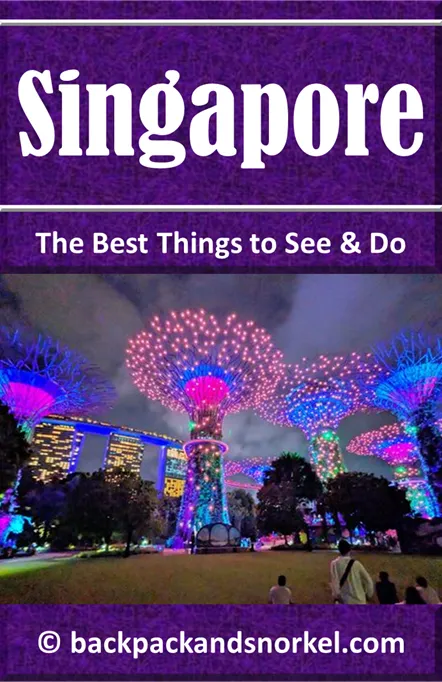
Are you planning a trip to Singapore and looking for a way to discover the city by yourself? This Singapore Purple Travel Guide is designed for the independent traveler who appreciates a seamless blend of futuristic architecture, world-class logistics, and lush urban greenery. From the soaring Supertrees at Gardens by the Bay to the vibrant heritage of Chinatown, our Backpack and Snorkel guide provides the factual details and original photography you need to master your own adventure without the need for an expensive tour group.
If you travel to eat and explore, Singapore is a revelation. Beyond the iconic skyline and the majestic Rain Vortex at Jewel Changi, you will find a culinary paradise in the city's clean and reliable hawker centers. This guide focuses on a "City and Sea" approach, helping you navigate the most famous attractions and hidden urban trails at your own pace. Whether you are seeking a detailed 5-day itinerary or deep historical insights, we provide the tools for a rewarding, self-guided journey through this modern island sanctuary.

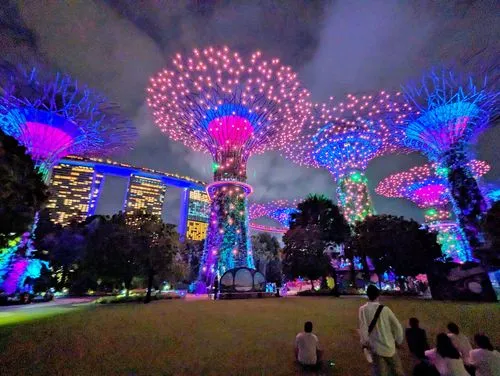
Here at Backpack and Snorkel Travel Guides, we promote self-guided walking tours.
But we realize that not everybody likes to walk by themselves in a foreign city. So, just in case that you rather go with ab guide: NO PROBLEM! Please see the GuruWalk and Viator tours below.
free GuruWalk tours
paid Viator tours
How much time do you need to visit Singapore?
To fully appreciate Singapore’s high-tech urbanism, a five-day trip is the ideal duration.
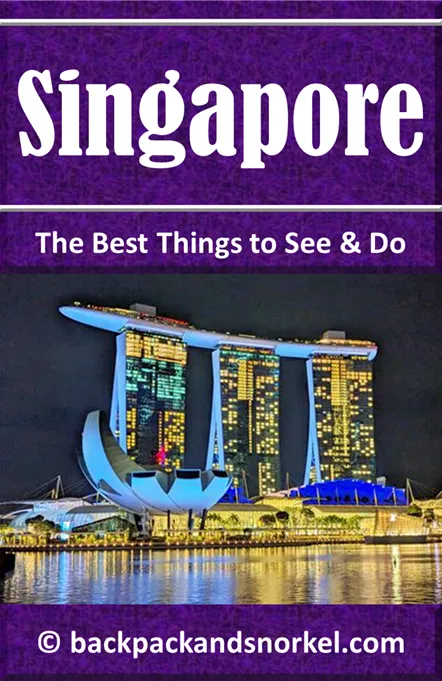
This is sufficient time to experience the iconic Marina Bay Sands, the Supertrees at Gardens by the Bay, and the cultural enclaves of Chinatown and Little India. A 5-day stay also allows for a dedicated relaxing day on Sentosa Island.
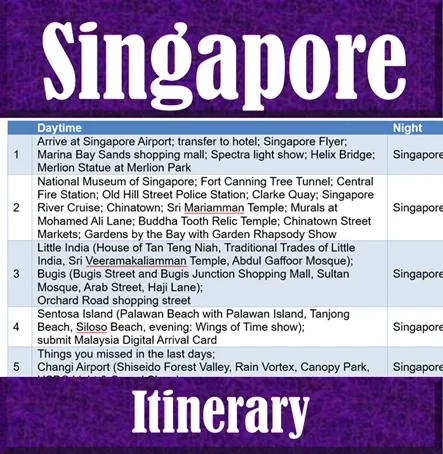
In this Singapore Purple Travel Guide, we present a meticulously planned five-day itinerary that balances high-energy city exploration with island relaxation. You can use this plan exactly as it is written or easily tailor the number of days in each location to suit your personal interests.
Our comprehensive five-day Singapore itinerary provides a day-by-day breakdown for your trip.
What is the best time to visit Singapore?
Singapore is a tropical city-state, which means it is hot and humid year-round. Temperatures typically range from 75°F (24°C) to 91°F (33°C). While there are no traditional four seasons, rainfall patterns vary throughout the year, influencing the best times for outdoor exploration or festival hopping.
Overall Best Time: February to April
This period is widely considered the ‘sweet spot’ for a visit to Singapore.
- The Dry Phase: This is the driest time of the year. February is particularly pleasant, averaging only 4.4 inches (112 millimeters) of rain.
- Outdoor Activities: With lower rainfall and slightly more breeze, this is the ideal window for walking tours, visiting the Singapore Zoo, or exploring the Botanic Gardens.
The Seasonal Transitions
- May to September (Southwest Monsoon)
This period sees an increase in short but intense afternoon thunderstorms. In Singapore, you should be aware of ‘Sumatra Squalls’—windy rainstorms that typically occur in the predawn hours or midday. Despite these bursts of rain, the weather remains relatively dry enough for sightseeing, and the city is vibrant with various mid-year festivals. - October and November (Inter-Monsoon)
These are the most unpredictable months. The winds are light, which often causes the humidity to feel stifling. Rainfall increases across the island as the seasons transition. This is also the period where the ‘Haze’ (smoke from regional agricultural fires) is most likely to affect air quality and visibility. - December and January (Northeast Monsoon)
This is the wettest phase for Singapore. The city can experience ‘monsoon surges’, which bring widespread, continuous moderate-to-heavy rain for several days at a time. While the temperatures are slightly cooler, you should plan for significant indoor time during these months.
Crowds and Festive Peaks
- Chinese New Year (Late January or February): This is a vibrant time to visit Chinatown, but you should expect massive crowds and significant price surges for accommodation. In 2026, Chinese New Year falls on February 17.
- The Great Singapore Sale and Food Festival (June – August): This is a popular time for shoppers and food enthusiasts. The Singapore Food Festival offers a deep dive into local flavors, while the weather remains manageable despite the occasional squall.
- School Holidays: You should be aware that June and December are major school holiday months. Popular attractions like Universal Studios Singapore or the S.E.A. Aquarium will have significantly longer wait times.
Weather Facts for the Traveler
- Humidity: Average humidity levels rarely drop below 80%. You should plan outdoor activities for the early morning (7:00 AM – 10:00 AM) or late afternoon to stay comfortable.
- The Afternoon Downpour: Even in the dry season, tropical thunderstorms are common. They are usually intense but short, lasting approximately 30 to 60 minutes, and they serve to cool the air.
- The Haze: Between August and October, smoke from agricultural fires in neighboring regions can occasionally cause smog, which may affect air quality. You should check the Pollutant Standards Index (PSI) if you are visiting during this window.
Self-Guided Planning Tips
Category |
Details |
|---|---|
Packing |
You should pack light, breathable cotton or ‘dry-fit’ fabrics. A high-quality compact umbrella is more useful than a raincoat in the stifling heat. |
Budget Tip |
Travel in May or September to avoid the mid-year holiday and festive crowds while still enjoying relatively stable weather. |
The ‘Rainy Day’ Plan |
Always have a list of indoor attractions (such as the National Museum of Singapore or Jewel Changi) ready for when a sudden downpour occurs. |
Traveler Tip
If you are visiting during the wet season (November – January), you should focus your itinerary on the many indoor world-class museums and shopping malls. Singapore is designed to keep you dry; the infrastructure includes extensive underground walkways and covered link-bridges that connect most major MRT stations to nearby attractions.
Below is the climate that you can expect during your trip to Singapore:


The highlights of the history of Singapore
Classical Era: Temasek and the Kingdom of Singapura
- 300 AD: Chinese records mention ‘Pu-luo-chung’ (Pulau Ujong), which is the earliest known name for the island of Singapore.
- 1025 AD: Emperor Rajendra Chola I of India launches a naval raid, sacking several regional ports including the settlement of Temasek.
- 1225 AD: Chinese official Chau Ju-Kua describes ‘Ling-ya-mon’ (Singapore) as a strategic trading outpost and a Srivijayan vassal.
- 1299: According to legend, Sang Nila Utama arrives on the island of Temasek, sights a lion, and founds the Kingdom of Singapura.
- 1330: Chinese traveler Wang Dayuan visits ‘Temasek’ and records a thriving, fortified trading settlement with a diverse population.
The Fall of Singapura and Colonial Beginnings
- 1398: Parameswara, the last King of Singapura, is forced to flee the island following a major Majapahit invasion from Java.
- 1819: Sir Stamford Raffles arrives and signs a treaty with Sultan Hussein Shah and the Temenggong to establish a British trading post.
- 1824: The Treaty of London (Anglo-Dutch Treaty) officially places Singapore within the British sphere of influence.
- 1826: Singapore, Melaka, and Penang unite to form the Straits Settlements, with Singapore eventually becoming the administrative capital.
- 1867: The Straits Settlements become a Crown Colony, moving from the control of British India to direct rule from London.
Twentieth Century: War and the Path to Nationhood
- 1923: The Johor-Singapore Causeway officially opens, providing the first permanent road and rail link to the mainland.
- 1942: Following the Malayan Campaign, the British surrender Singapore to the Japanese on February 15. The island is renamed ‘Syonan-to’ (Light of the South).
- 1945: Japan surrenders; the British Military Administration takes control of the island following the end of World War II.
- 1954: The People's Action Party (PAP) is founded by Lee Kuan Yew and his colleagues at the Victoria Memorial Hall.
- 1955: David Marshall becomes the first Chief Minister of Singapore following the Rendel Constitution.
- 1959: Singapore achieves full internal self-government; the PAP wins the general election and Lee Kuan Yew becomes the first Prime Minister.
- 1963: Singapore joins the Federation of Malaysia on September 16 to gain independence from British colonial rule.
- 1965: Following deep political and economic disagreements, Singapore separates from Malaysia on August 9 to become an independent and sovereign republic.
The Rise of a Global City
- 1967: Singapore becomes a founding member of the Association of Southeast Asian Nations (ASEAN).
- 1981: Singapore Changi Airport officially opens, replacing Paya Lebar Airport as the nation's primary international gateway.
- 1987: The Mass Rapid Transit (MRT) system begins operations, starting with a five-station stretch between Yio Chu Kang and Toa Payoh.
- 1990: Lee Kuan Yew steps down after 31 years as Prime Minister; Goh Chok Tong is sworn in as the second Prime Minister.
- 2004: Lee Hsien Loong is sworn in as the third Prime Minister of Singapore.
- 2010: The city hosts the inaugural Youth Olympic Games, marking its capability as a host for major international sporting events.
- 2015: Singapore celebrates its Golden Jubilee (SG50) and the nation mourns the passing of its founding father, Lee Kuan Yew.
- 2020: The COVID-19 pandemic leads to the unprecedented closure of the Johor-Singapore border and the implementation of ‘Circuit Breaker’ measures.
- 2024: Lawrence Wong is sworn in as the fourth Prime Minister of Singapore, marking the transition to the ‘4G’ leadership team.
Driving a car in Singapore
The Basics: Left-Hand Traffic
Singapore follows the British system; vehicles drive on the left side of the road, and the steering wheel is on the right. If you are accustomed to driving on the right, you must exercise extra caution, especially at roundabouts and when turning at intersections.
Why You Should Avoid Driving in Singapore
In Singapore, the government actively discourages private car ownership and usage through a system of high costs and strict regulations. For the vast majority of tourists, a rental car is a liability rather than an asset.
- Electronic Road Pricing (ERP): Singapore uses a sophisticated ‘pay-as-you-use’ congestion charging system. Automated gantries located on expressways and in the city center charge your vehicle's ‘In-Vehicle Unit’ (IU) every time you pass under them during peak hours. If you are in a rental car without a properly topped-up stored-value card, you may face significant fines.
- High Costs: Between the high cost of fuel, the ERP charges, and the daily rental rates, driving is the most expensive way to see the city.
- Parking Challenges: Parking is heavily regulated and can be difficult to find in popular districts. In the city center, rates are high. In residential areas (HDB), you must use the ‘Parking.sg’ mobile app to pay for your duration, as many car parks no longer accept paper coupons.
- Efficiency of Public Transport: Because the MRT (train) and bus systems are world-class, air-conditioned, and remarkably affordable, they almost always get you to your destination faster than a car would when you account for traffic and parking.
Our Recommendation: Stick to Public Transport and Grab
For a stress-free experience, we strongly recommend that you avoid renting a car while in Singapore.
- Use the MRT and Buses: They are exceptionally clean, fast, and cost-effective. You can pay for all public transport simply by tapping your contactless credit card or mobile wallet at the gantry.
- Use the Grab App: If you require door-to-door service or are traveling late at night, use the Grab app (Southeast Asia’s equivalent to Uber). It provides transparent pricing and eliminates the need to navigate unfamiliar roads.
- Between Cities: For the journey from Singapore to Kuala Lumpur, taking a luxury bus or a short flight is far more relaxing than navigating border traffic and highway tolls.
By skipping the rental car, you avoid the stress of navigating complex traffic rules, the frustration of finding parking in the humidity, and the complexity of managing digital road tolls.
Cross-Border Regulations (Singapore to Malaysia)
Driving a vehicle across the Johor-Singapore Causeway or the Second Link requires strict adherence to legal mandates:
- The ‘3/4 Tank Rule’: By law, any Singapore-registered vehicle leaving Singapore must have at least three-quarters of a tank of fuel. Failure to comply can result in a heavy fine or being turned back at the border.
- Vehicle Entry Permit (VEP): Foreign vehicles entering Malaysia must be registered for a VEP. This involves an RFID tag that tracks entry and exit and handles the payment of the Road Charge (RC) of RM 20 (US$4.60).
Traveler Tip
If you choose to use the MRT, you do not need to purchase a special transport card. Simply use your contactless Visa or Mastercard or your phone’s digital wallet (Apple Pay/Google Pay) to tap in and out at the stations. This is the most efficient way to travel without having to worry about topping up balances or calculating fares.
Public Transportation in Singapore
To navigate Singapore effectively, you must understand the ‘Golden Rule’ of tropical travel: the shortest walk can feel like a marathon in 90°F (32°C) heat with 80% humidity. Fortunately, Singapore possess world-class infrastructure designed to keep you moving in air-conditioned comfort.
1. Mass Rapid Transit (MRT) - The Gold Standard of Efficiency
Singapore’s Mass Rapid Transit (MRT) (website, network_map) is arguably the most user-friendly system in the world. It is clean, punctual, and covers almost every square inch of the island.
This is Premium Content! To access it, please download our
Backpack and Snorkel Purple Travel Guide- Payment is Seamless: You do not need to buy a specific travel card. You can simply tap your contactless Visa or Mastercard, Apple Pay, or Google Pay at any fare gate.
- The ‘Sheltered Walkway’ Network: Singapore is designed with thousands of miles of covered walkways. You can often walk from an MRT station to a shopping mall or hotel without ever being exposed to rain or direct sun.
- The Underground City: In areas like Orchard Road or Marina Bay, the MRT stations connect to massive underground malls. You can travel for miles in a climate-controlled environment.
- Accessibility: Every single station has elevators and ramps. If you have luggage or a stroller, the MRT is entirely stress-free.


2. Ride-Hailing in Singapore: Your ‘Heat Escape’ Strategy
While the trains are great, the ‘last mile’ (the walk from the station to your final door) is where the tropical weather hits hardest. This is where ride-hailing becomes essential.
Understanding the ‘Back-to-Back’ Wait Time
A critical detail for your planning is that Grab and other services utilize a ‘back-to-back’ booking system.
- How it Works: A driver can accept your ride request while they are still finishing a journey for another passenger.
- The Impact on You: If your assigned driver is currently completing another trip, your waiting time will be longer. The app will usually show a status such as ‘Driver is finishing a trip nearby’ and provide an estimated time for them to drop off the current passenger before they head toward you.
- Strategy: You should check the app status immediately after booking. If the driver is still in the middle of another ride, you have a few extra minutes to stay inside the air-conditioning. However, do not wait too long; once they drop off the previous passenger, they may arrive at your location very quickly.
Grab (The Dominant App)
Grab is the ‘Uber of Southeast Asia’. You should download this app before you arrive. It works seamlessly in both Singapore and Malaysia.
- Convenience: You can book a ride from inside an air-conditioned mall and only step outside when the app shows the driver is 1 minute away.
- Fixed Pricing: You see the fare before you book. Even if the driver gets stuck in heavy Kuala Lumpur traffic or a sudden tropical downpour, the price does not change.
- Safety: The app tracks your GPS location, shows your driver’s face and license plate, and allows you to share your ride status with friends.
- Affordability: In Singapore, Grab is cheaper than a rental car and far more convenient than hunting for a taxi in the rain.
Other Option
- Gojek (Singapore only): A strong competitor to Grab in Singapore, often offering slightly lower prices during off-peak hours.
Summary of Transit Strategies
Situation |
Best Choice |
Why? |
|---|---|---|
Heavy Rain / High Heat |
Grab / Ride-Hailing |
Door-to-door service; no walking in the elements. |
Rush Hour Traffic |
MRT |
Trains bypass the legendary Singapore traffic jams. |
Budget Sightseeing |
Public Bus / MRT |
Extremely cheap; Singapore's buses are all air-conditioned. |
Traveler Tip
If you see a dark cloud approaching, book your Grab immediately. Once the rain starts, ‘surge pricing’ kicks in, and wait times can jump from 3 minutes to 20 minutes as everyone else tries to escape the downpour.
Money and Credit Cards in Singapore
Singapore: A Near-Cashless Society
Singapore is one of the world's leaders in digital payments. You can virtually travel across the entire island without ever touching a physical banknote.
- Contactless is King: Visa and Mastercard ‘Tap to Pay’ (PayWave) work everywhere—from high-end boutiques on Orchard Road to the MRT/Bus system and even most vending machines. Apple Pay and Google Pay are equally universal.
- The Hawker Centre Transition: As of 2025, the Hawkers Go Digital program has successfully brought almost all food stalls online. Look for the SGQR sticker (a single QR code that accepts multiple apps).
- For Tourists: While locals use ‘PayNow’, tourists can often pay at these stalls using GrabPay (within the Grab app) or simply by tapping their contactless credit card if the stall has a terminal.
- When you still need cash: Carry $20–$50 in small denominations ($2, $5, $10 notes). You might need this for very small traditional shops in HDB heartlands, loading physical EZ-Link cards (if you do not use your phone), or at small ‘Mama Shops’ (convenience stores).
You can find the current exchange rates here: Singapore Dollar (SGD)
Payment Comparison Table
Situation |
Singapore Method |
|---|---|
Public Transport |
Tap your Credit Card / Phone |
High-End Dining |
Contactless Credit Card |
Hawker / Street Food |
Tap Card / GrabPay / Cash |
Taxis / Grab |
In-app Card Payment |
An important ‘Heat & Humidity’ Tip
Avoid the physical ‘Money Changer’ queues in the humid streets. The exchange rates at ATMs are now very competitive. It is much more comfortable to withdraw cash from an indoor, air-conditioned ATM at a bank or mall than to stand in a line at a street-side currency booth.
Tap water in Singapore
Singapore: Drink with Confidence
Singapore’s water system is a global marvel. Managed by the Public Utilities Board (PUB), the water undergoes rigorous treatment and more than 500,000 tests annually to ensure it exceeds WHO standards.
- Safety: 100% safe to drink directly from any tap (bathroom, kitchen, or public fountains).
- The ‘Old Building’ Myth: Some people worry about old pipes in older buildings. While the water leaving the treatment plant is perfect, very old plumbing can sometimes add a slight metallic taste. If you are in an old building, simply let the tap run for 10 seconds to flush the system.
- Cost & Sustainability: Bottled water in Singapore is expensive ($3–$5 per bottle). Save money and reduce plastic waste by carrying a reusable bottle and refilling it at your hotel or public ‘Water Points’ found in malls and parks.
Telephone in Singapore
Staying connected is vital for using ride-hailing apps and navigating the tropical heat. If your home mobile plan does not offer affordable international roaming, purchasing a local SIM card is a cheap and highly effective solution. Singapore offers eSIM options that you can activate before you even land.
- Country Code: Singapore: +65
- Singapore SIM Cards: Upon arrival at Changi Airport, visit a Singtel, StarHub, or M1 kiosk in the arrival hall.
- The Singtel $30 hi! Tourist SIM is highly recommended; it provides a massive 100GB of 5G data for 28 days.
- The ‘One-SIM’ Pro Tip: If you are visiting Singapore and Malaysia, you likely only need one SIM card. Most Singaporean tourist plans (like the Singtel $30 or $50 cards) include 5GB to 10GB of roaming data specifically for Malaysia. This allows you to cross the border and stay connected without ever swapping cards or searching for a new kiosk.
Note
Due to local security regulations, you must present your original passport to register any local SIM card.
In which Time Zone is Singapore
Singapore operates on GMT+8. It does not observe Daylight Savings Time.
You can find the current local time here.
Visa requirements for Singapore
Singapore is famously efficient. For most travelers, the process is entirely digital and requires no physical paperwork.
- Visa-Free Entry: Citizens of the United States, United Kingdom, Australia, and all EU nations typically receive a 90-day social visit pass upon arrival. Most other Western nationalities are granted 30 days.
- The SG Arrival Card (SGAC): This is a mandatory electronic health and arrival declaration. It is not a visa, but you cannot clear immigration without it.
- Timeline: You must submit it within 3 days before your arrival (including the day of arrival).
- Cost: It is completely free.
- Passport Validity: Your passport must be valid for at least 6 months from the date of entry.
Official Verification & Submission Links
To ensure your data is secure and that you are not charged unnecessary fees, use only these official government websites:
To Check Visa Requirements:
To Submit Your Mandatory Arrival Card:
Warning on ‘Visa Scams’
You will encounter many third-party websites that look official but charge $50–$100 to ‘process’ your arrival card. Submission of the SGAC is free. Always ensure the URL ends in .gov.sg.
Languages spoken in Singapore
To navigate the social landscape of Singapore effectively, it is helpful to understand not just what people speak, but how they use language to bridge their multicultural societies. Here is a detailed breakdown of the linguistic diversity in Singapore.
Singapore: A Global Linguistic Crossroads
Singapore recognizes four official languages: English, Mandarin Chinese, Malay, and Tamil. However, the linguistic reality is highly structured:
- English as the Working Language: English is the medium of instruction in schools and the primary language for business, government, and law. You can navigate the entire country, from the MRT to fine-dining restaurants, using only English.
- The Mother Tongue Policy: Most Singaporeans are bilingual, speaking English plus their ‘Mother Tongue’ (Mandarin, Malay, or Tamil) to preserve their cultural heritage.
- Singlish (The Local Flavor): In casual settings, you will hear Singlish. This is a colorful, fast-paced creole that blends English with grammar and vocabulary from Malay, Hokkien, Cantonese, and Tamil.
- Pro Tip: You will notice ‘sentence particles’ like lah, leh, and meh used to add emphasis or emotion. You do not need to speak it, but understanding it helps you catch the local rhythm.
- Signage: Almost all public signs, including those on the MRT and at Changi Airport, are written in all four official languages.
Useful Phrases for the Traveler
While English is sufficient, using these local terms will win you smiles and better service:
Phrase |
English Meaning |
Usage Tip |
|---|---|---|
Makan |
To eat / Food |
‘Let's go makan!’ |
Uncle / Auntie |
Respectful title |
Used to address elders (like a taxi driver or food stall owner), regardless of actual relation. |
Shiok |
Fantastic / Delicious |
Used to describe something great, especially food. |
Religions in Singapore
Singapore: Managed Diversity & Harmony
Singapore is often cited as the most religiously diverse country in the world. Because it is a secular state, no single religion is given official preference, and the government strictly enforces ‘religious harmony’ to ensure all groups coexist peacefully.
- The Breakdown (2025 Estimates):
- Buddhism (~31%): The most practiced faith, primarily among the Chinese community. You will see grand Mahayana temples as well as Thai and Burmese Buddhist centers.
- Christianity (~19%): A growing group, split between Catholic and various Protestant denominations (Methodist, Anglican, and large Megachurches).
- No Religion (~20%): A significant and growing percentage of Singaporeans identify as secular or atheist.
- Islam (~16%): Practiced by nearly all Malays and a portion of the Indian community.
- Hinduism (~5%): Centered in the vibrant ‘Little India’ district, with stunning Dravidian-style temples.
- Unique Feature: The Inter-Racial and Religious Confidence Circles (IRCC). Every neighborhood has a local group that brings leaders from different faiths together to build ties, ensuring that a mosque, a church, and a temple can exist on the same street without conflict.
Visiting Etiquette: The ‘Must-Knows’
When visiting houses of worship, following these rules shows immense respect for local traditions:
- The Footwear Rule: Always remove your shoes before entering a mosque, Hindu temple, or many Buddhist temples. You will see a shoe rack or a designated area outside. It is perfectly fine to wear socks, though some Hindu temples may prefer bare feet.
- Mosques: Women must cover their heads (scarves are usually provided at the entrance for tourists) and wear long sleeves and long pants/skirts. Men should wear long pants. Short-sleeved shirts are usually okay for men, but singlets (tank tops) are not.
- Temples: Avoid short shorts or sleeveless tops. A light shawl is a great item to keep in your bag to quickly cover your shoulders.
- The ‘Feet’ Taboo: In both Hindu and Buddhist traditions, the feet are considered the ‘lowest’ and dirtiest part of the body. Never point the soles of your feet toward an altar, a deity, or a priest. When sitting on the floor, tuck your legs beneath you or sit cross-legged.
- Photography: Always look for signs. Most places allow photos of the architecture, but taking photos of people during prayer is often considered intrusive. Never use a flash inside a prayer hall.
- The Right Hand: If you are giving a donation or receiving something from a priest or official, always use your right hand (or both hands). In many local cultures, the left hand is reserved for personal hygiene and is considered impolite for social interactions.
Must-Try Food Guide
Food is the national obsession in Singapore. To eat like a local, you must look beyond fine dining and head to the communal eating spaces that define the culture.
Our Singapore Foodie Dictionary
- Essential General Terms
- Makan: To eat / Food.
- Tapau: Takeaway / To go.
- Chope: To reserve a seat, usually with a tissue packet.
- Halal: Food prepared according to Islamic law (no pork or alcohol).
- Drinks (The 'Kopi' System)
Ordering coffee (Kopi) or tea (Teh) is an art form. Use these modifiers: - O (stands for the Hokkien word oh, which means black): No milk (with sugar).
- C (refers to Carnation, which was the most popular brand of evaporated milk when this system was created): With evaporated milk (and sugar).
- Kosong: No sugar.
- Peng: Iced.
- Tarik: ‘Pulled’ tea or coffee, frothed for a creamy texture.
- Popular Dishes
- Nasi Lemak: Malaysia's national dish; coconut rice served with sambal, anchovies, and peanuts.
- Laksa: Spicy noodle soup. Curry Laksa is creamy (KL/SG), while Asam Laksa is tangy/fish-based (Penang).
- Satay: Grilled meat skewers served with peanut sauce.
- Roti Canai: Flaky flatbread served with dhal or curry (called Roti Prata in Singapore).
- Char Kway Teow: Stir-fried flat rice noodles with cockles, Chinese sausage, and sprouts.
- Hainanese Chicken Rice: Poached chicken and seasoned rice; a Singaporean staple.
- Cendol: Dessert with green jelly, coconut milk, and palm sugar (Gula Melaka).
- Where You Eat
- Hawker Center: Large outdoor/semi-outdoor food courts (common in Singapore).
- Kopitiam: Traditional coffee shops serving breakfast and local favorites.
The Hawker Culture
Singapore’s food scene revolves around Hawker Centres—large, open-air complexes with dozens of specialized stalls.
- Chinatown (Maxwell Food Centre & Chinatown Complex):
- Must-Try: Hainanese Chicken Rice (look for the famous Tian Tian stall).
- The Experience: This is the best place to try Laksa (spicy coconut noodle soup) and Satay (grilled skewers).
- Little India (Tekka Centre):
- Must-Try: Nasi Biryani (spiced rice with mutton or chicken) and Roti Prata (flaky flatbread served with dhal).
- The Experience: Wander the narrow streets to find Murtabak—a giant stuffed prata—at the legendary Zam Zam near the Sultan Mosque.
- Little India (Tekka Centre):
- Must-Try: Katong Laksa. Traditionally eaten with only a spoon (the noodles are cut short).
- The Experience: Explore the colorful Peranakan shophouses while snacking on Otah (spiced fish cake grilled in banana leaves).
Hawker Etiquette:
- Choping: If you see a packet of tissues on an empty table, it is ‘reserved’. Find your own table and ‘chope’ it with a tissue pack before ordering.
- Tray Return: It is now mandatory in Singapore to return your tray and crockery to the designated stations.
Essential Travel Apps in Singapore
To navigate Singapore like a local, your smartphone is your most important tool. Singapore is highly digitized, and having the right apps can mean the difference between standing in a long ticket queue and walking straight into an attraction.
To discover these places by yourself, download and set up these apps (including linking a payment card) before you land.
App |
Primary Purpose |
Why you need it for Self-Discovery |
|---|---|---|
Grab |
Transport & Food |
The undisputed ‘super-app’. Use it for fixed-price rides (avoiding taxi haggling) and ordering food to your hotel. Works seamlessly across Singapore. |
Google Maps |
The Master Map |
Essential for walking tours. It tracks live bus and MRT arrival times with incredible accuracy in both countries. Make sure to download offline maps for Singapore. |
SimplyGo |
SG Public Transit |
In Singapore, you do not need a physical card; you can tap your phone/credit card. This app tracks your fares, shows your balance, and maps out your MRT routes. |
Citymapper |
City Navigation |
Often more precise than Google for the ‘last mile’. It tells you exactly which MRT exit to use to be closest to an attraction like the Merlion. |
Klook / Pelago |
Regional Tickets |
The best for ‘instant’ bookings. Pelago is owned by Singapore Airlines—use it for exclusive bundles. Perfect for skip-the-line entries. |
Unique Experiences |
Exceptional for finding local ‘hidden gem’ tours (like night food walks in Singapore) with a very user-friendly mobile voucher system. |
|
Unique Experiences |
Exceptional for finding local ‘hidden gem’ tours (like night food walks in Kuala Lumpur) with a very user-friendly mobile voucher system. |
Deep Dive: Choosing Your Booking App
While they may seem similar, Viator, GetYourGuide, and Klook serve different ‘self-discovery’ needs:
- Viator (A Tripadvisor Company) and GetYourGuide:
- Best for: High-quality digital vouchers. If you lose internet, their app stores the QR code offline. Their ‘Originals’ tours often include perks you cannot get elsewhere.
- Self-Discovery Tip: Use the ‘Meeting Point’ feature. It links directly to Google Maps to show you exactly where to start your walk.
- Klook:
- Best for: Pure price. In SE Asia, Klook usually has the deepest discounts for major spots.
- Self-Discovery Tip: Look for the ‘Klook Pass’—it allows you to pick 2–5 attractions for one flat fee, saving up to 40%.
Pro-Tip for Independent Travelers
In Singapore, you can now pay for most things via QR Code. Use the Grab app to scan ‘SGQR’ codes at hawker centers.
Power & Connectivityin Singapore
1. Power: The Hardware
- Plug Type: Type G (the British-style 3-rectangular-pin plug).
- Voltage & Frequency: 230V (SG) / 240V (MY) at 50Hz.
- Pro-Tip for North Americans/Japanese: Most modern electronics (phones, laptops, cameras) are ‘Dual Voltage’ (100-240V) and only need a plug adapter. However, do not plug in high-heat appliances like hair dryers or straighteners without a heavy-duty voltage converter, or you may fry the device.
- Airport and Hotel Charging: Changi Airport is very traveler-friendly and usually provides both universal outlets (that also accept European and North American plugs) and USB ports at most gates. Some mostly higher-class hotels also provide universal outlets in their guest rooms – but do not count on it.
2. Connectivity: How to stay online
The best way to discover Singapore independently is with a Traveler eSIM or a Cross-Border SIM.
Country |
Wi-Fi Strategy |
Recommended SIM / eSIM |
|---|---|---|
Singapore |
High Availability. Connect to Wireless@SGx (free public Wi-Fi) at airports, malls, and MRT stations. |
Singtel hi! Tourist SIM ($12): Gives you 100GB of 5G data and, crucially, 3GB of roaming data for Malaysia. Perfect for day trips to Johor Bahru. |
3. The ‘One SIM’ Solution (Cross-Border)
If you are traveling between both countries and do not want to swap SIM cards, look for these specific options:
- Airalo (eSIM): Download the app and buy the ‘Discover’ or ‘Asia’ regional plan. It is slightly more expensive but activates automatically as you cross the border.
- StarHub (SG): Their $12/15 Traveler eSIMs often include 3GB–5GB of roaming data that works in Malaysia, Indonesia, and Thailand.
- M1 (SG): Their tourist SIMs are famous for having ‘seamless’ data that treats Malaysia as part of the local network.
Self-Discovery Hack: Download your Google Maps for ‘Offline Use’ before leaving your hotel. Even with a local SIM, Singapore’s tall buildings and Malaysia’s rural roads can sometimes cause GPS lag.
4. Where to Buy
Singapore: Pick up your pre-ordered SIM at the UOB Currency Exchange or Changi Recommends counters at Changi Airport. You must bring your passport for registration.
Where do you want to go now?
Author: Rudy at Backpack and Snorkel
Bio: Owner of Backpack and Snorkel Travel Guides. We create in-depth guides to help you plan unforgettable vacations around the world.

Other popular Purple Travel Guides you may be interested in:
Like this Backpack and Snorkel Purple Travel Guide? Pin these for later: