Day 4: Serene Gardens and Spiritual Landmarks | Malaysia Purple Travel Guide
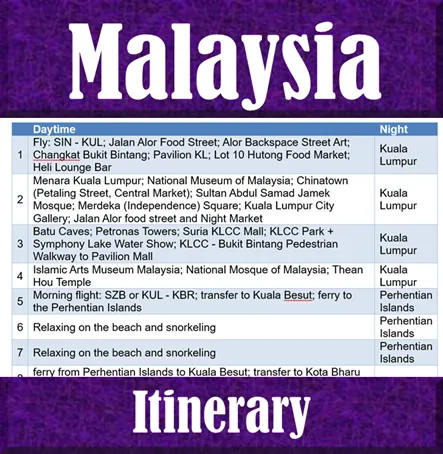
The fourth day of our Malaysia Purple Travel Guide itinerary is designed for a slower, more reflective pace, focusing on quiet gardens and grand architecture. While the previous days were about high-energy city life, today you will journey through the "Green Lung" of the capital. Most of these sites are clustered around the Perdana Botanical Garden area, making it easy to transition from one architectural marvel to the next before you head off to your next adventure.


Here at Backpack and Snorkel Travel Guides, we promote self-guided walking tours.
But we realize that not everybody likes to walk by themselves in a foreign city. So, just in case that you rather go with ab guide: NO PROBLEM! Please see the GuruWalk and Viator tours below.
free GuruWalk tours
paid Viator tours
Morning and Midday: Architecture of the Soul
Islamic Arts Museum Malaysia (IAMM)
(map, reviews, website)
This is Premium Content! To access it, please download our
Backpack and Snorkel Purple Travel GuideThe Islamic Arts Museum Malaysia (IAMM) is widely recognized as the finest museum in the country and the largest of its kind in Southeast Asia. Even before you enter, the building itself demands your attention as a modern architectural marvel. It features five massive, turquoise-tiled domes that were handcrafted by master artisans from Iran, creating a shimmering landmark at the edge of the Perdana Botanical Gardens. The exterior white marble is adorned with intricate geometric tilework that reflects centuries of artistic tradition.
Once you step into the air-conditioned interior, you will find an expansive collection of over 10,000 artifacts spread across 12 permanent galleries. Highlights include the Architecture Gallery, which houses incredibly detailed scale models of the world's most famous mosques, and the Quran & Manuscripts Gallery, featuring some of the oldest handwritten religious texts in the region. The museum's open-plan layout and natural light make it a peaceful place for a "self-guided" discovery of the intellectual and artistic achievements of the Islamic world.


National Mosque of Malaysia (Masjid Negara)
(map, reviews, website)
This is Premium Content! To access it, please download our
Backpack and Snorkel Purple Travel GuideLocated just across from the museum, the National Mosque of Malaysia is a bold departure from traditional mosque architecture. Completed in 1965 to celebrate the nation’s independence, it eschews the typical bulbous dome for a unique, 16-pointed star-shaped concrete roof. This design is inspired by an open umbrella—a symbol of protection and royalty in the tropics—while the 73-meter-high minaret resembles a folded umbrella. The 13 acres of surrounding gardens are filled with fountains and reflecting pools that offer a cool, quiet escape from the city noise.
The mosque is a stunning example of how modern engineering can blend with religious symbolism. As you walk through the marble-clad courtyard, you will experience the "serene side" of Kuala Lumpur. We highly recommend visiting during the midday sun to see the light filter through the intricate louvered screens, or staying nearby to hear the hauntingly beautiful Adhan (Call to Prayer) as it resonates through the valley.


Afternoon: Thean Hou Temple
Thean Hou Temple
(map, reviews, website)
This is Premium Content! To access it, please download our
Backpack and Snorkel Purple Travel GuidePerched atop the lush greenery of Robson Heights, Thean Hou Temple is a six-tiered architectural masterpiece and one of the most vibrant cultural landmarks in the city. Dedicated to Mazu, the Goddess of the Sea, this temple is a brilliant fusion of modern structural design and traditional Chinese motifs. It is world-famous for the thousands of red lanterns that hang across its massive courtyard, creating a sea of color that is particularly magical during festivals and early morning hours.
As you explore the temple grounds, you will find intricate dragon-carved pillars, ornate prayer halls, and a Chinese Zodiac garden. Because of its hilltop location, the temple terrace offers one of the best panoramic views of the Kuala Lumpur skyline, where you can see the Petronas Towers and Merdeka 118 rising in the distance. It is an active community hub where you might see traditional weddings or martial arts practices, making it an essential stop for anyone looking to understand the cultural diversity of Malaysia.
After visiting the temple, head back to your hotel to pack for your trip to the Perhentian Islands tomorrow.
Learn more about the temple and the famous thousands of red lanterns in our Thean Hou Temple guide.


Where do you want to go now?
Author: Rudy at Backpack and Snorkel
Bio: Owner of Backpack and Snorkel Travel Guides. We create in-depth guides to help you plan unforgettable vacations around the world.

Other popular Purple Travel Guides you may be interested in:
Like this Backpack and Snorkel Purple Travel Guide? Pin these for later: