Kuala Lumpur & Perhentian Islands: A Self-Guided Journey | Malaysia Purple Travel Guide
Malaysia is one of the countries that surprised us the most, especially Kuala Lumpur with its ultra-modern high-tech downtown area and traditional neighborhoods. We loved the balance of exploring high-energy city streets before slowing down on a tropical beach during the off-season. This guide focuses on a streamlined "City and Sea" route, taking you through the heart of the capital and the quiet marine sanctuaries of the Perhentian Islands. We chose these two spots specifically so you can spend less time sitting on long-distance buses and more time actually exploring. Whether you are standing among massive skyscrapers or swimming in the clear tides of the South China Sea, this self-guided itinerary offers the best of both worlds.
The Strategic Advantage: Why You Should Visit in the May Shoulder Season
Getting the timing right is the secret to a great trip in Malaysia, and we built this guide specifically for the May shoulder season. While the West Coast starts getting hit with heavy monsoon rains in May, the East Coast of Malaysia is right in the middle of its prime dry season. By going during this window, you get the best marine conditions with crystal-clear water for snorkeling in the Perhentian Islands. You also beat the massive crowds that arrive in July and August. This keeps your travel plans moving smoothly without worrying about weather delays.
From Iconic Towers to Untamed Reefs: A Journey of Contrast
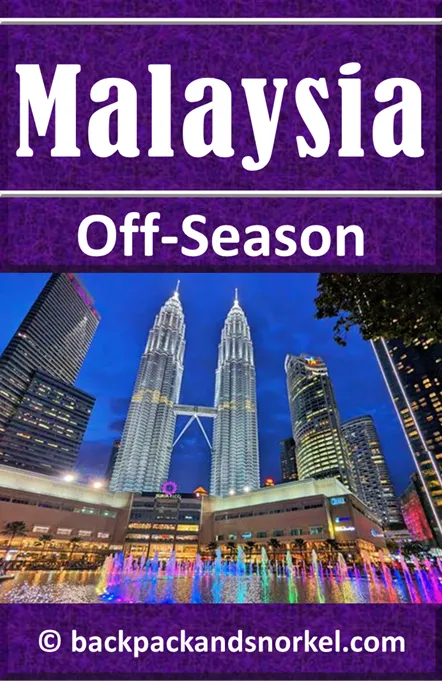
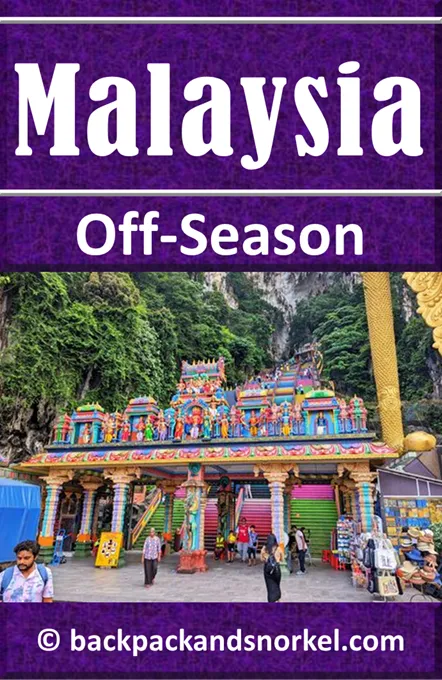
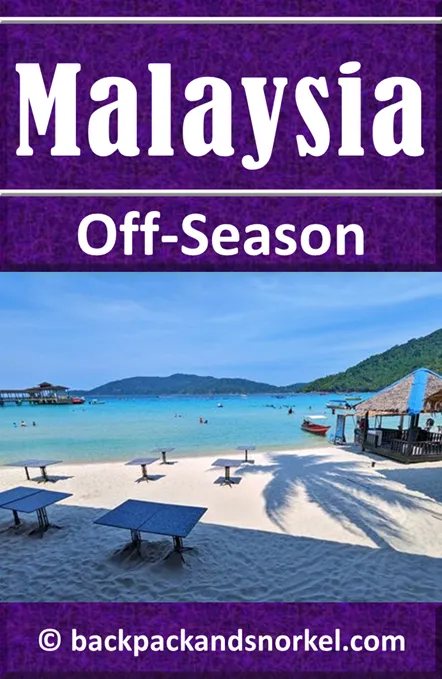
Your adventure starts in Kuala Lumpur, where you can look up at the famous Petronas Twin Towers and visit ancient sites like the Batu Caves. From there, you will head to the turquoise waters of the Perhentian Islands, where the jungle grows right down to the sand. You do not even need to hire a boat to find adventure here; some of the best snorkeling in the world is just a few steps from the beach. You can spend your days swimming with colorful fish, sea turtles, and colorful corals at your own pace. With original photos and straightforward facts, this guide helps you see the real Malaysia without the stress.
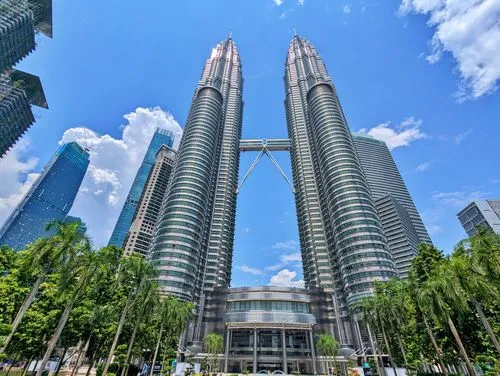


Here at Backpack and Snorkel Travel Guides, we promote self-guided walking tours.
But we realize that not everybody likes to walk by themselves in a foreign city. So, just in case that you rather go with ab guide: NO PROBLEM! Please see the GuruWalk and Viator tours below.
free GuruWalk tours
paid Viator tours
How much time do you need to visit Malaysia?
To fully appreciate the cultural depth of Kuala Lumpur and the natural splendor of the Perhentian Islands, an eight-day trip is the ideal duration.
This timeframe allows you to explore each destination thoroughly without the exhaustion of constant travel.
- Kuala Lumpur (3–4 Days): In the Malaysian capital, three to four days will allow you to visit the Petronas Twin Towers, the Batu Caves, and the historic Merdeka Square. This duration also provides ample time to explore the city’s legendary street food scene in Bukit Bintang and Petaling Street at a relaxed pace.
- Perhentian Islands (4–6 Days): Because the journey to the East Coast involves a domestic flight and a boat transfer, you should dedicate at least four full days to the islands. This ensures you have enough time to visit multiple snorkeling spots, trek through the island jungles, and truly unwind on the beach.
- Travel and Buffer Days (1-2 Days): It is important to account for the transit time between Kuala Lumpur and the Perhentian Islands and recommended to add a day to count for bad weather.
The ‘City and Sea’ Strategy
While many travelers try to cram every Malaysian state into a single trip, this guide advocates for a more focused approach. By concentrating on these three specific areas, you avoid the six-to-eight-hour bus rides required to reach the Cameron Highlands or Penang. Instead, you can utilize efficient flight connections or the high-speed rail links, ensuring that your vacation remains a relaxing experience rather than a logistical marathon.
In this Malaysia Purple Travel Guide, we present a meticulously planned eight-day itinerary that balances high-energy city exploration with deep island relaxation. You can use this plan exactly as it is written or easily tailor the number of days in each location to suit your personal interests.
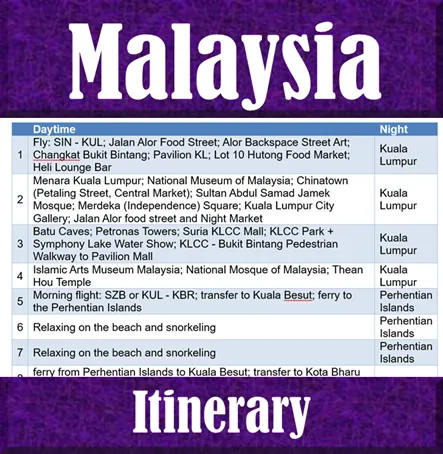
Here you can find the comprehensive day-by-day breakdown in our Mayalsia Itinerary.
What is the best time to visit Malaysia?
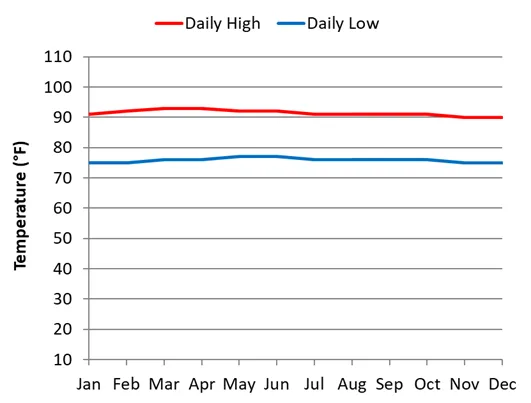
Malaysia is a tropical nation, meaning it is hot and humid year-round with temperatures typically ranging from 75°F (24°C) to 91°F (33°C). While there are no traditional four seasons, rainfall patterns vary significantly by region. Because this guide focuses on Kuala Lumpur and the Perhentian Islands, understanding the ‘split’ in weather between the West and East coasts is vital.
See the travel time recommendations for Kuala Lumpur and the Perhentian Islands here.
If your goal is to follow the classic Malaysian trail—exploring the high-tech streets of Kuala Lumpur, the tea plantations of the Cameron Highlands, the street food of Penang, and the beaches of Langkawi—your timing should shift toward the winter and early spring. Unlike the East Coast, these regions are at their best when the rest of the country is facing the Northeast Monsoon.
See the travel time recommendations for a traditional Malaysia itinerary here.
Travel time recommendations for Kuala Lumpur and the Perhentian Islands
The ‘Goldilocks’ Period: May to September
This is the premier window for the itinerary outlined in this guide. While the West Coast (Kuala Lumpur) begins to see an increase in afternoon showers, the East Coast (Perhentian Islands) enjoys its dry season.
- The East Coast Prime: The weather is consistently sunny, and the sea is often as flat as a mirror. This provides underwater visibility reaching up to 100 feet (30 meters), which is perfect for snorkeling and diving.
- Kuala Lumpur: You will experience plenty of sunshine, though short, intense afternoon thunderstorms are common. These usually serve to cool the city down after a hot morning.
The Shoulder Season: March to April
This is a fantastic ‘sweet spot’ for travel.
- The Islands Reopen: The Perhentian Islands typically reopen to tourists in March. During this time, you can benefit from lower ‘shoulder season’ prices and fewer crowds before the mid-year rush.
- Kuala Lumpur: The city enjoys manageable humidity and plenty of clear skies.
The ‘East Coast’ Exception (November to February)
If you plan to visit the Perhentian Islands, you must avoid this window.
- The Closure: The islands effectively ‘shut down’ from November to February.
- The Reason: The Northeast Monsoon brings heavy seas and constant rain. Boat transfers become dangerous, and almost all resorts close their doors entirely.
- Kuala Lumpur during this time: This is the wettest phase for the capital. The city can experience prolonged rain, though the excellent indoor infrastructure (malls and museums) makes it still very much ‘visitable.’
Crowds and Festive Peaks
- Chinese New Year (Late January or February): This is a vibrant time to visit the cultural districts of Kuala Lumpur, but you should expect massive crowds, fully booked transport, and price surges. In 2026, Chinese New Year falls on February 17.
- School Holidays: You should be aware that June and December are major school holiday months in Malaysia. Popular attractions and transport to the islands will be significantly busier.
Weather Facts for the Traveler
- Humidity: Average humidity levels rarely drop below 80%. You should plan outdoor city activities for the early morning (7:00 AM – 10:00 AM) or late afternoon to avoid the most stifling heat.
- The Afternoon Downpour: Even in the ‘dry’ season, tropical thunderstorms are common. They are usually intense but short, lasting approximately 30 to 60 minutes.
- The Haze: Between August and October, smoke from regional agricultural fires can occasionally cause ‘haze’ (smog), which may affect air quality and visibility in Kuala Lumpur.
Self-Guided Planning Tips
Category |
Details |
|---|---|
Packing |
You should pack light, breathable cotton or ‘dry-fit’ fabrics. A high-quality compact umbrella is more useful than a raincoat in the heat. |
Budget Tip |
Travel in May or September to avoid the mid-year holiday crowds while still enjoying excellent weather on the East Coast. |
The ‘Rainy Day’ Plan |
Always have a list of indoor attractions in Kuala Lumpur (such as the Islamic Arts Museum or Pavilion KL) ready for a sudden downpour. |
Traveler Tip
If you are visiting the Perhentian Islands for snorkeling or diving, aim for June, July, or August. This is when sea conditions are at their most stable and visibility is at its absolute peak. For Kuala Lumpur, do not let a ‘rainy’ forecast discourage you; the city is designed with extensive covered link-bridges and underground walkways to keep you dry.
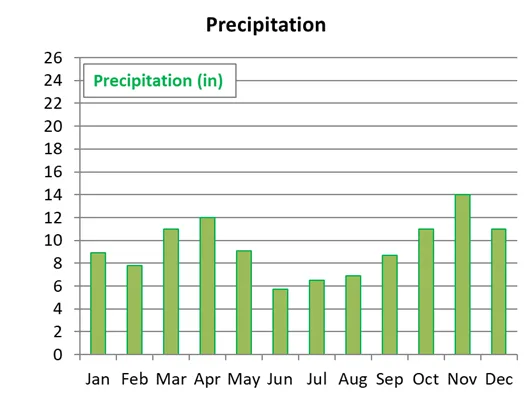
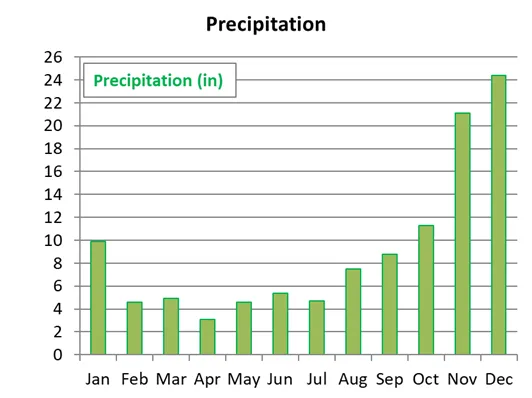
Below is the climate that you can expect during your trip to Kuala Lumpur in Malaysia:
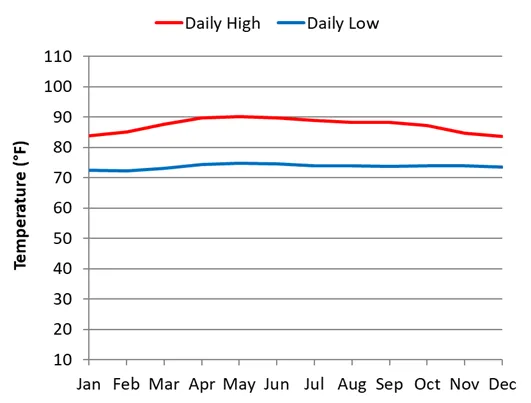
Below is the climate that you can expect during your trip to the Perhentian Islands in Malaysia:
Travel time recommendations for a traditional Malaysia itinerary
- The Prime Window (December to March): This is the "dry" season for the West Coast. While you will still encounter the occasional tropical shower, you will enjoy the most consistent sunshine in Langkawi and Penang. The Cameron Highlands will be cool and crisp, which is perfect for hiking through the mossy forests and tea estates.
- The "West Coast Monsoon" (September to November): You should be aware that the West Coast experiences its heaviest rainfall during these months. Langkawi and Penang can see strong winds and choppy seas, which may affect ferry schedules and beach activities.
- The Humidity Factor: Because these areas are more developed, the humidity in the cities can feel more intense. Traveling in January or February offers slightly lower humidity levels, making the long walks through George Town’s heritage streets much more comfortable.
Quick Comparison: East Coast vs. West Coast Timing
To help you decide when to book your flight, here is a quick look at how the two main routes compare:
Feature |
East Coast (Perhentian Islands) |
West Coast (Penang & Langkawi) |
|---|---|---|
Best Months |
April to September |
December to March |
Avoid Months |
November to February (Closed) |
September to November (Heavy Rain) |
Peak Season |
July and August |
December and January |
Vibe |
Rustic, Nature-focused, Diving |
Culinary, Heritage, Resort-life |
Traveler Tip for the Traditional Route
If you choose the traditional West Coast route in January or February, try to time your visit around Thaipusam. This massive Hindu festival is best experienced at the Batu Caves near Kuala Lumpur or in Penang. It is an incredible cultural spectacle that you will not want to miss, though you should prepare for very large crowds and book your accommodation well in advance.
Below is the climate that you can expect during your trip to Kuala Lumpur in Malaysia:
The highlights of the history of Malaysia
Prehistory: The Dawn of the Peninsula
- 1,830,000 BC: A meteor impact in the Lenggong Valley preserves the earliest evidence of hominid tool-making in the region.
- 235,000 BC: Early humans inhabit the Mansuli Valley in Sabah, leaving behind the oldest dated stone tools in Borneo.
- 46,000 BC: Samang Buat Cave becomes the oldest inhabited cave site in Sabah and Borneo.
- 40,000 BC: A modern human skull, known as the ‘Deep Skull’, is found in the Niah Caves of Sarawak.
- 11,000 BC: ‘Perak Man’ is buried in the Lenggong Valley, becoming the oldest complete skeleton found in Malaysia.
- 6,000 BC: Early inhabitants create the Tambun rock art in Perak, depicting human figures in reddish-purple hematite.
- 500 BC: Global maritime trade routes link the peninsula to India and China, earning it the nickname ‘The Golden Chersonese’.
Classical Era: Hindu-Buddhist Kingdoms
- 200 BC: The Bujang Valley (Old Kedah) emerges as a vital trade hub for the Bay of Bengal.
- 150 AD: The Greek geographer Ptolemy includes the Malay Peninsula in his world map.
- 400 AD: The Gangga Negara kingdom thrives in present-day Perak, exporting gold and tin.
- 683 AD: The Srivijaya Empire expands its maritime influence, seizing control of the strategic Strait of Malacca.
- 1136 AD: King Phra Ong Mahawangsa of Kedah converts to Islam, becoming Sultan Mudzaffar Shah I, establishing the oldest continuous sultanate in the region.
- 1303: Islam reaches the eastern peninsula, as evidenced by the Terengganu Inscription Stone.
The Malacca Sultanate & Colonial Era
- 1400: Parameswara founds the Melaka Sultanate, which becomes the center of the Malay world and a global trade powerhouse.
- 1405: Admiral Zheng He arrives in Melaka, establishing a long-standing diplomatic alliance with the Ming Dynasty of China.
- 1511: Afonso de Albuquerque conquers Melaka for Portugal, marking the start of European colonial presence on the peninsula.
- 1528: Sultan Alauddin Riayat Shah II establishes the Johor Sultanate as a successor state to Melaka.
- 1641: The Dutch, allied with Johor, seize Melaka from the Portuguese after a fierce siege.
- 1786: Captain Francis Light establishes a British settlement in Penang.
- 1824: The Anglo-Dutch Treaty divides the archipelago, placing the peninsula firmly in the British sphere of influence.
- 1841: James Brooke is installed as the first ‘White Rajah’ of Sarawak.
- 1874: The Pangkor Treaty marks the beginning of formal British intervention in the internal affairs of the Malay States.
- 1896: Perak, Selangor, Negeri Sembilan, and Pahang form the Federated Malay States.
Twentieth Century: War and Merdeka
- 1909: The Treaty of Bangkok transfers the northern Malay states (Kedah, Kelantan, Terengganu, and Perlis) from Siam to the British.
- 1941: Japanese forces land in Northern Malaya, initiating the Malayan Campaign during World War II.
- 1945: Japan surrenders; the British Military Administration takes control of the region.
- 1948: The Federation of Malaya is inaugurated; the Malayan Emergency (a 12-year communist insurgency) begins.
- 1957: Malaya gains independence from Britain on August 31; Tunku Abdul Rahman becomes the first Prime Minister.
- 1963: The Federation of Malaysia is officially born on September 16, consisting of Malaya, Singapore, Sarawak, and Sabah.
- 1965: Singapore separates from Malaysia to become an independent republic.
- 1969: Violent civil unrest (the May 13 Incident) breaks out in Kuala Lumpur, leading to significant social and economic policy shifts.
- 1970: The New Economic Policy (NEP) is introduced to redistribute wealth and eradicate poverty.
- 1981: Dr. Mahathir Mohamad begins his first term as Prime Minister, initiating a period of rapid modernization.
- 1985: The first Malaysian national car, the Proton Saga, is launched.
- 1991: The government announces ‘Vision 2020’, a plan for Malaysia to become a fully developed nation.
- 1998: The Petronas Twin Towers are officially completed, becoming the tallest buildings in the world at the time.
- 1999: The federal administrative capital moves from Kuala Lumpur to the newly built city of Putrajaya.
The Modern Era
- 2008: George Town and Melaka are jointly inscribed as UNESCO World Heritage Sites for their unique architectural and cultural townscapes.
- 2018: The Pakatan Harapan coalition wins the General Election, marking the first change of government since independence.
- 2020: The COVID-19 pandemic leads to the ‘Movement Control Order’ (MCO) and the closure of international borders.
- 2022: Anwar Ibrahim is sworn in as the 10th Prime Minister of Malaysia.
Driving a car in Malaysia
The Basics: Left-Hand Traffic
Malaysia follows the British system; vehicles drive on the left side of the road, and the steering wheel is on the right. If you are accustomed to driving on the right, you must exercise extra caution, especially at roundabouts and when turning at intersections.
Malaysia: The Road Trip Reality
Malaysia is ‘car-friendly’ and possesses one of the best highway networks in Southeast Asia, such as the North-South Expressway (PLUS).
- Toll Payments (Crucial): Malaysian toll booths are 100% cashless. You cannot pay with physical money or credit cards at the gate. You must have a Touch 'n Go (TnG) card or a ‘SmartTAG’ device. These cards can be purchased and reloaded at many gas stations (like Petronas or Shell) and convenience stores.
- Driving Style: While the highways are excellent, city driving in Kuala Lumpur can be aggressive. Motorcyclists often weave between lanes (lane-splitting), so you must check your mirrors constantly.
- Fuel: Petrol is significantly cheaper in Malaysia than in Singapore. However, foreign-registered vehicles are restricted from purchasing the highly subsidized RON95 fuel and must use RON97 or higher.
Cross-Border Regulations (Malaysia to Singapore)
- Cross-Border Fees: Most Malaysian rental companies charge an additional daily fee or a flat surchage to allow the vehicle into Singapore.
- Insurance: You must ensure the rental insurance covers you for driving in Singapore. Many standard Malaysian rental policies expire the moment you cross the border unless you have paid for an extension.
- Permission: Some budget rental agencies strictly prohibit their cars from entering Singapore. If you ignore this and have an accident, you will be liable for all costs.
Mandatory Requirements for Entry
To drive a Malaysian-registered car into Singapore, you must have the following:
- Autopass Card: This acts as your vehicle's electronic identification and is used to pay for entry permits and tolls. You should apply for this online via the Land Transport Authority (LTA) OneMotoring website at least one week before your trip. You cannot simply buy this at the border booth anymore.
- Vehicle Entry Permit (VEP): All foreign-registered cars must have a valid VEP to enter Singapore. You must apply for this online.
- LTA Approval Email: You must carry a digital or printed copy of the LTA approval for your vehicle.
- Valid Road Tax and Insurance: You must have valid Malaysian road tax and a certificate of insurance that specifically covers Singapore.
Costs Involved (VEP Fees)
Singapore charges a VEP fee for foreign cars to manage traffic congestion:
- Passenger Cars: Approximately S$35 per day.
- Free Periods: VEP fees are generally waived on Saturdays, Sundays, Singapore Public Holidays, and daily between 5:00 PM and 2:00 AM.
- Tolls: You will also be charged for tolls at the Causeway or Second Link via your Autopass card.
Our Recommendation: Stick to Public Transport and Grab in Malaysia
For a stress-free experience, we strongly recommend that you avoid renting a car.
- Use the LRT/MRT within Kuala Lumpur and use the Grab app for door-to-door service.
- Between Cities: For the journey from Kuala Lumpur to Singapore, taking a luxury bus or a short flight is far more relaxing than navigating border traffic and highway tolls.
By skipping the rental car, you avoid the stress of navigating unfamiliar roads, the frustration of finding parking in the humidity, and the complexity of managing digital toll payments.
Public Transportation in Malaysia
This is a long article, here are shortcuts:
1. Kuala Lumpur LRT, MRT, Monorail, and KTM Komuter
2. The Importance of the Touch 'n Go Card
3. Ride-Hailing in Malaysia
To navigate Kuala Lumpur effectively, you must understand the ‘Golden Rule’ of tropical travel: the shortest walk can feel like a marathon in 90°F (32°C) heat with 80% humidity. Fortunately, both cities possess world-class infrastructure designed to keep you moving in air-conditioned comfort.
1. Kuala Lumpur: The Multimodal Hub
(website)
This is Premium Content! To access it, please download our
Backpack and Snorkel Purple Travel GuideKuala Lumpur’s transport system is more varied, consisting of the LRT, MRT, Monorail, and KTM Komuter.
- The Hub (KL Sentral): Almost every line converges here. It is a massive, air-conditioned terminal where you can switch from the airport express to the city trains.
- The Monorail Experience: The Monorail is iconic but can be crowded. It glides above the traffic in the Bukit Bintang shopping district, offering great views, but the stations are often smaller and may require climbing stairs.
- Payment: While you can buy single-journey tokens, you should purchase a Touch 'n Go card (available at most stations). It works across all train lines and even on buses.
- The GoKL Free Bus: Look for the bright purple buses. These are free for everyone and loop through major tourist sites like the Petronas Towers and Bukit Bintang.
To ensure you are ready to navigate Kuala Lumpur’s transit system the moment you arrive, here is the detailed process for acquiring and using a Touch 'n Go (TnG) card.
2. The Importance of the Touch 'n Go Card
Malaysia’s public transport infrastructure (LRT, MRT, Monorail, and buses) primarily relies on the Touch 'n Go card. Although some gates are starting to accept credit cards, the TnG card remains the most reliable method for all modes of transport and even some retail payments.
Where to Purchase Your Card
You should aim to get your card as soon as you reach the city center to avoid fumbling with cash at individual ticket machines.
- KL Sentral Station: This is the most convenient location. Visit the Touch 'n Go Hub or the Customer Service Offices located inside the LRT or MRT stations within the building.
- Convenience Stores: You can find cards at 7-Eleven, myNEWS, or KK Super Mart outlets throughout Kuala Lumpur and at the airport.
- Watsons Pharmacies: Many Watsons outlets sell a ‘Watsons-branded’ TnG card that functions exactly like the standard version but often comes with additional retail discounts.
Cost and Top-Up Procedures
- Initial Cost: A new card typically costs RM 10 (US$2.30). This is a non-refundable fee for the card itself and does not include any pre-loaded credit.
- Reloading (Top-Up): You can add credit at:
- Self-Service Kiosks: Located in most LRT and MRT stations (these are air-conditioned and easy to use).
- Convenience Stores & Gas Stations: Simply tell the cashier you want to ‘Reload Touch 'n Go’. Note that some locations may charge a small service fee of RM 0.50.
- Touch 'n Go eWallet App: If you have a Malaysian SIM card and the app, some newer cards (NFC-enabled) allow you to reload directly from your phone.
Using the Card for the ‘City and Sea’ Itinerary
Since your guide focuses on Kuala Lumpur and the Perhentian Islands, the card will be your primary tool for the first half of your trip.
- In Kuala Lumpur: Tap the card on the yellow reader at the turnstiles when entering and exiting the station. For buses, tap when you board and again when you leave.
- At the Airport: You can also use the Touch 'n Go card to pay for the KLIA Transit train (the one with stops), though it is often easier to buy a specific ticket for the KLIA Ekspres as mentioned earlier.
- Retail Use: Many ‘Mamak’ stalls and small shops in KL now accept TnG for payment, which is a great way to use up any small remaining balance before you fly to the Perhentian Islands.
Traveler Tip
Always ensure you have a minimum balance of RM 5 to RM 10 on the card. Some station gates will not open if your balance is too low, even if the fare for that specific trip is small.
Remark
We personally like using Grab to go anywhere within Kuala Lumpur and rarely use public transportation. Depending on the weather, waiting times for Grab, and your willingness to pay more for a Grab ride, it can make sense to go to Batu Caves and/or back to downtown by train. You can do this without needing to buy a Touch 'n Go card.
3. Ride-Hailing in Malaysia: Your ‘Heat Escape’ Strategy
While the trains are great, the ‘last mile’ (the walk from the station to your final door) is where the tropical weather hits hardest. This is where ride-hailing becomes essential.
Understanding the ‘Back-to-Back’ Wait Time
A critical detail for your planning is that Grab and other services utilize a ‘back-to-back’ booking system.
- How it Works: A driver can accept your ride request while they are still finishing a journey for another passenger.
- The Impact on You: If your assigned driver is currently completing another trip, your waiting time will be longer. The app will usually show a status such as ‘Driver is finishing a trip nearby’ and provide an estimated time for them to drop off the current passenger before they head toward you.
- Strategy: You should check the app status immediately after booking. If the driver is still in the middle of another ride, you have a few extra minutes to stay inside the air-conditioning. However, do not wait too long; once they drop off the previous passenger, they may arrive at your location very quickly.
Grab (The Dominant App)
Grab is the ‘Uber of Southeast Asia’. You should download this app before you arrive. It works seamlessly in both Singapore and Malaysia, and is our exclusive way to travel in Kuala Lumpur due to the heat and humidity.
- Convenience: You can book a ride from inside an air-conditioned mall and only step outside when the app shows the driver is 1 minute away.
- Fixed Pricing: You see the fare before you book. Even if the driver gets stuck in heavy Kuala Lumpur traffic or a sudden tropical downpour, the price does not change.
- Safety: The app tracks your GPS location, shows your driver’s face and license plate, and allows you to share your ride status with friends.
- Affordability: In Malaysia, Grab is incredibly cheap. A 15-minute ride often costs less than RM 15 (US$3.45).
Other Option
- AirAsia Ride: A growing alternative in KL that often has more drivers available during peak ‘surge’ times when Grab prices are high.
Summary of Transit Strategies
Situation |
Best Choice |
Why? |
|---|---|---|
Heavy Rain / High Heat |
Grab / Ride-Hailing |
Door-to-door service; no walking in the elements. |
Rush Hour Traffic |
MRT / LRT |
Trains bypass the legendary KL traffic jams. |
KLIA to City |
KLIA Ekspres |
Reaches the city in 28 minutes; faster than any car. |
Subang Airport to City |
Grab / Taxi |
Closest airport to downtown; no direct rail link currently. |
Budget Sightseeing |
Public Bus |
Extremely cheap |
Traveler Tip
If you see a dark cloud approaching, book your Grab immediately. Once the rain starts, ‘surge pricing’ kicks in, and wait times can jump from 3 minutes to 20 minutes as everyone else tries to escape the downpour.
Money and Credit Cards in Malaysia
Malaysia: The Hybrid Economy
Malaysia has seen a massive surge in QR payments, but cash remains a vital backup, especially for the ‘authentic’ local experiences you are looking for.
- Credit Cards: Widely accepted in malls, supermarkets, hotels, and established restaurants. Note that American Express is often not accepted outside of international hotel chains and luxury retailers.
- DuitNow and E-Wallets: You will see DuitNow QR codes (pink logos) at almost every counter.
- Pro Tip: If you have the Grab app, you can use GrabPay to scan many of these codes. Additionally, if you are a user of regional wallets like Touch 'n Go (Malaysia), Alipay, or WeChat Pay, they are widely integrated.
- When Cash is Mandatory: You must have cash for:
- Pasar Malam (Night Markets): For your street food discoveries, vendors almost exclusively take cash.
- Traditional Kopitiams: Older coffee shops in heritage areas (like Chinatown or old sections of KL) often prefer cash for small transactions under RM20.
- Rural Areas: If you venture outside major cities, the digital infrastructure is less reliable.
- ATM Strategy: Malaysian ATMs (like Maybank or CIMB) generally do not charge a local withdrawal fee to foreigners, though your home bank might. Always choose to be charged in Ringgit (MYR) rather than your home currency to get a better exchange rate.
Payment Comparison Table
Situation |
Malaysia Method |
|---|---|
Public Transport |
Touch 'n Go card (Physical) |
High-End Dining |
Credit Card / GrabPay |
Hawker / Street Food |
Cash is King / DuitNow QR |
Night Markets |
Cash Only |
Taxis / Grab |
In-app Card Payment |
An important ‘Heat & Humidity’ Tip
Avoid the physical ‘Money Changer’ queues in the humid streets. The exchange rates at ATMs are now very competitive. It is much more comfortable to withdraw cash from an indoor, air-conditioned ATM at a bank or mall than to stand in a line at a street-side currency booth.
You can find the current exchange rates here: Malaysian Ringgit (MYR)
Tap water in Malaysia
The ‘Treat Before You Drink’ Rule
In Malaysia, while the water leaving the treatment plants generally meets safety standards, the aging distribution network (pipes) can cause re-contamination by the time it reaches your tap.
- The Consensus: Do not drink straight from the tap. Even locals do not do this.
- The ‘Boil or Filter’ Standard:
- In Hotels: Most 4-star and 5-star hotels provide an electric kettle. It is standard practice to boil tap water and let it cool before drinking. Many modern hotels also have ‘Filtered Water Taps’ installed in the room.
- In Airbnbs/Homes: Most Malaysian households use a multi-stage filtration system (like Coway or Cuckoo). If your host has one of these, the ‘Filtered’ setting is safe to drink.
- Public Water Stations: Look for ‘Vending Machine’ style water dispensers on the street. These use Reverse Osmosis (RO) and are safe for refilling bottles for a few cents.
- Ice and Salads: In established restaurants and cafes in cities like Kuala Lumpur and Penang, ice is usually made from filtered, food-grade water and is safe. For street food stalls, it is safer to stick to canned or bottled drinks.
- Brushing Teeth: Using tap water to brush your teeth is generally considered safe for most travelers in major cities. Just avoid swallowing large amounts. If you have an extremely sensitive stomach, use bottled water.
Traveler’s Strategy for Malaysia
Location |
Water Action |
|---|---|
Luxury Hotels |
Use the provided bottled water or the in-room filtration tap. |
Budget/Boutique |
Use the kettle to boil water every night for the next day. |
Out and About |
Buy bottled water from 7-Eleven or 99 Speedmart (RM 1.50 – RM 3). |
Rural Areas |
Stick strictly to sealed bottled water or use a travel purifier (like a Grayl or LifeStraw). |
Pro Tip
In Malaysia, check the color of the bottle cap. A white cap usually means ‘Drinking Water’ (filtered/RO), while a blue or green cap means ‘Mineral Water’ (sourced from underground/springs). Mineral water typically tastes better!
Telephone in Malaysia
Staying connected is vital for using ride-hailing apps and navigating the tropical heat. If your home mobile plan does not offer affordable international roaming, purchasing a local SIM card is a cheap and highly effective solution. Malaysia now offers eSIM options that you can activate before you even land.>
- Country Codes: Malaysia: +60
- Malaysia SIM Cards: You can find booths for Maxis (Hotlink) and CelcomDigi immediately before and after passport control at KLIA.
- CelcomDigi currently offers the most robust 4G and 5G coverage across both Peninsular Malaysia and Borneo.
- Maxis (Hotlink) is known for the fastest speeds in urban areas like Kuala Lumpur.
- The ‘One-SIM’ Pro Tip: If you are visiting Singapore and Malaysia, you likely only need one SIM card. Most Singaporean tourist plans (like the Singtel $30 or $50 cards) include 5GB to 10GB of roaming data specifically for Malaysia. This allows you to cross the border and stay connected without ever swapping cards or searching for a new kiosk.
Note: Due to local security regulations, you must present your original passport to register any local SIM card in either country. Many kiosks will also require a digital fingerprint scan in Malaysia.
In which Time Zone is Malaysia
Malaysia operates on GMT+8. Despite the geographical distance from the meridian. It does not observe Daylight Savings Time.
You can find the current local time here.
Visa requirements for Malaysia
Malaysia: The Social Visit Pass
Malaysia offers a similar, welcoming policy for tourists, but with a few unique digital requirements for 2025.
- Visa-Free Entry: Travelers from the US, UK, EU, and Australia generally receive a 90-day social visit pass. Citizens of many other nations (like the UAE or South Africa) also receive 90 days, while others receive 30.
- Malaysia Digital Arrival Card (MDAC): As of 2024, all foreign nationals (except Singaporeans and those with long-term passes) must complete the MDAC.
- Timeline: Submit within 3 days before arrival.
- The Autogate Benefit: If you are from one of 63 ‘low-risk’ countries (including the US, UK, Australia, and Germany), you can use the automated gates at the airport for much faster entry. You must have submitted your MDAC to be eligible.
- Proof of Onward Travel: Malaysian immigration officers are more likely than Singaporean officers to ask for proof of your flight out of Malaysia. Ensure you have your flight or bus confirmation ready on your phone.
Official Verification & Submission Links
To ensure your data is secure and that you are not charged unnecessary fees, use only these official government websites:
To Check Visa Requirements:
- Malaysia Immigration (slow website)
To Submit Your Mandatory Arrival Cards:
- Submit Malaysia Digital Arrival Card (MDAC) (slow website)
Warning on ‘Visa Scams’
You will encounter many third-party websites that look official but charge $50–$100 to ‘process’ your arrival card. Submission of the MDAC is free. Always ensure the URL ends in .gov.my.
Languages spoken in Malaysia
To navigate the social landscape of Malaysia effectively, it is helpful to understand not just what people speak, but how they use language to bridge their multicultural societies. Here is a detailed breakdown of the linguistic diversity in Malaysia.
Malaysia: Unity through Bahasa Malaysia
In Malaysia, language reflects a deep history of trade and indigenous roots.
- Bahasa Malaysia (The National Language): Also known as Malay, this is the official language. It is phonetically consistent and uses the Latin alphabet, making it relatively easy for travelers to read signs and menus.
- English (The ‘Second’ Language): English is a compulsory subject in schools and is spoken with high proficiency in Kuala Lumpur, Penang, and major tourist hubs like the Perhentian Islands. You will have no trouble communicating in hotels, malls, or with Grab drivers.
- Manglish: Similar to Singlish, Malaysia has its own informal version of English (Manglish) that incorporates Malay and Chinese dialects. It is equally efficient and expressive.
- Regional Diversity: In the cities, you will frequently hear Cantonese and Hokkien. In rural areas or local ‘makan’ (eating) spots, a few basic Malay phrases go a long way in building rapport.
Useful Phrases for the Traveler
While English is sufficient, using these local terms will win you smiles and better service:
Phrase |
English Meaning |
Usage Tip |
|---|---|---|
Makan |
To eat / Food |
‘Let's go makan!’ |
Terima Kasih |
Thank you |
The most important phrase in Malaysia. |
Sama-Sama |
You are welcome |
The standard response to Terima Kasih. |
Boleh |
Can / Possible |
‘Boleh?’ is used to ask if something is okay. |
Uncle / Auntie |
Respectful title |
Used to address elders (like a taxi driver or food stall owner), regardless of actual relation. |
Religions in Malaysia
Malaysia: A Modern Islamic Nation
In Malaysia, religion is closely tied to ethnic identity. Under the Constitution, Islam is the religion of the Federation, and all ethnic Malays are legally defined as Muslim from birth.
- The Breakdown (2025 Estimates):
- Islam (~63.5%): The state religion. It is primarily Sunni (Shafi'i school). You will hear the Azan (call to prayer) five times a day from beautiful, landmark mosques.
- Buddhism (~19%): Second-largest faith, practiced largely by the ethnic Chinese population.
- Christianity (~9%): Very prominent in East Malaysia (Sabah and Sarawak), where many indigenous groups are Christian.
- Hinduism (~6%): Practiced by the ethnic Indian community. The Batu Caves near KL is one of the most important Hindu shrines outside of India.
- The ‘Dual System’: Malaysia operates a parallel legal system. While civil law applies to everyone, Sharia law governs personal matters (like marriage and inheritance) for Muslims. Non-Muslims are free to practice their faiths, though proselytizing to Muslims is legally restricted.
Visiting Etiquette: The ‘Must-Knows’
When visiting houses of worship, following these rules shows immense respect for local traditions:
- The Footwear Rule: Always remove your shoes before entering a mosque, Hindu temple, or many Buddhist temples. You will see a shoe rack or a designated area outside. It is perfectly fine to wear socks, though some Hindu temples may prefer bare feet.
- Dress Modestly:
- Mosques: Women must cover their heads (scarves are usually provided at the entrance for tourists) and wear long sleeves and long pants/skirts. Men should wear long pants. Short-sleeved shirts are usually okay for men, but singlets (tank tops) are not.
- Temples: Avoid short shorts or sleeveless tops. A light shawl is a great item to keep in your bag to quickly cover your shoulders.
- The ‘Feet’ Taboo: In both Hindu and Buddhist traditions, the feet are considered the ‘lowest’ and dirtiest part of the body. Never point the soles of your feet toward an altar, a deity, or a priest. When sitting on the floor, tuck your legs beneath you or sit cross-legged.
- Photography: Always look for signs. Most places allow photos of the architecture, but taking photos of people during prayer is often considered intrusive. Never use a flash inside a prayer hall.
- The Right Hand: If you are giving a donation or receiving something from a priest or official, always use your right hand (or both hands). In many local cultures, the left hand is reserved for personal hygiene and is considered impolite for social interactions.
Must-Try Food & Neighborhood Guide
Food is the national obsession in Malaysia. To eat like a local, you must look beyond fine dining and head to the communal eating spaces that define the culture.
Our Malaysia Foodie Dictionary
- Essential General Terms
- Makan: To eat / Food.
- Tapau or Bungkus (MY): Takeaway / To go.
- Halal: Food prepared according to Islamic law (no pork or alcohol).
- Drinks (The 'Kopi' System)
- O (stands for the Hokkien word oh, which means black): No milk (with sugar).
- C (refers to Carnation, which was the most popular brand of evaporated milk when this system was created): With evaporated milk (and sugar).
- Kosong: No sugar.
- Peng: Iced.
- Tarik: ‘Pulled’ tea or coffee, frothed for a creamy texture.
- Popular Dishes
- Nasi Lemak: Malaysia's national dish; coconut rice served with sambal, anchovies, and peanuts.
- Laksa: Spicy noodle soup. Curry Laksa is creamy (KL), while Asam Laksa is tangy/fish-based (Penang).
- Satay: Grilled meat skewers served with peanut sauce.
- Roti Canai: Flaky flatbread served with dhal or curry.
- Char Kway Teow: Stir-fried flat rice noodles with cockles, Chinese sausage, and sprouts.
- Cendol: Dessert with green jelly, coconut milk, and palm sugar (Gula Melaka).
- Where You Eat
- Mamak: 24-hour Indian-Muslim eateries (common in Malaysia).
- Kopitiam: Traditional coffee shops serving breakfast and local favorites.
Ordering coffee (Kopi) or tea (Teh) is an art form. Use these modifiers:
Malaysia: Night Markets & Mamak Stalls
Malaysian food is a bold, spicy blend of Malay, Chinese, and Indian influences, often enjoyed under the stars.
- Kuala Lumpur (Bukit Bintang / Jalan Alor):
- Must-Try: Grilled Chicken Wings and Satay.
- The Experience: Jalan Alor is a chaotic, vibrant ‘food street’. For a more local vibe, visit Kampung Baru for the best Nasi Lemak (Malaysia’s national dish: coconut rice, sambal, anchovies, and egg).
- Kuala Lumpur (Chinatown / Petaling Street):
- Must-Try: Hokkien Mee (thick yellow noodles in dark, fragrant soy sauce) and Claypot Chicken Rice.
- Penang (George Town):
- Must-Try: Char Kway Teow (stir-fried flat noodles with prawns and cockles) and Penang Assam Laksa (a tangy, fish-based broth).
- The Experience: Head to Gurney Drive or Chulia Street at night to see vendors cooking over roaring charcoal fires.
The ‘Mamak’ Culture (Malaysia):
- A Mamak is an Indian-Muslim eatery, often open 24/7.
- Must-Order: Teh Tarik (‘pulled’ milky tea) and Roti Canai. It is the ultimate local hangout spot for watching football or late-night chats.
Essential Travel Apps in Malaysia
To navigate Malaysia like a local in 2025, your smartphone is your most important tool. These two countries are highly digitized, and having the right apps can mean the difference between standing in a long ticket queue and walking straight into an attraction.
To discover these places by yourself, download and set up these apps (including linking a payment card) before you land.
App |
Primary Purpose |
Why you need it for Self-Discovery |
|---|---|---|
Grab |
Transport & Food |
The undisputed ‘super-app’. Use it for fixed-price rides (avoiding taxi haggling) and ordering food to your hotel. Works seamlessly across both SG and MY. |
Google Maps |
The Master Map |
Essential for walking tours. It tracks live bus and MRT arrival times with incredible accuracy in both countries. Make sure to download offline maps for the regions in Malaysia you plan to visit. |
Citymapper |
City Navigation |
Often more precise than Google for the ‘last mile’. It tells you exactly which MRT exit to use to be closest to an attraction like the Merlion. |
Klook / Pelago |
Regional Tickets |
The best for ‘instant’ bookings. Pelago is owned by Singapore Airlines—use it for exclusive bundles. Perfect for skip-the-line entries. |
Unique Experiences |
Exceptional for finding local ‘hidden gem’ tours (like night food walks in Kuala Lumpur) with a very user-friendly mobile voucher system. |
|
Unique Experiences |
Exceptional for finding local ‘hidden gem’ tours (like night food walks in Kuala Lumpur) with a very user-friendly mobile voucher system. |
|
Touch 'n Go |
MY Cashless Pay |
The ‘SimplyGo’ of Malaysia. Nearly every street vendor in KL or Penang uses the TNG QR code. Essential for a truly local experience. |
Deep Dive: Choosing Your Booking App
While they may seem similar, Viator, GetYourGuide, and Klook serve different ‘self-discovery’ needs:
- Viator (A Tripadvisor Company) and GetYourGuide:
- Best for: High-quality digital vouchers. If you lose internet, their app stores the QR code offline. Their ‘Originals’ tours often include perks you cannot get elsewhere.
- Self-Discovery Tip: Use the ‘Meeting Point’ feature. It links directly to Google Maps to show you exactly where to start your walk.
- Klook:
- Best for: Pure price. In SE Asia, Klook usually has the deepest discounts for major spots like Universal Studios or the Petronas Towers.
- Self-Discovery Tip: Look for the ‘Klook Pass’—it allows you to pick 2–5 attractions for one flat fee, saving up to 40%.
Pro-Tip for Independent Travelers
In both countries, you can now pay for most things via QR Code.
- The Touch 'n Go (TnG) eWallet is king. You can link your international credit card to it to pay at tiny stalls that do not take physical cards.
Power & Connectivityin Malaysia
1. Power: The Hardware
Malaysia uses the same electrical standards, making it easy to carry one set of gear for both.
- Plug Type: Type G (the British-style 3-rectangular-pin plug).
- Voltage & Frequency: 230V (SG) / 240V (MY) at 50Hz.
- Pro-Tip for North Americans/Japanese: Most modern electronics (phones, laptops, cameras) are ‘Dual Voltage’ (100-240V) and only need a plug adapter. However, do not plug in high-heat appliances like hair dryers or straighteners without a heavy-duty voltage converter, or you may fry the device.
2. Connectivity: How to stay online
The best way to discover these places independently is with a Traveler eSIM or a Cross-Border SIM.
Country |
Wi-Fi Strategy |
Recommended SIM / eSIM |
|---|---|---|
Malaysia |
Patchy. Malls and cafes have Wi-Fi, but it is often slow or, most of the time, requires a local phone number to sign in. |
CelcomDigi / Hotlink: Buy at KLIA airport. For ~$6–$9, you can get massive ‘Unlimited’ data plans for 30 days. |
3. The ‘One SIM’ Solution (Cross-Border)
If you are traveling between both countries and do not want to swap SIM cards, look for these specific 2025 options:
- Airalo (eSIM): Download the app and buy the ‘Discover’ or ‘Asia’ regional plan. It is slightly more expensive but activates automatically as you cross the border.
- StarHub (SG): Their $12/15 Traveler eSIMs often include 3GB–5GB of roaming data that works in Malaysia, Indonesia, and Thailand.
- M1 (SG): Their tourist SIMs are famous for having ‘seamless’ data that treats Malaysia as part of the local network.
Self-Discovery Hack: Download your Google Maps for ‘Offline Use’ before leaving your hotel. Even with a local SIM, Malaysia’s rural roads can sometimes cause GPS lag.
4. Where to Buy
Look for the bright blue (CelcomDigi) or red (Hotlink/Maxis) kiosks immediately after you clear customs at KLIA. They will install and activate the SIM for you on the spot.
Where do you want to go now?
Author: Rudy at Backpack and Snorkel
Bio: Owner of Backpack and Snorkel Travel Guides. We create in-depth guides to help you plan unforgettable vacations around the world.

Other popular Purple Travel Guides you may be interested in:
Like this Backpack and Snorkel Purple Travel Guide? Pin these for later: