The Taj Mahal: Jewel of Mughal Architecture and Eternal Love Story | India Purple Travel Guide
(map, reviews, website, tickets)
This is Premium Content! To access it, please download our
Backpack and Snorkel Purple Travel GuideThe Taj Mahal is the most universally recognized symbol of India itself. It is the culmination of Mughal architecture, an unparalleled marble marvel, and a testament to one man’s enduring grief. This chapter details what you need to know about the 'Crown of Palaces', from its intimate history and flawless geometry to the practicalities of a visit.
Personally, I think the Taj Mahal is the most impressive building I have ever visited.
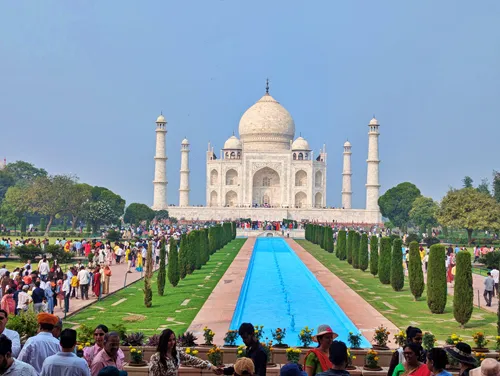
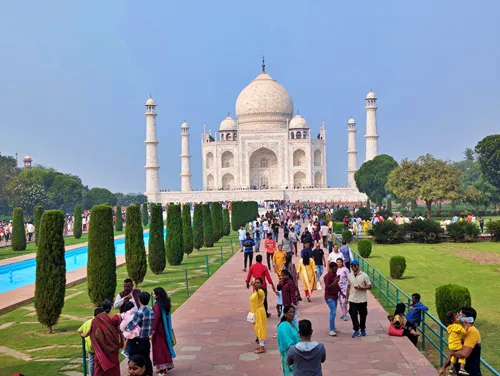
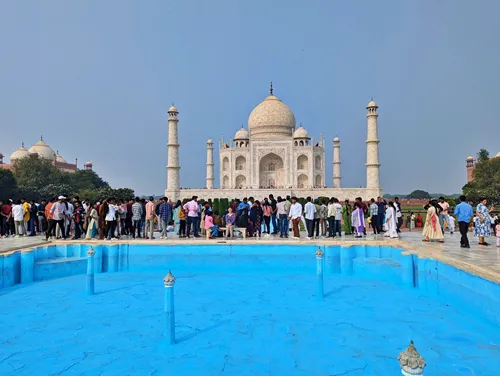
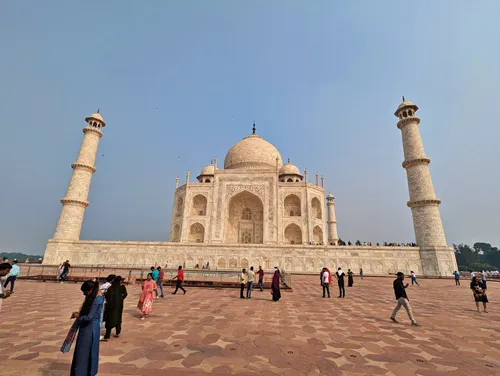
Here at Backpack and Snorkel Travel Guides, we promote self-guided walking tours.
But we realize that not everybody likes to walk by themselves in a foreign city. So, just in case that you rather go with ab guide: NO PROBLEM! Please see the GuruWalk and Viator tours below.
free GuruWalk tours
paid Viator tours
Essential Traveler Information and Logistics
Visiting the Taj Mahal requires some planning, especially regarding time and ticketing, due to the massive crowds.
Admission Fee and Ticketing
Without the Mausoleum fee – price of online tickets at the time of writing:
Domestic Tourists: ₹45
SAARC/BIMSTEC Tourists: ₹535
Foreign Tourists: ₹1,050
Mandatory Mausoleum Fee: An additional ₹200 fee is required if you wish to climb the plinth and enter the main marble mausoleum chamber where the cenotaphs are located. This is highly recommended.
Domestic Tourists: ₹245
SAARC/BIMSTEC Tourists: ₹735
Foreign Tourists: ₹1,250
SAARC = Afghanistan, Bhutan, India, Maldives, Nepal, Pakistan, Sri Lanka
BIMSTEC = Bangladesh, Bhutan, India, Myanmar, Nepal, Sri Lanka, Thailand
Tickets at the ticket counters cost a little more.
Online Booking: Strongly recommended to avoid long lines at the counter. Tickets can be booked via the official ASI website (see link above).
Opening Hours and Best Time to Visit
The Taj Mahal strictly adheres to its schedule.
Operating Hours: Sunrise to Sunset (typically 6:00 AM to 6:30 PM).
Closed Day: Every Friday. The complex is only open on Fridays for those who need to visit the mosque for prayers.
Timing Strategies for the Traveler
Sunrise (Best Experience):
Pros: The light is soft and beautiful, painting the marble in pink and golden hues. Crowds are at their absolute minimum, allowing for peaceful reflection and unobstructed photos.
Cons: Requires waking up very early (gates open approximately 30 minutes before sunrise).
Sunset (Alternative Beauty):
Pros: Golden hour light is spectacular. The feeling of the monument closing down offers a serene mood.
Cons: Crowds tend to be higher than at sunrise, as many day-trippers arrive in the afternoon.
Noon (Worst Time):
Pros: The marble reflects sunlight and appears bright white.
Cons: The heat (especially between March and October) is intense, and there is very little shade. The crowds can be overwhelming.
Mandatory Rules and Traveler Tips
Entry Gates: There are three main entry gates. The East Gate opens earliest and is recommended for sunrise visits (it is often less crowded than the West Gate). The West Gate is popular with domestic tourists and often has the longest queues. The South Gate opens later and is closest to many hotels.
Pollution Exclusion Zone: To protect the marble from pollution, there is a 1 km (0.6 mile) motor traffic exclusion zone around the Taj Mahal. Private cars, taxis, and auto-rickshaws must stop outside this zone. Visitors must walk or take the authorized, zero-emission transportation options provided by the government (electric buses, battery-operated carts, or cycle rickshaws) to reach the entrance gates.
Prohibited Items: Security is strict. Large bags, backpacks, food, tobacco, lighters, tripods, and chargers (even power banks) are all prohibited. Only a small clear bag with essential items (water, phone, camera, passport, wallet) is allowed. Lockers are available for hire.
Shoe Covers: Mandatory upon entering the main marble plinth to protect the marble. These are provided near the entrance to the mausoleum entrance after showing your ticket.
Silence: While tourists are inevitable, visitors are strongly encouraged to maintain a respectful and quiet demeanor within the complex, particularly near the main tomb.
Photography: Professional photography equipment (tripods, excessive gear) is forbidden. Simple cameras and mobile phones are permitted. The best reflection shot is from the central water channel near the main gate.
Why the Taj Mahal will be a highlight of your trip
A visit to the Taj Mahal should be much more than a standard item on a tourist checklist. This is a grandiose structure that really is an experience that transcends time, culture, and expectation. Even after seeing thousands of pictures, nothing prepares you for the sheer brilliance of the white marble catching the light, or the palpable sense of devotion that drove its creation.
The Power of Light and Emotion: The Taj Mahal is a dynamic structure, changing its mood and color with the time of day. It is often described as possessing a feminine quality, taking on pink hues at sunrise, dazzling white under the mid-day sun, and a soft, golden glow under the moonlight. This shifting ambiance makes the experience deeply personal and emotional.
Architectural Perfection: This monument is considered the zenith of Indo-Islamic design. It is an exercise in perfect symmetry and refined ornamentation, blending Persian, Islamic, and Indian architectural styles into a unified whole. It is a structure of such flawless geometry that it feels spiritually uplifting.
A Symbol of Eternal Love: At its core, the Taj Mahal is an epic love story, the final resting place of Empress Mumtaz Mahal and the Emperor who commissioned it, Shah Jahan. Understanding this human context turns the cold marble into a warm, beating heart.
UNESCO World Heritage Status: Declared a World Heritage Site in 1983, it is recognized globally as a masterpiece of human creative genius, demanding reverence and protection.
The Detailed History: A Story of Love, Grief, and Empire
The history of the Taj Mahal is inseparable from the personal life and political power of the fifth Mughal Emperor, Shah Jahan.
The Builder and The Beloved
The story begins with Arjumand Banu Begum, who was given the title Mumtaz Mahal (Chosen One of the Palace). She was Shah Jahan’s third wife and dearest companion. Their relationship was legendary; she accompanied him on military campaigns, gave him fourteen children, and was his confidante on matters of state.
In 1631, during a military campaign in Burhanpur, Mumtaz Mahal died while giving birth to her fourteenth child. Shah Jahan was reportedly devastated, entering a period of intense mourning that drastically aged him. According to court chronicles, before her death, Mumtaz Mahal asked Shah Jahan to promise her four things: to build her a tomb worthy of her beauty, to marry again, to be kind to their children, and to visit the tomb on her death anniversary. Shah Jahan fulfilled the first and the third promises instantly.
Driven by this profound grief, Shah Jahan resolved to build a mausoleum that would honor his wife and symbolize their eternal love. He selected the site in Agra, on a bend of the Yamuna River, ensuring the monument would have a breathtaking and dramatic backdrop against the water. The complex was originally known as Rauza-i Munawwara (the Luminous Tomb), a title befitting its celestial white facade.
Construction: Logistics, Labor, and Design
Construction began in 1632 and continued for an astonishing 22 years, employing over 20,000 artisans, including masons, stone cutters, inlayers, carvers, painters, calligraphers, and dome builders, who were brought in from all across India, Persia, Central Asia, and Europe.
Materials and Transport: The chief material, the flawless white Makrana marble, was quarried in Rajasthan and transported over 400 km by a fleet of over 1,000 elephants and countless bullock carts, ensuring the final structure had the purest material possible. Other precious and semi-precious stones for the inlay work (like lapis lazuli, jade, crystal, amethyst, and turquoise) were sourced from Tibet, China, Afghanistan, Sri Lanka, and Arabia.
Architectural Leadership: While the true chief designer remains a subject of academic debate, the common consensus credits Ustad Ahmad Lahauri as the main architect. His genius ensured the perfect blend of Persian geometry with traditional Indian decorative elements.
Foundation Mastery: Building the colossal structure on the banks of a major river presented a massive engineering challenge. The foundation relied on deep wells filled with stone and concrete and an intricate system of wells and heavy timbers (sal wood) that, counter-intuitively, were kept perpetually moist by the river water, giving them structural longevity.
The Aftermath and Mughal Decline
Shah Jahan envisioned the Taj Mahal not just as a tomb but as part of a magnificent riverfront architectural plan. Legend, though largely unsubstantiated, suggests he intended to build a twin tomb for himself in black marble across the river, connected by a bridge, but this vision never materialized.
Before the Taj Mahal was completed, Shah Jahan's son, Aurangzeb, seized power in 1658, deeming his father’s extravagance a threat to the empire. Shah Jahan was imprisoned in the nearby Agra Fort where, for the last eight years of his life, he could only gaze upon the finished Taj Mahal from a window in the Musamman Burj tower.
Upon his death in 1666, Shah Jahan was interred beside Mumtaz Mahal in the lower vault of the Taj Mahal. This final placement is the only asymmetrical element in the entire monument, a subtle yet profound breaking of perfection that signifies the completion of the love story.
Decoding the Architecture: Flawless Geometry and Illusion
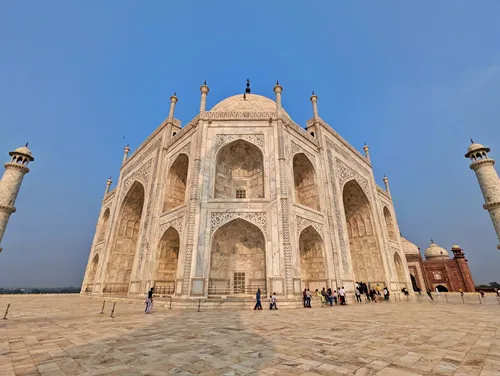
The Taj Mahal is often lauded as the most beautiful building in the world because of its aesthetic sophistication. It is built entirely of Makrana white marble and sits upon a massive, square plinth (base).
Symmetry and the Dome
Perfect Symmetry (Bilateral): The entire complex is a study in bilateral symmetry, meaning if a line were drawn through the center of the mausoleum and the main entrance gate, the right and left sides would be perfect mirror images of each other. This symmetry extends to the main structure, the garden, and the flanking buildings.
The Double Dome: The main dome, a classic Mughal feature, is colossal. It is a double dome, an outer shell that gives the monument its impressive height, and an inner shell that creates a more proportionate ceiling for the interior chamber. This ingenious design allowed for both grand exterior scale and practical interior space.
The Lotus Finial: Crowning the dome is a large brass finial, originally gold, that is a hybrid of Persian and Indian elements. The Persian kalash (pot) is topped by a crescent moon, a symbol of Islam, with the horns pointing skyward in the classic Mughal orientation.
The Minarets: A Calculated Flaw
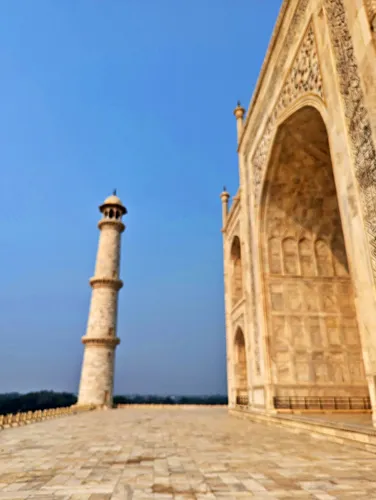
The four towering minarets (spires) that frame the main mausoleum are not vertical. They are subtly tilted outwards at a slight angle.
The Purpose of the Tilt: This calculated structural deviation was a brilliant piece of practical engineering. If any of the minarets were to collapse during an earthquake or other natural disaster, they would fall away from the main tomb, thus protecting the central structure and the bodies interred within.
The Art of Calligraphy and Optical Illusion
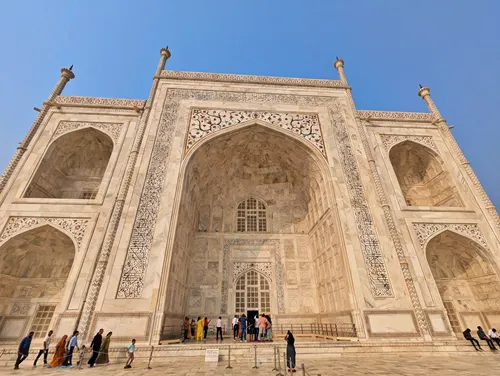
One of the most spectacular features is the extensive use of calligraphy, created from inlaid black marble set into the white stone. The text consists of passages from the Qur'an.
Optical Adjustment: The calligraphers employed an incredible optical trick. As the inscriptions rise toward the top of the arches, the size of the letters subtly increases, ensuring that the script appears perfectly uniform in size and proportion when viewed from the ground, overcoming the distortion caused by distance. This attention to minute detail epitomizes the complex artistry of the structure.
The Flanking Buildings: The Mosque and the Jawab
Flanking the main mausoleum are two identical, yet distinct, red sandstone structures. They restore the perfect bilateral symmetry of the complex:
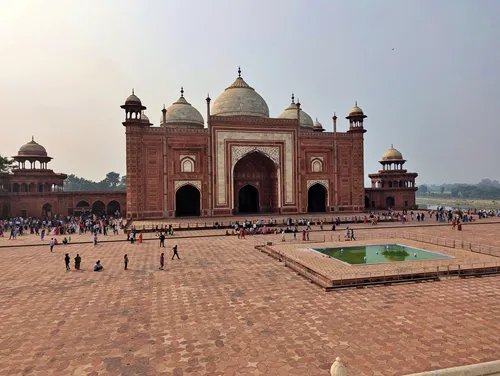
The Mosque (West Side): This is a functioning mosque, facing the west toward Mecca. Its red sandstone provides a powerful color contrast to the white marble of the tomb.
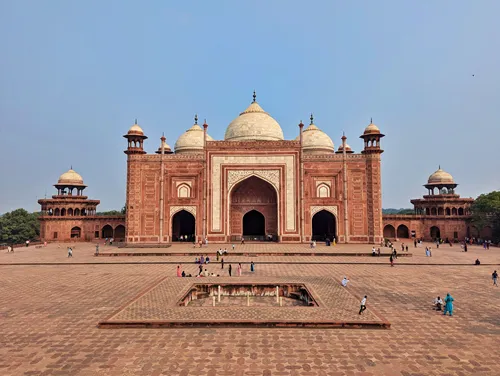
The Jawab (East Side): Meaning ‘Answer’ or ‘Reply,’ this structure is a perfect mirror image of the mosque. It was built solely for the sake of architectural balance and is not used for prayer, often serving as a rest house. The symmetry between the two structures is a crucial element of the Taj's perfect design.
Pietra Dura: The Art of Inlay
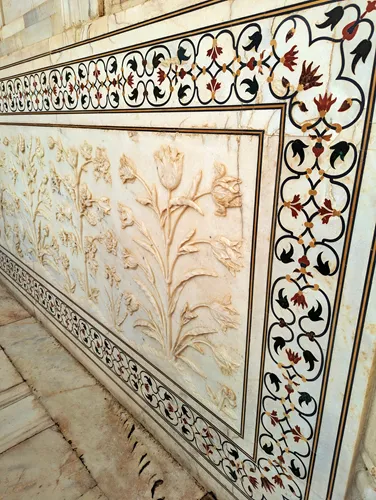
The main decoration is not paint, but the laborious art of Pietra Dura (Italian for ‘hard stone’).
Technique: Thousands of pieces of polished, colored precious and semi-precious stones were meticulously cut and inlaid into the white marble surface, forming intricate floral, geometric, and abstract patterns. The quality of the inlay is such that when a flashlight is shone on it, the stones appear to glow from within. The entire mausoleum is covered with these intricate patterns, turning the marble facade into a giant jewel box. When you go into the burial chamber, staff will likely point this feature out to you – and likely also ask for a tip. Be advised, the light from your cell phones is not strong enough to create this effect.
The true magic of the Taj Mahal is found not in the size of the blocks, but in the tiny, intricate details achieved through Pietra Dura. This technique allowed the Mughal architects to infuse the structure with spiritual meaning and symbolism that goes far beyond the four rivers we just discussed.
Here is how Shah Jahan and his artisans used specific stones to create a symbolic tapestry of Paradise within the tomb.
Mughal Symbolism in Pietra Dura
The Taj Mahal uses an estimated 28 different types of precious and semi-precious stones sourced from all over the world. These stones were not chosen arbitrarily for color; their intrinsic qualities were intended to reflect the abundance, health, and purity of the afterlife.
1. The Color and Symbolism of Stones
The use of specific colored stones in the white marble was central to representing the Nine Types of Gems (Navratna) considered auspicious and heavenly in both Islamic and Hindu traditions:
Stone Type |
Origin (Symbolic) |
Symbolic Meaning |
Location/Application |
|---|---|---|---|
Lapis Lazuli (Blue) |
Afghanistan (Far-off lands) |
The Heavens, Truth, and Protection |
Used frequently in the mosque and the cenotaph screen to represent the vast, blue sky of Paradise (Jannah). |
Carnelian (Orange/Red) |
India, Yemen |
Life, Vitality, and Earthly Warmth |
Used for filling the centers of many of the floral patterns, representing the blossoming energy of life. |
Jade (Green) |
China |
Purity, Healing, and Eternal Spring |
The color green is strongly associated with Islam and Paradise. Jade is used to symbolize the perpetual greenery and lushness of the heavenly gardens. |
Crystal/Quartz (Clear) |
Himalayas |
Purity, Water, and Light |
Used to make water appear more brilliant and to add a glittering effect to floral dew drops, mirroring the clear, flowing rivers. |
Amethyst (Purple) |
Brazil, Sri Lanka |
Royalty and Spiritual Aspiration |
Used sparingly to denote the elevated, royal status of Mumtaz Mahal and Shah Jahan in the afterlife. |
2. Flowers and the Tree of Life
The Pietra Dura designs are overwhelmingly floral, and each flower is a spiritual portrait of paradise:
The Number of Petals: Many of the carved flowers feature nine petals. In Mughal cosmology, nine was the number associated with the Throne of God (Arsh), lending divine authority and holiness to the structure.
The Persian Cypress Tree: The repeated motif of the cypress tree (a tall, slender, dark tree) flanking a flowering tree symbolizes the Tree of Life (Sidrat al-Muntaha in Islamic tradition). The juxtaposition of the dark, vertical cypress with the bright, blossoming flowers represents death leading to rebirth and the eternal blossoming of the soul in Paradise.
The contrasting presence of the cypress and the flowering tree is one of the most powerful and consistent symbolic motifs in all of Mughal architecture, and it beautifully encapsulates the emotional duality of the Taj Mahal: grief and hope.
The use of these two trees is often repeated in the Pietra Dura (inlay work) around the cenotaphs, the screen, and even the surrounding walls, turning the entire complex into a visual sermon on life and death.
The Symbolic Contrast of the Two Trees
This motif is essentially a visual depiction of the journey of the soul from the earthly realm to Paradise.
1. The Cypress Tree (Death and Eternity)
The cypress is universally used in Mughal and Persian garden design as a symbol of Mourning, Immortality, and Eternity.
Form and Function: The tree is tall, dark, and its narrow, straight shape points directly upward toward the Heavens. In traditional Persian garden design, the cypress was often planted near tombs because it remains evergreen, symbolizing everlasting life and the soul's enduring existence after death.
Symbolism at the Taj: At the Taj Mahal, the cypress signifies the grief of Shah Jahan over his wife's death and the commitment to a permanent, eternal memorial. It is the symbol of the beloved's passing and her eventual ascension to the Divine.
2. The Flowering Tree (Life and Resurrection)
In stark contrast, the flowering tree—usually depicted as a stylized rose, tulip, or jasmine—symbolizes Life, Rebirth, and the Beauty of Jannah (Paradise).
Form and Function: These trees are depicted as broad, overflowing with colorful blossoms, and often bursting from a vase or pot. They represent the blossoming of the soul upon entering Paradise, the abundant fruits, and the lush, shaded gardens promised in the Qur'an.
Symbolism at the Taj: The flowering trees represent the hope of resurrection and the divine promise of the afterlife. They signify that Mumtaz Mahal is not gone, but is blooming in a perfect, eternal garden where there is no grief.
Putting the Two Together: The Dual Motif
When you look at the Pietra Dura panels, you will notice that the cypress tree and the flowering tree are almost always paired:
Cypress + Flowering Tree: This combination represents the concept that grief (cypress) leads to everlasting joy (flowering tree). It is a visual equation stating that the earthly sorrow of death is immediately balanced by the divine beauty of the eternal garden.
The Qalam and the Kama: Some scholars also interpret the pair as two essential elements of creation: the pen (qalam), which writes the fate (the straight cypress), and the bow (kama), representing nature and passion (the curved, blooming tree).
The entire message conveyed by this dual motif is one of balance: the acceptance of death as the necessary journey to achieve the ultimate reward of a perfect, beautiful, and eternal life.
3. The Octagonal Design
The main mausoleum chamber itself is built on an octagonal plan, and the exquisitely carved marble screen surrounding the cenotaphs is also octagonal.
The octagon is a transitional shape between the square (representing the earthly realm, the Kaaba, and stability) and the circle (representing the perfection and infinity of God/Heaven).
The eight sides represent the eight gates of Paradise (abwāb al-jannah) that the righteous believers are promised to enter. By building the tomb chamber in this shape, the architects ensured that the Queen's resting place was physically situated at the entry point to the eternal realm.
The entire complex, from the illusion at the gate to the geometric patterns of the stones inside, is designed as a physical manifestation of a spiritual journey.
The Concept of Bilateral Symmetry
At its simplest, the Taj Mahal employs bilateral symmetry, meaning if you draw a line down the exact center, the left side is a mirror image of the right. This is true for the mausoleum, the main Charbagh garden, and the flanking mosque and guesthouse.
However, the Mughals took this concept much further, using a combination of units and proportional relationships to ensure every single structure related mathematically to the others.
1. The Proportional Grid (The Gaz)
The entire complex is governed by a strict proportional grid system based on the Mughal unit of measurement called the Gaz.
Fixed Ratios: The primary building block is the 1:2 Ratio.
The height of the central Iwan (the large archway on the main tomb) is roughly half the total height of the dome and base structure.
The entire mausoleum is a square plot where the width is equal to the height of the tomb up to the bottom of the dome drum.
The four minarets are designed to be exactly 1/7th the height of the main dome, creating a subtle visual echo in their proportions.
2. The Golden Ratio and Octagonal Geometry
While the Golden Ratio (Φ≈ 1.618) is often debated, Mughal builders certainly understood the harmonious qualities of mathematically derived proportions, especially those related to the circle and the octagon (the shape of the central chamber).
The Octagonal Key: The central space is an octagon, which is the perfect shape to translate the square of the Earth (mortal realm) into the circle of Heaven (eternal realm). The geometry ensures that all eight openings and sides lead the eye toward the center, where the cenotaphs are placed.
Layered Symmetry: The geometric symmetry is layered in three dimensions:
Axial Symmetry: The complex is perfectly balanced along its main North-South axis (from the Great Gate, through the reflecting pool, to the mausoleum).
Radial Symmetry: This is found in the floral Pietra Dura patterns, where the patterns branch out from a central point.
Reflective Symmetry (The Pool): The still water of the Charbagh reflecting pool creates a perfect mirror image of the mausoleum, turning the half-dome and arch of the monument into a visually complete circle—an ultimate symbol of perfection and eternity—when viewed from the main entrance.
3. Deliberate Imperfection: The Leaning Minarets
In a final touch of genius, the four minarets surrounding the tomb are not placed perfectly straight up. They are subtly designed to lean outward (away from the mausoleum) by a calculated, tiny degree.
This was not an aesthetic choice, but a seismic safety feature.
In the event of an earthquake, the minarets would fall outward, away from the main dome, thus preserving the primary structure—the tomb of Mumtaz Mahal—at all costs.
This blend of mathematical precision, layered symbolism, and practical engineering is what makes the Taj Mahal a true architectural marvel.
Exploring the Taj Complex: The Three Zones
The entire complex is a massive 42-acre site, divided into three main zones that guide the visitor's journey toward the tomb.
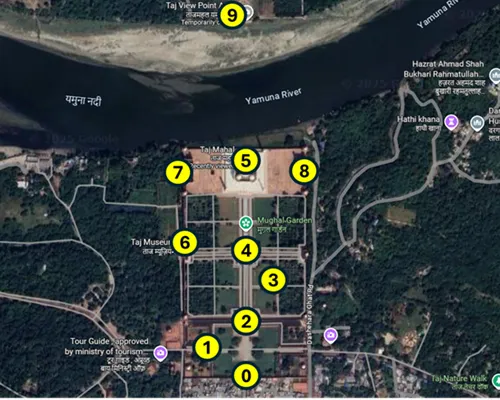
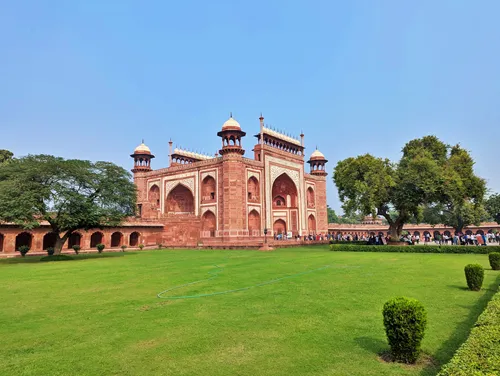
The Great Gate (Darwaza-i Rauza)
The journey begins at the massive red sandstone entrance gateway. This gate is an architectural masterpiece in its own right, designed to visually frame the tomb perfectly.
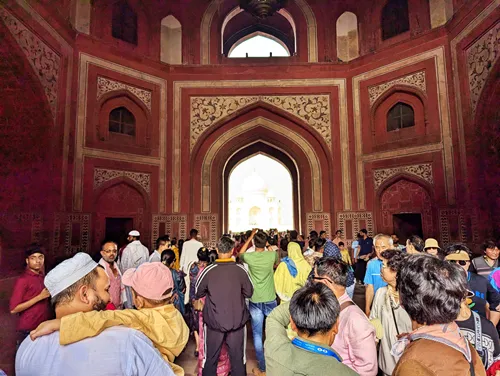
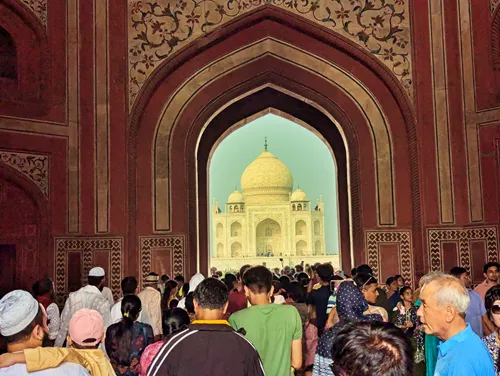
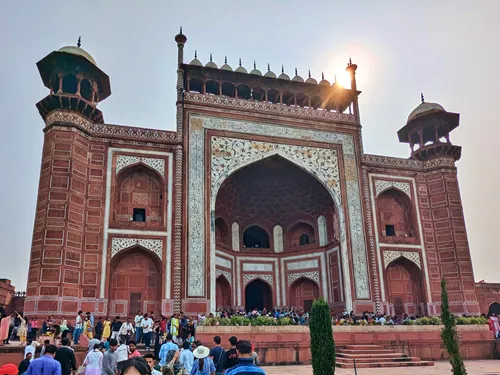
The Visual Reveal (The Optical Illusion)
The gate is specifically designed to create an incredible optical illusion. Upon entry, the massive scale of the Taj Mahal is initially obscured and framed, making the dome appear close and deceptively small.
Framing and Confinement: When you stand just inside the Great Gate's massive archway, your immediate visual field is dominated by the confining red sandstone frame of the gate itself. The Taj Mahal, which is actually several hundred meters away across the garden, is viewed through this tight frame. The brain registers the monument as being smaller and closer than it is because its immense size is visually contained by the adjacent, overwhelming scale of the gate.
As you step forward through the arch and into the Charbagh garden, the monument seems to dramatically ‘grow’ and expand, instantaneously revealing its true, colossal scale and breathtaking magnificence`, a stunning visual transition orchestrated by the architects to maximize the emotional impact of the first sighting.
The Release of Scale: The moment you step a few feet out from under the arch and into the Charbagh garden, the immediate, confining frame of the gate instantly disappears from your direct view. The full, immense distance of the complex and the monument's actual colossal scale suddenly dominate your perspective. This instantaneous visual release causes the Taj Mahal to appear to leap forward and expand, magnifying the emotional shock and splendor of the final sight.
This overall effect of dynamic perspective is perfectly complemented by the second trick you selected: the Calligraphy Optical Adjustment.
Calligraphy Optical Adjustment
The calligraphers (primarily Amanat Khan) used a sophisticated technique known as compensatory scaling. They didn't just place letters; they physically carved the letters on the highest sections of the arches and panels to be significantly larger than those at eye level (sometimes up to 30% larger). Because the human eye compensates for the effect of distance, the larger, farther away letters appear to be the exact same size as the closer, smaller ones, ensuring the entire inscription reads with flawless vertical uniformity.
Calligraphy of the Gate (Verses of Paradise)
The archway is adorned with intricate black marble calligraphy that consists of Qur'anic verses related to the Day of Judgment and the promise of Paradise. The script welcomes visitors with the powerful metaphorical idea of entering a celestial garden (Heaven), reinforcing the concept of the Taj Mahal complex as a piece of heaven on earth. Furthermore, the calligraphers applied the same optical adjustment found on the tomb itself: the size of the letters subtly increases as they ascend the arch, ensuring the entire inscription appears uniform and legible when viewed from the ground.
The verses inscribed on the Great Gate are primarily taken from the last chapters, or Surahs, of the Qur'an, specifically focusing on the theme of Judgment Day and the promised rewards of Heaven (Jannah).
The calligraphy consists of 22 panels that form a continuous frieze around the Great Gate's central archway. The most notable and comprehensive passage is from
The inscription is most famous for its concluding verses, which are intended to greet the souls entering their eternal rest, thereby welcoming visitors into the complex as if they are entering the garden of Heaven itself. The final verses of this Surah read:
‘O soul at peace, return to your Lord, well pleased (with him) and well-pleasing (to Him)! Enter among My servants! And enter My Paradise!’
This poetic and welcoming script reinforces the architectural design of the Charbagh Garden that lies immediately beyond the gate, setting up the entire complex as a symbolic representation of the eternal resting place. The Optical Adjustment used by the calligrapher, Amanat Khan, ensured that this message, no matter how high up the arch it was carved, would be perfectly legible to the traveler entering the complex.
The Charbagh Garden
The magnificent Persian-style Charbagh (Four-part) garden covers the entire area between the main gate and the mausoleum.
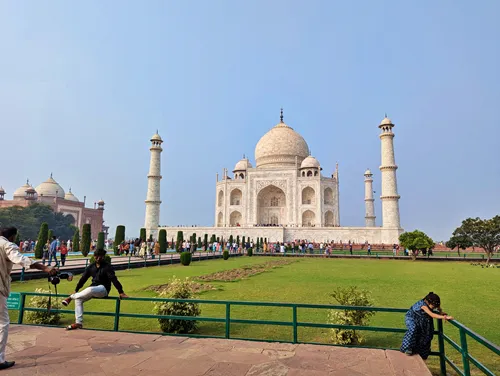
Symbolism: The garden is based on the concept of Paradise (Jannah) described in the Qur’an, with four quadrants representing the four rivers of Paradise. The central reflecting pool is designed to provide the most iconic, perfect, and stable reflection of the mausoleum.
The Viewing Angle: The garden’s design deliberately directs the visitor’s eye, making the journey across the garden an integral part of the experience, slowly preparing the mind for the monumental view ahead.
The Four Rivers of Paradise (Jannah)
The number four is central to the design of the Charbagh garden because Islamic tradition interprets the promised gardens of Paradise as being divided and nourished by four distinct rivers or streams.
The Significance of Four
The four rivers are mentioned in the Qur'an as the ultimate sensory reward for the faithful. They are not merely bodies of water; they are rivers of specific substances, symbolizing life, knowledge, pleasure, and purification in the afterlife. The four substances are:
- Water (for life and purity)
- Milk (for knowledge and sustenance)
- Honey (for sweetness and abundance)
- Wine (which is pure and non-intoxicating, for spiritual pleasure)
The physical Charbagh at the Taj Mahal replicates this by using two central waterways (the one you see with the reflection, and the one running perpendicular to it) to divide the garden into four perfect quarters, with the channels symbolizing these four promised rivers.
Qur'anic Verses
The most direct and frequently cited verse that outlines these four types of rivers in Jannah is found in Surah Muhammad (Chapter 47), Verse 15:
‘Is the description of Paradise, which the righteous are promised, wherein are rivers of water, the taste and smell of which are not changed; and rivers of milk, the taste of which will remain unchanged; and rivers of wine, delicious to those who drink; and rivers of clarified honey (pure and clear) – in it (Paradise) they will have every kind of fruit and forgiveness from their Lord.’
Other verses throughout the Qur'an constantly describe Paradise as ‘Gardens beneath which rivers flow’, emphasizing flowing water and greenery as the ultimate reward in an otherwise arid region (e.g., Surah At-Tawbah, 9:72).
The Reflecting Pool and the Symbol of Stillness
While the four flowing channels represent the dynamic rivers of Paradise, the central reflecting pool (Al-Hawd) itself is also rooted in a profound spiritual concept, though it is not explicitly mentioned as a pool in the same detail as the rivers in the Qur'an.
The Pool of Kawthar
The central water body and the overall idea of a gathering pool are often symbolically linked to the Kawthar (also spelled Al-Kawthar), which is mentioned in Surah Al-Kawthar (Chapter 108).
The Kawthar is described as a River or Fountain of Abundance in Paradise granted specifically to the Prophet Muhammad. In Islamic tradition, this concept is often associated with a large, beautiful body of water, a fountain or pool, where the faithful will gather.
In the physical design of the Taj Mahal:
The movement in the channels symbolizes the four flowing rivers.
The stillness of the central pool, which creates the perfect, stable, and unmoving reflection of the Taj Mahal, symbolizes the eternity, purity, and perfect stillness of the Divine presence that the soul attains in Paradise. The perfect reflection of the tomb signifies the eternal presence of the soul in its heavenly dwelling.
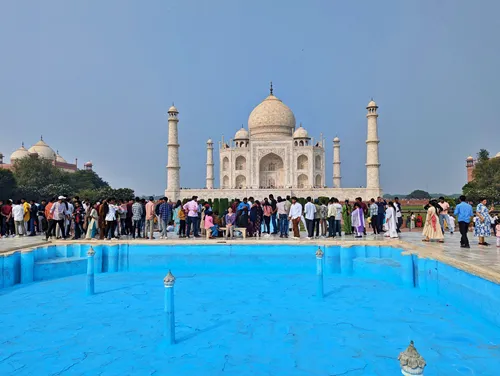
The Main Mausoleum and the Cenotaphs
The main marble structure stands on its raised plinth, accessible by a set of stairs.
The Upper Chamber: Inside the mausoleum, behind an exquisitely carved octagonal marble screen, are the false sarcophagi (cenotaphs) of Mumtaz Mahal and Shah Jahan. Visitors are allowed to enter the chamber, but are not allowed to touch or approach them. These are symbolic markers.
The Crypt: The actual bodies are interred in a far plainer vault directly beneath the cenotaphs, at garden level, which is sealed off from public view. This lower chamber represents the resting place closer to the earth.
The Upper Chamber: The Cenotaphs
The Upper Chamber is the heart of the mausoleum and the space where the visitor's eye is meant to be overwhelmed by beauty and divine geometry. This is the chamber you see when you enter the main dome.
Unfortunately, photography is not allowed in the Upper Chamber.
Design and Decoration
The Octagonal Design: As mentioned before, the room itself is an octagon, symbolizing the transition from the earthly square to the heavenly circle and representing the eight gates of Paradise.
The Marble Screen: The cenotaphs are enclosed by an exquisite octagonal screen of pure white marble, known as the jali. This screen is a masterpiece of craftsmanship, carved with delicate floral vines and geometric patterns (like repeating stars and hexagons). It took ten years to complete and acts as a transparent yet protective veil around the symbolic graves.
The False Sarcophagi (Cenotaphs): These are the elaborate, raised marble tombs you see. They are magnificent, decorated top-to-bottom with Pietra Dura inlay, featuring intricate floral patterns made from thousands of precious and semi-precious stones.
Mumtaz Mahal’s Cenotaph: Placed exactly in the geometric center of the room. It is flat at the top and features inscriptions from the Qur'an related to comfort and the promised rewards of Heaven.
Shah Jahan’s Cenotaph: Added later and placed slightly to the west of Mumtaz Mahal’s. Because he was a man, his cenotaph is slightly taller with a small raised pen box carved on the top, a traditional symbol for a ruler's tomb. This addition breaks the perfect bilateral symmetry of the complex, which was originally designed solely around Mumtaz Mahal.
The inscriptions on her symbolic tomb are not historical facts or biographical data, but rather a collection of Qur'anic verses carefully selected to comfort the soul of Mumtaz Mahal with the prospect of Paradise and implore God's mercy upon her.
The texts serve two main purposes:
1. The Divine Names (The Asma ul Husna)
The sides of Mumtaz Mahal's cenotaph are primarily adorned with the calligraphic inscriptions of the 99 Names of Allah (Asma ul Husna).
These names invoke the attributes of God and are meant to surround the deceased with the Divine presence. They include powerful attributes such as:
‘O Noble’ (Al-Karim)
‘O Magnificent’ (Al-Majid)
‘O Unique’ (Al-Wahid)
‘O Eternal’ (Al-Hayy or Al-Baqi)
‘O Glorious’ (Al-Jalil)
2. Verses of Paradise and Mercy
The most significant verses, found on the top block and sides of her cenotaph, are prayers of welcome and reassurance. They include passages from the Qur'an that speak directly to the destiny of the righteous soul.
A key theme is based on an angelic prayer, often summarized as:
‘The words of the Qur’anic prayer, recited by angels, implore Allah to allow the faithful to enter Paradise, a touching request for God’s mercy towards His devout servant, Mumtaz Mahal.’
Specific Surahs (chapters) and verses used on her cenotaph often include themes found in:
Surah 41 (Fussilat), Verse 30: Which promises the faithful: Indeed, those who say, 'Our Lord is Allah,' and then remain steadfast, the angels will descend upon them, [saying], 'Do not fear and do not grieve but receive good tidings of Paradise which you were promised.'
Surah 83 (Al-Mutaffifin), Verses 22-28: These verses describe the joy and elevated status of the righteous in Paradise, dwelling in gardens and drinking from a pure source.
In essence, the entire epitaph is a final, complex prayer etched in stone by Shah Jahan, asking for Allah's forgiveness and welcoming Mumtaz Mahal's soul into the highest gardens of Heaven.
Purpose
The cenotaphs serve purely a symbolic and aesthetic purpose. They are designed to be viewed from the sunlight filtering through the jali screen, allowing the gemstones to sparkle and create a vision of Paradise for the living visitor, linking the earthly experience to the heavenly reward.
The Crypt: The Actual Graves
Directly beneath the Upper Chamber is the actual burial vault, or Crypt. This chamber is in stark contrast to the opulence above and is inaccessible to the public.
Design and Purpose
Location: The crypt is situated at the level of the garden’s water table and is set into the solid marble foundation of the plinth. This places the bodies literally beneath the center of the dome, directly under the cenotaphs, and closer to the earth.
Simplicity and Humility: Unlike the chamber above, the crypt is extremely austere and simple. The walls are bare, and the two tombs themselves are plain, unadorned blocks of marble. There is no elaborate Pietra Dura or complex carving.
The Resting Place: This design follows a core tenet of Islamic burial: the body must return to the earth with humility, without worldly adornment. The plainness of the crypt ensures that the true place of rest is solemn and untouched by the grand human ambition displayed in the superstructure.
Orientation: Both bodies are positioned in the traditional Islamic manner, laid on their right sides with their faces turned toward Mecca (the Qibla), reinforcing the religious devotion of the deceased.
Symbolic Meaning
The contrast between the two chambers is deeply symbolic: the magnificent Upper Chamber represents the glorious status of the soul in Heaven and the tribute paid by the living (Shah Jahan), while the stark Crypt represents the humble reality of the body returning to the dust and the ultimate equality of all before God.
This dual design ensures that the monument fulfills both a spiritual obligation to humility and an imperial desire for eternal remembrance.
Views
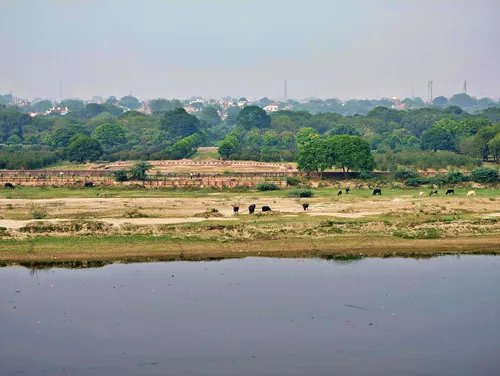
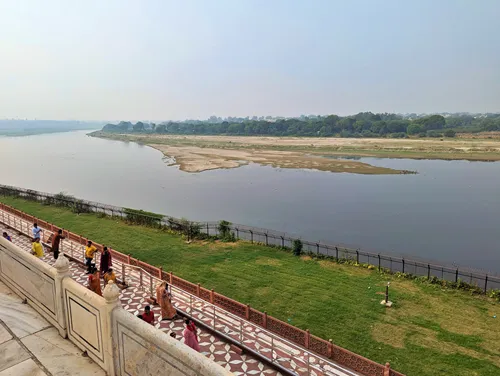
From the Taj Mahal Mausoleum you have great views on:
The Yamuna River
The Taj Museum: Unlocking the Story Behind the Marble
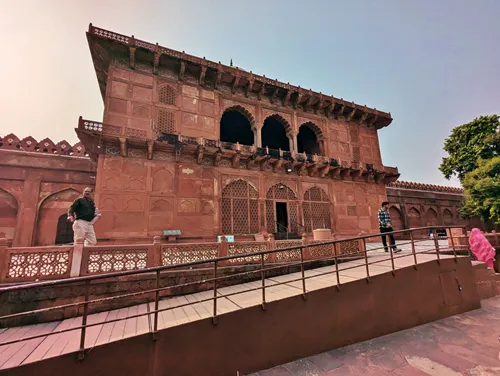
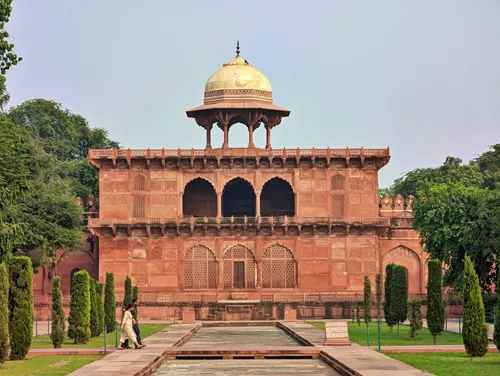
The Taj Museum is an often-overlooked stop that provides essential context to the monument’s creation, the Mughal era, and the lives of its builders. Located west of the Pool of Kawthar, it is a good visit for anyone who wants to fully appreciate the masterpiece before or after seeing the tomb.
Location and Context
To find it: After passing through the Great Gate, you will enter the vast garden (Charbagh) leading up to the mausoleum. The museum is located in the western enclosure of the inner courtyard, nestled in the corner near the famous Pool of Kawthar that runs down the center of the garden.
The Building: It is a small, two-story structure built in 1906 under the direction of Lord Curzon (the then Viceroy of India), designed to blend seamlessly with the red sandstone architecture of the Mughal era.
What You Will Discover Inside
The museum is divided into three main galleries and a central hall, housing over 300 artifacts that offer a tangible link to the monument's 17th-century origins.
1. Royal Portraits and Personal Artifacts
Mughal Miniatures: The collection features rare, original Mughal miniature paintings, including highly prized portraits of Shah Jahan and Mumtaz Mahal—offering a more intimate view of the royal couple than the abstract perfection of the tomb.
Celadon Plates: Look for the intriguing celadon plates and utensils. According to legend, these were used in the court because they were believed to shatter or change color if poisoned food was served, showcasing the intricate security concerns of the imperial court.
2. Architectural and Artistic Plans
Original Drawings: This is arguably the museum’s most important collection. You can view original architectural drawings, site plans, and elevation sketches of the Taj Mahal. These provide insights into the precise symmetry, complex mathematics, and ambitious engineering planning that went into creating the structure.
Calligraphy: The galleries display original royal decrees and examples of Mughal calligraphic manuscripts, highlighting the artistic mastery that covered both the monument's exterior and interior.
3. Coins and Historical Records
The collection also includes various gold and silver coins from the Mughal period, as well as samples of the inlaid stones (known as pietra dura) used in the marble work, giving you a close-up look at the materials that make the Taj so unique.
Visitor Information and Tips
Entry and Timing: Entry is included in your standard admission ticket to the Taj Mahal complex. It is open from 10:00 AM to 5:00 PM and is closed on Fridays (like the rest of the Taj Mahal complex).
Best Time to Visit: Visit the museum after you have seen the main mausoleum. This allows you to better appreciate the artifacts, connecting the history and portraits to the spectacular architecture you just experienced.
Duration: Plan for about 30 to 45 minutes for a thorough visit. Photography is generally not allowed inside to protect the delicate manuscripts and artwork.
The Taj Mahal Mosque: The Living Part of the Monument
The Taj Mahal is renowned for its perfect symmetry; a design feat achieved not only by the mausoleum itself but also by the flanking structures built along the banks of the Yamuna River. The Taj Mahal Mosque is the structure located on the west side of the mausoleum, balancing the entire complex. As an active place of worship, it represents the living, functional part of the monument.
Architectural Role and Balance
The Mosque is a monumental structure constructed entirely of red sandstone, contrasting strikingly with the pure white marble of the main tomb. This visual contrast is intentional: the red sandstone emphasizes the earthly, functional elements of the complex, while the white marble signifies the divine and eternal nature of the tomb.
Symmetry and the Jawab
The Mosque is placed precisely on the western flank of the main plinth. To maintain perfect symmetry, an identical structure, known as the Jawab (meaning ‘answer’ or ‘response’), stands on the eastern flank. The Jawab (also called: Mehmaan khana) is not used for prayer because it is not oriented toward Mecca; it serves solely as an architectural counterbalance, completing the exquisite harmony of the design.
Design Details
The Mosque features three majestic domes and a recessed archway (iwan), all decorated with intricate marble inlay work and calligraphy. The interiors are covered in beautiful frescoes and detailed relief carvings.
Religious Significance and Visitor Etiquette
The primary function of the Mosque is to serve as a prayer hall. It is consecrated ground and is still actively used by the local Muslim community.
Friday Closure
Because the Mosque is active, the entire Taj Mahal complex is closed to all visitors every Friday to allow the local community to gather for the congregational prayers (Jumu'ah). This is an essential scheduling point for all travelers.
Worship
Visitors should be mindful and respectful of worshippers at all times. Foot coverings must be removed before entering the prayer hall.
The Mosque as an Observation Point
The platform of the Mosque provides one of the most unique and beautiful perspectives of the Taj Mahal. From the western side, you have a good view of the mausoleum's intricate marble details and the dramatic contrast of the white dome against the backdrop of the sky. This location is often cited by photographers as an excellent spot for taking pictures, particularly during the early morning hours.
The Jawab (Mehmaan Khana): Architectural Harmony and Function
The Jawab is a frequently misunderstood structure within the Taj Mahal complex. It is the majestic red sandstone building located on the eastern side of the main mausoleum’s plinth. Its primary function is not religious but purely architectural and ceremonial, completing the perfect bilateral symmetry of the complex.
Understanding the Names
The building is known by two distinct names that describe its role in the Mughal design:
The Jawab (The Answer): This is the formal architectural designation. The Jawab is built as an exact mirror image, or ‘answer’, to the Taj Mahal Mosque (which is located on the western flank). The complex’s design is based on the principle of bilateral symmetry, where every element on one side of the central axis must be balanced by an identical element on the other side. The Jawab was constructed solely to achieve this harmony, giving the entire plinth a balanced and flawless appearance.
The Mehmaan Khana (Guest House): This name describes the building’s functional use. As the Jawab is not oriented toward Mecca (a requirement for Muslim prayer halls), it cannot be used as a mosque. Instead, it historically served as a reception or assembly hall, a place for congregants, royal visitors, or guests to gather, rest, or prepare before or after prayer services held in the adjacent Mosque. It is sometimes also referred to as the Community Hall.
Design and Aesthetics
The Jawab is structurally identical to the Mosque. It is constructed entirely of red sandstone, which is richly inlaid with white marble details, including calligraphy and geometric patterns.
The deep, vibrant color of the sandstone serves a powerful aesthetic purpose: it provides a stunning visual contrast to the luminous white marble of the main tomb. This contrast highlights the tomb's ethereal, otherworldly quality by framing it between two vibrant, human-scale structures. The three majestic domes and the recessed archway (iwan) mirror those of the Mosque, emphasizing the visual unity of the entire riverfront design.
Visitor Experience
Today, the Jawab is primarily appreciated as a masterpiece of design and balance. The elevated platform of the structure offers one of the best and often least crowded observation points of the main Taj Mahal. From the eastern side, visitors gain an exceptional perspective of the mausoleum's flawless symmetry and the harmonious way it interacts with the surrounding red sandstone structures.
Main Entrance and Monkeys
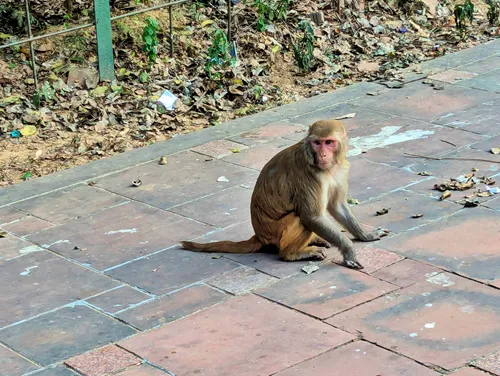
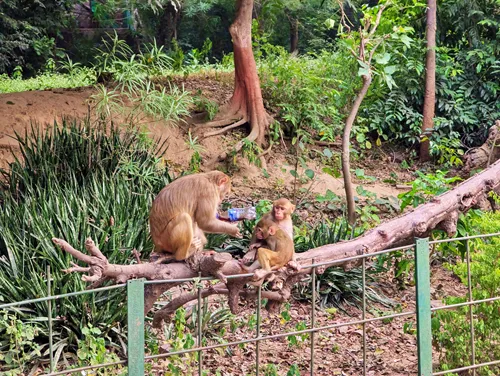
The path leading from the street south of the ticketing area and the main entrance is inhabited by a notable population of Rhesus Macaques. These monkeys are highly accustomed to human presence and are known for their opportunistic and bold behavior.
While observing these animals can be part of the travel experience, visitors must exercise extreme caution and avoid any direct interaction. The monkeys are primarily drawn to food, so it is essential to keep all snacks, water bottles, and small, loose belongings secured and out of sight. They may attempt to snatch items, particularly small bags, phones, or plastic bottles.
Critical Safety Note: Travelers must be advised that these monkeys can cause severe biting wounds when they are approached, cornered, or denied the food they may attempt to snatch. Maintaining a respectful distance and avoiding confrontation are essential to ensure personal safety and prevent disturbance to the natural behavior of these charismatic, yet potentially dangerous, residents of the complex.
Exhibition
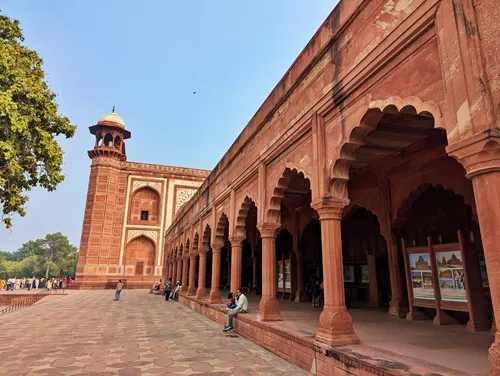
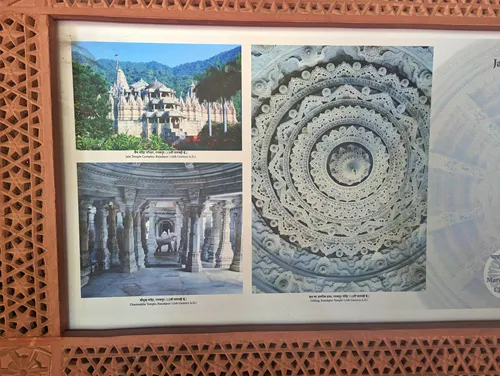
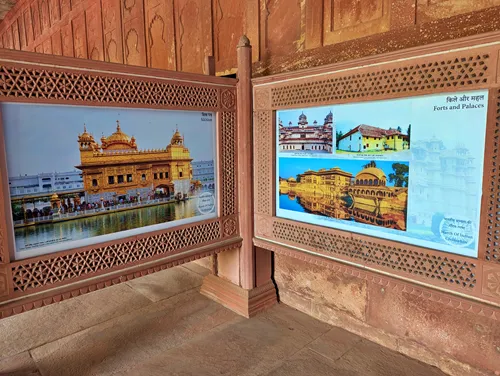
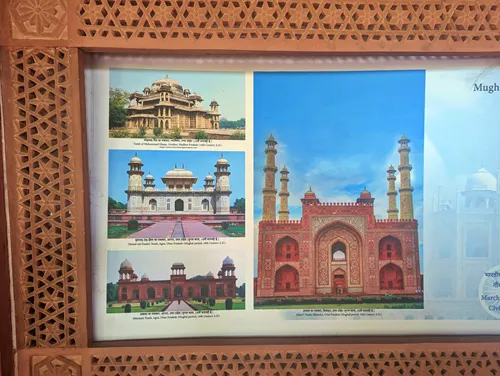
While most visitors rush to the main mausoleum, the Exhibition area is a quiet, enriching stop that provides essential context to the monument’s creation and the Mughal era. Once you pass through the Great Gate, walk to the left, and you will see several informational boards about other historic buildings in India.
Our proposal is to make this stop your last stop before you exit the Taj Mahal complex.
Back to the Day 4 Walking Tour
Where do you want to go now?

Author: Rudy at Backpack and Snorkel
Bio: Owner of Backpack and Snorkel Travel Guides. We create in-depth guides to help you plan unforgettable vacations around the world.

Other popular Purple Travel Guides you may be interested in:
Like this Backpack and Snorkel Purple Travel Guide? Pin these for later: