The Red Fort (Lal Qila): Citadel of Mughal Power in Delhi | India Purple Travel Guide
(map, reviews, website, buy_tickets)
This is Premium Content! To access it, please download our
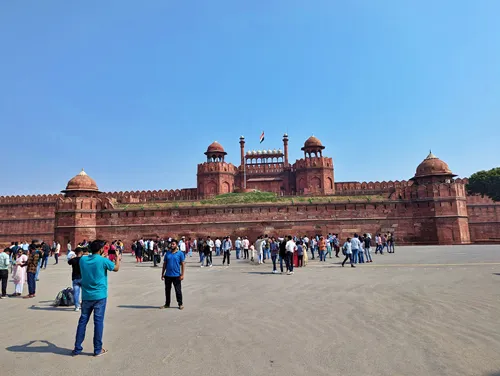
Backpack and Snorkel Purple Travel GuideThe Red Fort (or Lal Qila in Hindi) is a colossal symbol of India's past. This UNESCO World Heritage site is officially a fort, but its gigantic size makes it appear more like a walled city. It was built by the Mughal emperor Shah Jahan and remains the most important place in India's national consciousness. India’s Prime Minister addresses the nation every Independence Day from its ramparts.
Here at Backpack and Snorkel Travel Guides, we promote self-guided walking tours.
But we realize that not everybody likes to walk by themselves in a foreign city. So, just in case that you rather go with ab guide: NO PROBLEM! Please see the GuruWalk and Viator tours below.
free GuruWalk tours
paid Viator tours
Why You Should Visit
Visiting the Red Fort is essential for grasping the sheer scale and opulence of the Mughal Empire at its zenith. It represents the final, grand evolution of Mughal architecture, blending Timurid, Persian, and indigenous Indian styles. It is a place of deep historical resonance, transporting you back to a time of emperors, diamond-studded thrones, and elaborate court ceremonies. Beyond its history, the fort grounds are beautifully maintained, offering a peaceful contrast to the chaotic streets of Old Delhi just outside its gates.
Just be advised that much of the Red Fort’s glory is gone as the British dismantled many of the palace structures and use parts of the complex as military barracks. To manage expectations and avoid disappointment, please look at the photos of the individual buildings below.
Admission and Opening Hours
Open: Tue-Sun; Mondays closed
Opening Hours: Sunrise to Sunset
Entry Fee: ₹35 (Indians), ₹500 (foreigners) (at the time of writing)
Photography: no fee for photography, but ₹25 for video filming
Sound & Light Shows: 6pm onwards in English and Hindi
Sound & Light Show Ticket: ₹80 (adults), ₹30 (children)
History and Importance
The Red Fort was commissioned in 1638 by Emperor Shah Jahan, who was also responsible for building the Taj Mahal. He made the strategic decision to shift the capital of the Mughal Empire from Agra to a newly planned city, Shahjahanabad (now Old Delhi).
1648: Completion: The fort took ten years to build and was completed in 1648. It was the ceremonial and political heart of the Mughal government for nearly 200 years.
The Crown Jewel: The fort once contained the famous Peacock Throne (Takht-e-Taus), a glittering masterpiece inlaid with emeralds, rubies, and diamonds, including the legendary Koh-i-Noor diamond.
Decline and Conquest: The fort was famously sacked by the Persian invader Nader Shah in 1739, who seized the Peacock Throne and disassembled it. Fragments of the throne have likely been used in Persian royal treasuries and artifacts.
The British eventually seized control of the fort after the Revolt of 1857 (India's First War of Independence). The British dismantled many of the palace structures and converted parts of the complex into military barracks.Modern Significance: On August 15, 1947, India’s first Prime Minister, Jawaharlal Nehru, hoisted the Indian tricolor flag above the Lahori Gate, marking the birth of independent India. This tradition continues annually, cementing the fort’s role as the paramount symbol of national sovereignty.
Architecture and Design
The fort gets its name from its massive, 75-foot-high enclosing walls of red sandstone. While the exterior is imposing and defensive, the interior structures are masterpieces of delicate craftsmanship.
The Red Fort’s architecture is characterized by two distinct styles: the defensive, towering walls typical of earlier Mughal forts, and the refined, sophisticated pavilions inside, which introduced the pietra dura (inlay of semi-precious stones) ornamentation style, perfecting the aesthetic of the Mughal court. The key element is the architectural system of ‘columns, arches, and lintels’, which distinguishes the pavilions.
The Red Fort Complex: A Detailed Tour of Key Structures
The following detailed breakdown covers the 17 key points of interest, generally following a processional route an emperor would have taken from the public entrances to the private palaces.
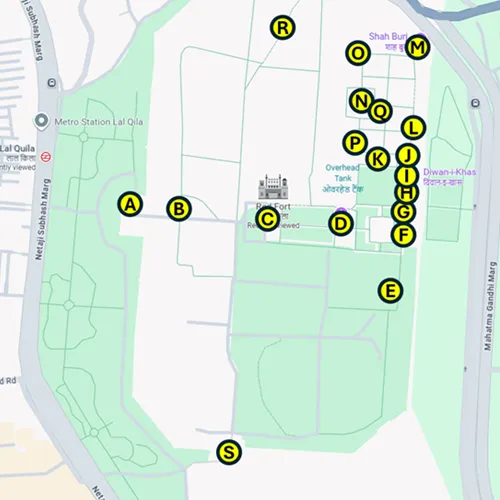
A = Lahori Darwaza (Gate)
B = The Chhatta Bazaar
C = The Naubat Khana (The Drum House)
D = Diwan-i-Aam
E = The Mumtaz Mahal
F = The Rang Mahal
G = Nahr-i-Bihisht (Stream of Paradise)
H = The Khas Mahal
I = Diwan-i-Khas
J = The Hammams
K = Moti Masjid
L = The Hira Mahal
M = The Shah Burj
N = Zafar Mahal
O = Bhadon Pavilion
P = Sawan Pavilion
Q = Hayat Baksh Bagh
R = The Red Fort Baoli
S = The Delhi Gate
I. The Imperial Entry and Public Zones
The Lahori Darwaza (Lahore Gate)
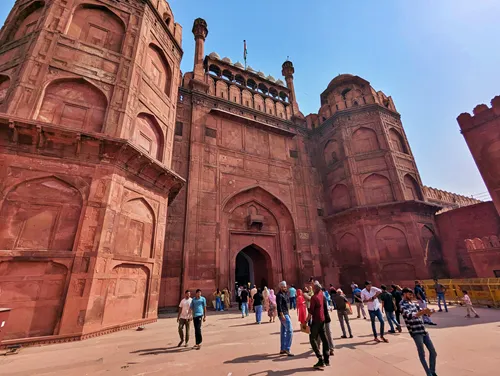
The Lahori Darwaza serves as the magnificent primary entrance and ceremonial face of the Red Fort, acting as the crucial architectural link between the royal complex and the bustling city of Shahjahanabad (Old Delhi) that laid beyond its walls. It is the gateway through which all modern visitors enter and is steeped in both Mughal history and modern Indian national identity.

Feature |
Architectural and Historical Significance |
|---|---|
Builder & Date |
Shah Jahan, completed in 1648 CE. |
Context |
Strategically built to open onto the broad, central thoroughfare of Shahjahanabad, known then and now as Chandni Chowk. This ensured the Emperor's processions and public ceremonies were visible to the populace. |
The Original Structure & Size |
The gate is a massive, three-story structure built of red sandstone, projecting immense power. Its impressive central arched opening measures 41 ft (12.5 m) tall and 24 ft (7.3 m) wide. It is flanked by impressive semi-octagonal turrets (burj) and topped with delicate white marble chhatris (open pavilions) and crenellations. |
Aurangzeb’s Barbican (Key Detail) |
The gate's original frontal symmetry was intentionally broken by Emperor Aurangzeb. He added a massive, high-walled defensive forecourt called a barbican in front of the gate. This addition serves two purposes: defensively, it prevents a direct, unimpeded frontal charge; and politically, it forces visitors to make a sharp, 90-degree turn before entering, reducing their velocity and imposing humility before reaching the court. |
Visitor Experience |
The gate leads directly into the Chhatta Chowk (Covered Market), where royalty and high officials once shopped. This transition immediately immerses you from the outside world into the commercial heart of the fort. |
National Importance |
The Lahori Darwaza holds immense symbolic value in modern India. It is the historic spot where the Prime Minister of India hoists the national flag and delivers the annual address every Independence Day (August 15th). |
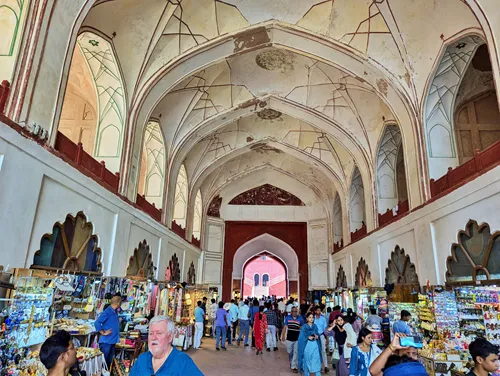
The Chhatta Bazaar (Covered Bazaar)
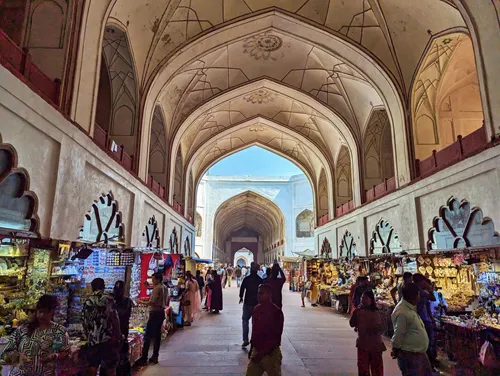
Immediately upon passing through the massive Lahori Gate, visitors step into the Chhatta Bazaar (Covered Bazaar). This stunning, barrel-vaulted arcade is one of the most distinctive and modern elements of Shah Jahan’s design, offering an immediate transition from the world of military defense to the world of royal commerce.
Feature |
Architectural and Historical Significance |
|---|---|
Builder & Date |
Shah Jahan, constructed simultaneously with the Fort, completed in 1648 CE. |
Function |
This was the exclusive retail hub for the nobility, particularly the women of the royal zenana (harem), who were often cloistered and did not shop in the public markets. It provided a secure, climate-controlled, and high-end shopping experience. |
Original Name |
It was originally known as Bazaar-i-Musaqqaf (Covered Market) or sometimes the Meena Bazaar (referring to the painted, colorful decorations and the market’s occasional use by noblewomen to sell their own crafted goods during festivals). |
Architecture |
The bazaar is a unique example of 17th-century covered commercial architecture in India. It consists of two parallel rows of 32 square apartments (shops) on either side, which are protected by a continuous, vaulted ceiling. This barrel vault was revolutionary, providing shade, temperature control, and security. |
Commerce & Luxury |
The shops were intentionally small and uniform, designed to maximize revenue and ensure standardized trade. Here, merchants sold only the finest luxury goods to the royal court: silks, brocades, jewelry, precious metals, ivory carvings, perfumes, spices, and weapons of exceptional craftsmanship. |
Hydraulic Cooling |
In addition to the cool shade provided by the thick stone vaulting, the building was ingeniously integrated into the fort's water system. A channel ran through the center of the bazaar, which was periodically filled with water, allowing evaporation to further cool the air circulating through the market, a highly sought-after comfort in Delhi's intense heat. |
Visitor Experience |
Today, the Chhatta Bazaar retains its commercial function, selling souvenirs and handicrafts, giving modern visitors a tangible link to its original purpose as the entrance to the ultimate Mughal imperial city. |
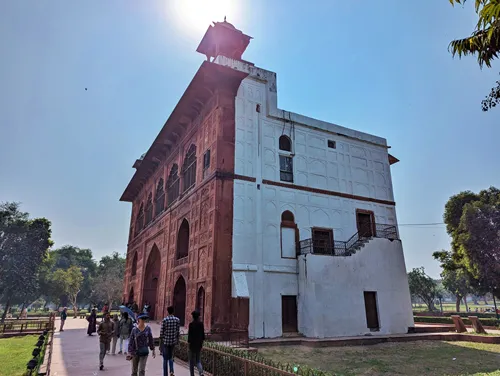
The Naubat Khana (The Drum House)
The Naubat Khana (meaning 'Drum House' or, more formally, the Naqqar Khana) stands prominently as the ceremonial gateway between the public entry courtyard and the inner palace complex. It is a striking two-story, rectangular structure, built entirely of red sandstone, and serves as the visual and acoustic threshold to the Diwan-i-Aam (Hall of Public Audience).



Feature |
Architectural and Ceremonial Significance |
|---|---|
Builder & Date |
Shah Jahan, completed in 1648 CE. |
Location & Function |
Positioned directly on the axis from the Chhatta Bazaar, the Naubat Khana controls access to the inner court. All commoners were required to dismount here, a ritual enforced by its massive arches. |
Ceremonial Music |
This structure was the command center for the royal band, known as the Naqqar Khana. From the upper floor, court musicians performed five times a day, using loud instruments like drums (naqqara), trumpets, and shahnai (pipes). |
Audial Signaling |
The music's primary purpose was to herald the Emperor's movements, mark the change of watches, signify major public ceremonies, and announce the formal times of prayer. This constant, regulated sound defined the rhythm and majesty of the imperial city. |
Architectural Detail |
The structure is built with a deep, arched entryway that emphasizes its role as a portal. Originally, the walls and ceilings of the Naubat Khana were likely adorned with magnificent gold artistry and vibrant frescoes, intended to dazzle the incoming high-ranking nobles. Faint traces of this elaborate decoration may still be seen beneath the soot and wear. |
The Hathi Pol (Elephant Gate) |
The ground floor also functioned as the Hathi Pol (Elephant Gate), but only for the very highest nobility. Princes and nobles of the highest rank were permitted to ride their elephants and horses into the lower arch. Six side chambers provided waiting and valet service for the guards and their animals, reinforcing the rigid protocol and hierarchy of the court. |
Transition |
Passing through the Naubat Khana marks the transition from the relatively relaxed commercial world of the Chhatta Bazaar into the solemn, ordered space of the Diwan-i-Aam, where the Emperor sat on his throne. |
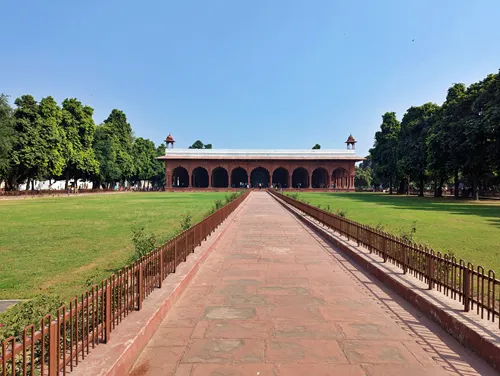
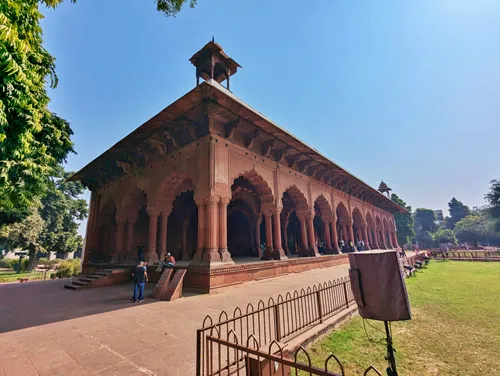
Diwan-i-Aam (Hall of Public Audience)
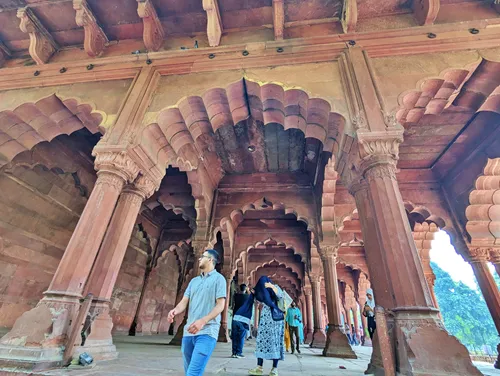
The Diwan-i-Aam (meaning 'Hall of Public Audience') is a massive, open-sided pavilion that served as the grand stage for the Emperor’s public court. This was the location where the Mughal ruler presented himself to the masses, conducted general state business, received oaths of fealty, heard petitions, and dispensed justice to the common populace.
Feature |
Architectural and Ceremonial Significance |
|---|---|
Builder & Date |
Shah Jahan, completed in 1648 CE. |
Function |
Public Darshan (Viewing) and Justice. Every day, the Emperor would appear here at a fixed hour, allowing his subjects to catch a glimpse of him—a ritual essential to Mughal legitimacy and religious status. |
Architecture & Scale |
The pavilion is rectangular, measuring approximately 100 feet wide and 60 feet deep. It is supported by 40 elegant red sandstone columns arranged in three aisles. These columns divide the space into bays and ensure that the maximum number of people could witness the spectacle. |
The Marble Illusion |
In its original state, the red sandstone of the columns and ceilings was meticulously covered in shining white chunam plaster. This practice was typical of the early Shah Jahan period, creating the illusion of pure white marble and enhancing the brightness and majesty of the interior for the throngs gathered outside. |
The Jharokha-i-Nashan |
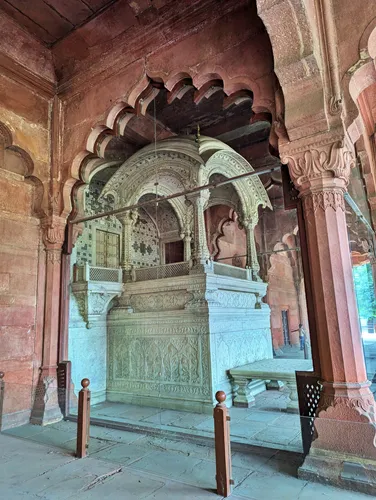
The most important architectural element is the highly ornate, recessed balcony on the eastern wall, known as the Jharokha-i-Nashan (Seat of the Emperor) or the Emperor's Throne. It is built on a raised platform clad entirely in white marble and decorated with exquisite ornamentation. Only the Emperor was allowed on this platform. |
Pietra Dura Artistry (Key Detail) |
The wall panels backing the Emperor’s marble throne are the highlight of the Diwan-i-Aam. They feature highly intricate, European style pietra dura (inlaid stone mosaic) artwork. These panels were executed by a Florentine artist, Ortensio Bronzano, and depict European figures like Orpheus playing the lyre, alongside Hindu and Persian motifs of birds and flowers. This stunning fusion highlights the vast, global artistic influences flowing into the Mughal court. |
Ceremony & Hierarchy |
The space in front of the throne was strictly ordered: the highest-ranking nobles (mansabdars) stood closest, followed by lower-ranking officials, and finally the common subjects in the expansive courtyard, reinforcing the rigid hierarchy of the empire. |
The Diwan-i-Aam was a masterful piece of political theater, designed to impress, intimidate, and legitimize the authority of the Mughal Emperor through scale, symmetry, and spectacular art.
II. The Private Imperial Residences (Zenana and Khas)
The Mumtaz Mahal (Palace of the Exalted One)
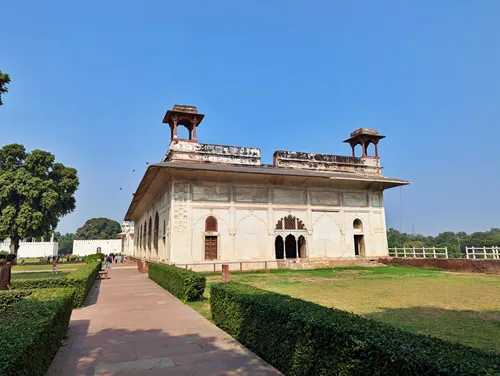
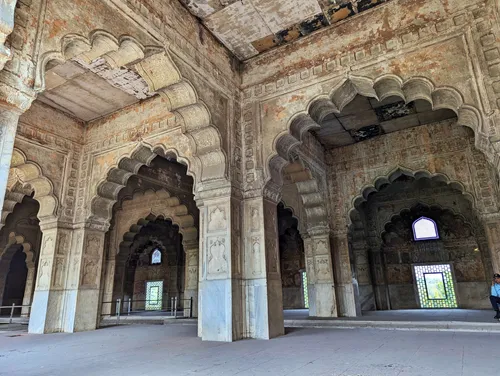
The Mumtaz Mahal is a beautiful white marble pavilion originally built as part of the haram (royal apartments) for the imperial ladies. It is significant both as an architectural remnant of the private lives of the Mughal women and for its modern role as the primary museum within the fort complex.
Feature |
Architectural and Historical Significance |
|---|---|
Builder & Date |
Shah Jahan, built concurrently with the rest of the palace, completed around 1648 CE. |
Function |
It was originally one of six identical, smaller residential apartments lining the eastern wall (facing the Yamuna River), built for the use of the princesses and other high-ranking royal ladies (zenana). |
Architecture |
The pavilion is instantly identifiable by its perfect symmetry and its façade of five open, scalloped arches leading into a single, large hall. The structure is built primarily of white marble, which enhances the air flow and light, and its roof would have been crowned with elegant copper domes. |
Interior Decoration |
The walls and ceiling of the Mumtaz Mahal were originally decorated with highly intricate and colorful wall paintings and floral designs done in the Persian style. Like many royal pavilions, it would have been furnished with luxurious carpets and cushions, and featured shallow channels for water to run through, providing natural cooling. |
The Name |
While the building is traditionally named for Mumtaz Mahal (Shah Jahan’s beloved wife, for whom the Taj Mahal was built), she passed away long before the Red Fort was completed. The name is honorific, reflecting the pavilion’s luxurious purpose and likely the residence of a favorite royal consort or princess. |
Modern Use: Museum |
Today, the Mumtaz Mahal is conserved as the Red Fort Archaeological Museum. It houses a vast collection of artifacts related to the Mughal Empire, including weapons, textiles, royal firman (decrees), paintings, and relics connected to the 1857 Revolt (the First War of Indian Independence), which saw the British overthrow the last Mughal Emperor, Bahadur Shah Zafar, within these very walls. |
Visitor Tip |
The transition from the simple marble exterior to the museum exhibits inside allows the visitor to directly connect the physical space of the Mughal court with the material culture that defined it. |
The Rang Mahal (Palace of Colors)
The Rang Mahal (meaning 'Palace of Colors') was the most exclusive and luxurious structure within the royal zenana (women's quarters) of the Red Fort. It served as the main palace for the Chief Empress and royal ladies, and its architecture is a breathtaking testament to the Mughal court's mastery of aesthetics, light, and water engineering.
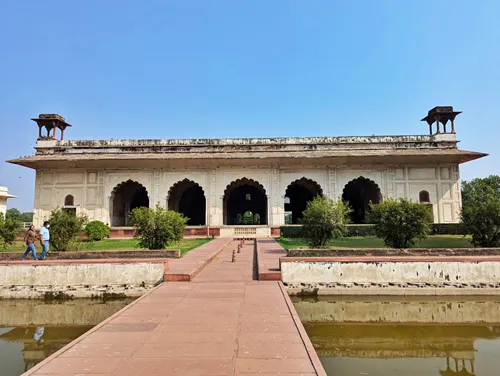
Feature |
Architectural and Historical Significance |
|---|---|
Builder & Date |
Shah Jahan, completed around 1648 CE. |
Primary Function |
Chief residential palace of the Empress (Padshah Begum) and the most important pavilion in the zenana. It was the location for intimate gatherings, celebrations, and royal leisure. |
Name Origin |
The name 'Palace of Colors' was derived from the spectacular decoration of the interiors. Originally, the walls and ceilings were covered with magnificent floral paintings, extensive gold-work (gilding), and inlaid semi-precious gems. The combination of light reflecting off the gold and the vibrant frescoes created a dazzling, multi-hued spectacle. |
Architecture & Facade |
Built entirely of polished white marble, the pavilion is supported by square marble columns. The eastern façade facing the river features the characteristic five scalloped arches. Due to its dual structure, the ground floor was sometimes referred to as the Shish Mahal (Mirror Palace) due to mirrored embellishments designed to multiply the light and water reflections. |
Nahr-i-Bihisht |
The Stream of Paradise (Nahr-i-Bihisht) flowed directly through the very center of the hall, reinforcing the palace's symbolism as a paradise on Earth. This stream was both a cooling mechanism and a crucial element of the interior design. |
The Lotus Fountain (Kamal Mahal) |
The stream culminated in the famous central feature: a large, magnificent white marble lotus fountain. Intricately carved with twelve petals, this fountain was instrumental in circulating the cooling air. Historically, it was sometimes filled with scented water, often perfumed rosewater, which, combined with the sound of the cascading water, enhanced the palace's opulent ambiance and cooling effect. |
Modern Appearance |
While the original gold and gem inlays were plundered after the 1857 Revolt, the white marble structure, and the central channel, known for its superb carving, still allow visitors to appreciate the breathtaking beauty of this private imperial retreat. |
Nahr-i-Bihisht (Stream of Paradise)
The Nahr-i-Bihisht (meaning 'Stream of Paradise'; sometimes spelled: Nahr-e-Behisht) was not just a canal; it was the lifeblood and the defining aesthetic element of the Red Fort's private imperial section (haram and zenana). It was a complex feat of hydraulic engineering that symbolized the Mughal aspiration to create a self-contained paradise (jannat) on earth, directly referencing the description of rivers flowing beneath the gardens of heaven in the Quran.
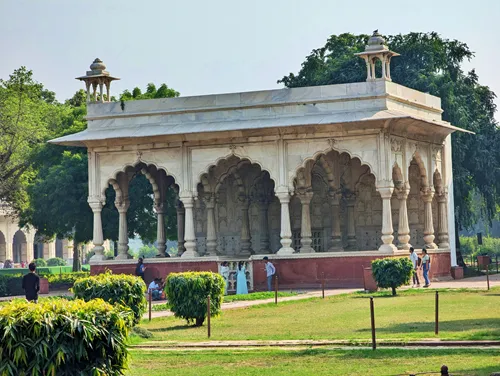
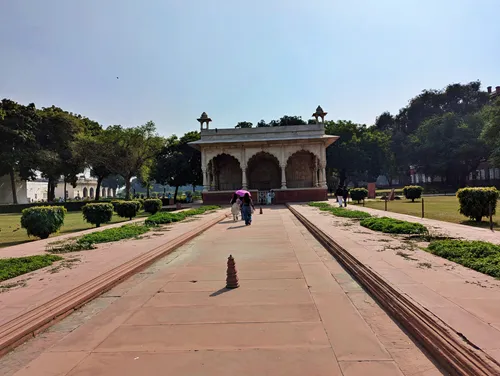
Feature |
Architectural and Symbolic Significance |
|---|---|
Primary Function |
Passive Air Conditioning and Aesthetic Centerpiece. The constant flow of water served as an ingenious source of evaporative cooling, drastically lowering the ambient temperature of the marble halls during Delhi’s intense summer heat. It also provided a soothing visual and auditory backdrop. |
Source & Flow |
The canal was an artificial water channel fed by water drawn from the Yamuna River. It was lifted at the Shah Burj (King's Tower) at the fort’s northern end using advanced Persian water-lifting systems (likely based on the saqiya or waterwheel). |
Course |
From the Shah Burj, the Nahr-i-Bihisht flowed southwards, defining the axis of the entire private palace complex. It ran directly through the center of the most important residential pavilions: the Khas Mahal (Private Palace), the Rang Mahal (Palace of Colors), and the now-demolished Pearl Mosque area. |
Decorative Focus |
In each pavilion, the channel was designed to create different artistic effects. For instance, in the Rang Mahal, it terminated in the beautiful marble lotus fountain (Kamal Mahal), while in the Khas Mahal, it often flowed over carved marble slides (abshar) that created ripple patterns and amplified the cooling sound of running water. |
Symbolism |
The stream reinforced the Persian-Mughal concept of the Chahar Bagh (Four-Part Garden), where water channels divided space and symbolized the four rivers of paradise. The inscriptions above the Diwan-i-Khas famously declare: ‘If there is a paradise on earth, it is this, it is this, it is this.’ The Nahr-i-Bihisht made this claim physically tangible. |
Nahr-i-Bihisht (The more accurate academic spelling):
Nahr: River/Stream
-i- (or -e-): The Izafat, a short vowel sound added in Persian/Urdu to connect two words (like the English ‘of’).
Bihisht: Paradise.
The use of 'i' and 'h' reflects a closer adherence to the original Persian phonetics and spelling conventions often preferred by linguists and academic historians.
Nahr-e-Behisht (The popular and anglicized spelling):
This spelling often uses 'e' for the Izafat sound (as it is phonetically close to an 'e' in many Indian languages) and 'e' in ‘Behisht’ instead of ‘Bihisht.’
This is the spelling most frequently found in popular travel guides, signage, and general conversation because it is often easier for English speakers to pronounce.
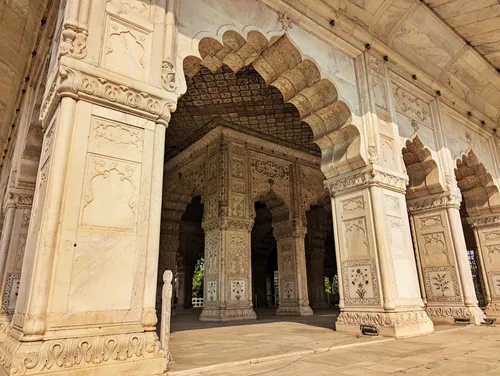
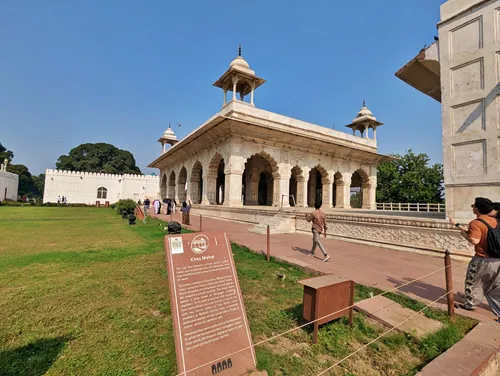
The Khas Mahal (The Private Palace)
The Khas Mahal (meaning 'The Private Palace') was the most exclusive and private section of the Red Fort, serving as the personal residence and administrative nerve center for the Mughal Emperor. Built entirely of polished white marble, this pavilion was the ultimate symbol of imperial luxury and provided the critical space where the ruler interacted with his most trusted officials and, symbolically, with his distant subjects.
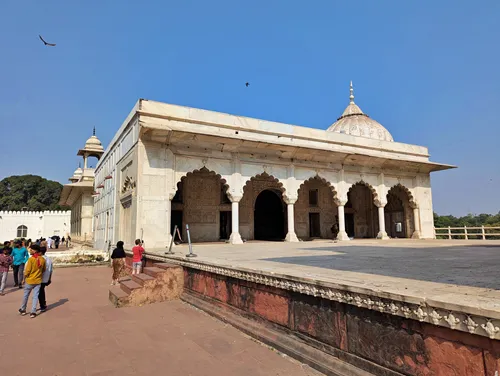
Feature |
Architectural and Historical Significance |
|---|---|
Builder & Date |
Shah Jahan, completed in 1648 CE. |
Primary Function |
The Emperor's personal residence and private administrative offices, occupying the central position on the eastern river-facing wall, flanking the Diwan-i-Khas. |
Material |
Built entirely of high-quality white marble, distinguished by intricate carvings, gilded ceilings, and marble jalis (screens) designed to maintain privacy while maximizing airflow and light. |
Internal Water System |
The central Nahr-i-Bihisht (Stream of Paradise) flowed directly through this private palace, further enhancing its cooling and creating a peaceful, soothing ambiance within the Emperor’s chambers. |
Decoration |
The ceilings and columns were originally adorned with rich gold and floral motifs. The marble panels often bear inscriptions detailing the magnificence of the palace, reinforcing the 'paradise on earth' theme. |
The Khas Mahal complex is divided into three distinct, highly personal sections, reflecting the Emperor's daily schedule of worship, administration, and rest:
1. Khwabgah (The Sleeping Chamber)
Function: The Emperor's ultimate private sleeping chamber. This was the most secluded room in the entire palace, reserved solely for rest and protected by the innermost ring of guards.
Aesthetic: It was designed for simplicity and comfort, often decorated minimally to encourage peace and religious devotion. It was typically covered with rich carpets and fine silks. The architecture focused on maximizing cross-ventilation from the river (Yamuna), using finely carved marble screens (jalis) to filter the sunlight and cooling breezes.
2. Baithak and Musamman Burj (The Sitting Room and Octagonal Tower)
Baithak (Sitting Room): This section served as the Emperor's semi-private administrative office and sitting room. It was here that he would hold private, confidential discussions (Khilwat-i-Khas) with ministers, ambassadors, and generals, away from the formality and scrutiny of the Diwan-i-Khas.
Musamman Burj (Octagonal Tower): Directly adjacent to the Baithak is the projecting, three-story octagonal tower. This tower was the site of the most important daily public ritual: the Jharokha Darshan (Showing of the Emperor to the public). Every morning, the Emperor would appear at the jharokha (balcony) facing the river, allowing the common populace, who gathered on the bank below, to catch a glimpse of their ruler. This ritual was a vital source of public morale and political legitimacy, symbolically connecting the divine ruler to the masses.
3. Taseeh Khana (House of Praise)
Function: A small, highly private room dedicated to the Emperor’s personal worship and religious reflection.
Significance: It was used for private prayer, reading the Quran, or counting the beads of a rosary (tasbih), reinforcing the fact that even the powerful Mughal Emperor maintained a strict personal devotional life. This room's small scale and minimal ornamentation underscore its spiritual, rather than political, function.
The Khas Mahal represents the core of the Emperor's existence, seamlessly blending imperial duty, political governance, and private religious life within a singular, exquisitely crafted marble structure.
Diwan-i-Khas (Hall of Private Audience)
The Diwan-i-Khas (meaning 'Hall of Private Audience') was the most exclusive and sumptuously decorated hall in the entire Red Fort. It was the absolute pinnacle of imperial protocol, reserved only for the most high-stakes meetings: private discussions with the highest nobility (Umara), trusted ministers, diplomatic envoys, and foreign heads of state.
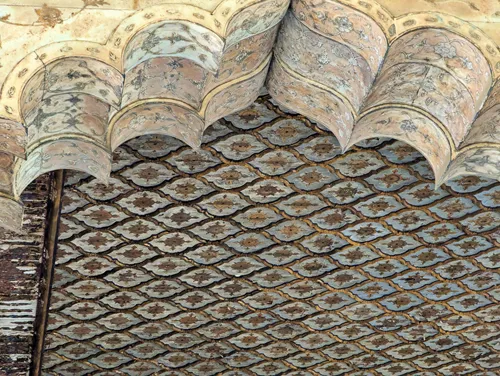
Feature |
Architectural and Historical Significance |
|---|---|
Builder & Date |
Shah Jahan, completed in 1648 CE. |
Function |
Confidential Administration. This was the seat of the Emperor’s inner council, where state policy was formulated, top-secret decisions were made, and royal honors and titles were conferred. |
Architecture & Material |
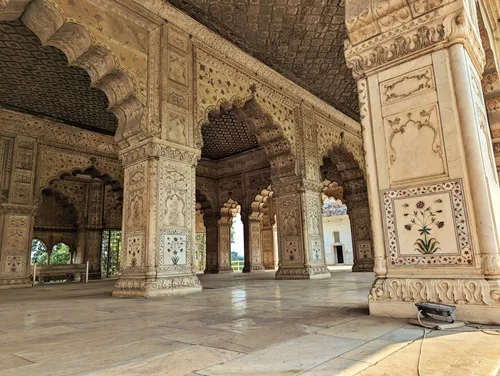
The hall is a breathtaking pavilion, built almost entirely of pure white marble. Unlike the Diwan-i-Aam, the Diwan-i-Khas is smaller, more intimate, and refined. Its structure is defined by its series of graceful, cusped arches that support a flat roof. |
Opulence & Gilding |
The columns, arches, and ceilings were once entirely covered in pure gold gilding and vibrant paint, creating an astonishing spectacle of wealth and power that left foreign dignitaries speechless. The white marble provided a luminous background for this incredible detail. |
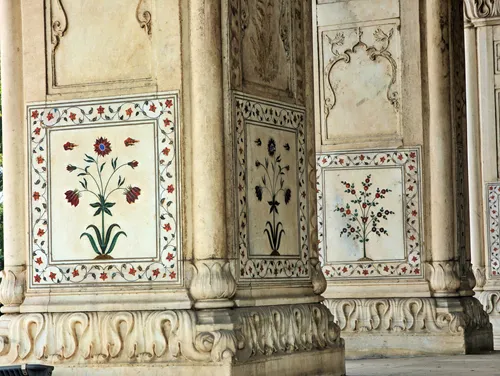
Pietra Dura Inlay |
The marble columns are heavily decorated with spectacular pietra dura (inlaid stone mosaic). These intricate floral motifs—depicting jasmines, poppies, and tulips—were crafted from semi-precious stones (such as carnelian, lapis lazuli, and agate), transforming the structure into a glittering jewel box. |
The Peacock Throne (Takht-e-Taus) |
This hall is the precise spot where the legendary Peacock Throne (Takht-e-Taus) once stood on a raised platform. The throne was one of the most magnificent pieces of furniture ever created, inlaid with thousands of jewels, and valued in the 17th century at nearly twice the cost of the entire Red Fort complex. |
The Paradise Couplet |
The walls of the Diwan-i-Khas famously bear the iconic Persian couplet inscribed in gold: ‘Agar Firdaus bar ru-ye Zamin ast, Hamin ast-o hamin ast-o hamin ast.’ (If there is a paradise on earth, it is this, it is this, it is this). This inscription perfectly encapsulates Shah Jahan’s vision of the Red Fort as a divine, terrestrial paradise. |
Tragic History (The Plunder) |
The opulence was short-lived. As you noted, the fort was captured by the Persian invader Nader Shah in 1739 CE. He looted the palace, seizing both the Peacock Throne and the Koh-i-Noor diamond. The throne was disassembled and carried back to Persia, leaving the Diwan-i-Khas tragically vacant of its most famous artifact. |
The Diwan-i-Khas remains a powerful but haunting shell of its former glory, demanding the visitor to use imagination to fill in the spectacular gold and jewel-encrusted details that once made it the most expensive room in the world.
The Hammams (Royal Baths)
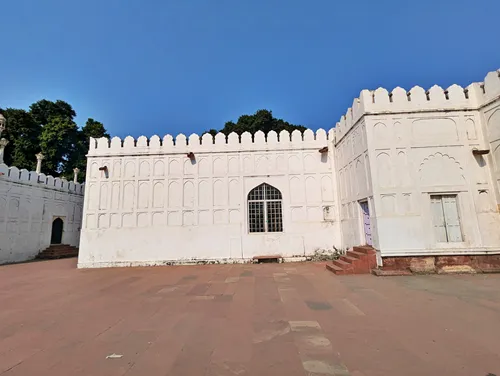
The Hammams (Royal Baths) complex is a fascinating section of the Red Fort, situated just west of the Diwan-i-Khas. This structure was the pinnacle of Mughal luxury and engineering, providing a private, sophisticated royal spa experience reserved exclusively for the Emperor and his most trusted family members.
Feature |
Architectural and Technical Significance |
|---|---|
Builder & Date |
Shah Jahan, completed in 1648 CE. |
Function |
Royal Ablutions and Private Consultations. While primarily for bathing, the high security and intimate nature of the Hammams meant they were often used for highly sensitive political meetings, as eavesdropping was virtually impossible here. |
Architecture & Rooms |
The complex comprises three main marble rooms, separated by thick marble screens (jalis). Each room served a specific purpose: |
Sophisticated Heating |
The Mughals employed an ingenious hydraulic system beneath the marble floors. Water was heated in copper cauldrons built into the western wall. Hot water was then channeled through pipes, warming the floors and generating steam for the vapor baths. |
Climate Regulation |
The thick walls and marble construction were crucial for regulating temperature, keeping the rooms cool in summer and retaining heat in winter. The flooring sloped gently toward drains to ensure efficient removal of water. |
Light and Ambience |
The ceilings of the Hammams are domed, and small star-shaped or floral openings were cut into them. These openings were embedded with thick, colored glass which filtered the natural light. This created a dappled, ambient glow that changed with the time of day, enhancing the luxury and privacy of the bathing ritual. |
Decorations |
The interiors were once richly decorated with pietra dura inlay work, though much of this opulence was removed after 1857. The smooth, polished marble remains, allowing the visitor to appreciate the engineering and artistry of this private sanctuary. |
III. The Gardens, Pavilions, and Auxiliary Structures
Moti Masjid (The Pearl Mosque)
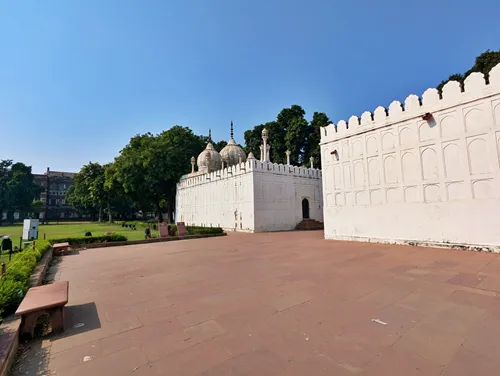
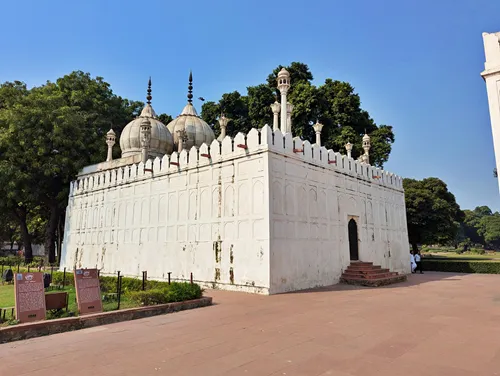
The Moti Masjid (meaning 'The Pearl Mosque') stands in sharp architectural contrast to the surrounding grandeur and secular luxury of Shah Jahan’s Red Fort. Built by his son, Emperor Aurangzeb, this mosque is a powerful statement of religious piety, austerity, and the shift in Mughal aesthetic tastes toward simplicity and orthodoxy.

Feature |
Architectural and Historical Significance |
|---|---|
Builder & Date |
Emperor Aurangzeb, completed in 1660 CE. |
Primary Function |
Emperor's Private Worship. Aurangzeb commissioned this mosque specifically for his personal and private use, as the massive Jama Masjid (the main congregational mosque of the city) was located outside the secure fort walls. |
Architecture & Material |
Unlike the red sandstone and gold-gilded pavilions of his father, the Moti Masjid is built entirely of pure white marble. Its small scale and simple, yet elegant, form underscore the difference between his reign and the extravagant reign of Shah Jahan. |
Aesthetic of Austerity |
The mosque’s style is intentionally subdued and simple. It relies almost entirely on the material itself—the flawless white marble—and its refined lines, perfect symmetry, and proportional harmony, rather than the heavily ornate pietra dura or excessive carving seen elsewhere in the fort. This simplicity symbolizes Aurangzeb's emphasis on religious austerity and his less lavish court customs. |
The Courtyard |
The courtyard is small and enclosed, maintaining a high level of privacy. It features a central marble basin for ritual ablutions (wazu). The prayer hall is accessed via three arched openings. |
The Domes |
The structure is crowned by three distinctive bulbous domes that were originally covered in gilded copper plates (now removed). The subtle, refined curves of the domes contribute significantly to the mosque's elegant profile. |
Orientation |
The prayer hall is oriented toward the Qibla (the direction of Mecca, to the west), featuring a simple mihrab (niche) that indicates the direction of prayer. |
The Hira Mahal (Diamond Palace)
The Hira Mahal (meaning 'Diamond Palace') is one of the smaller, later pavilions within the Red Fort, but its history is deeply tied to the twilight years of the Mughal Empire. It serves as a poignant reminder of the architectural shift towards simpler, recreational structures built by the last reigning emperors.
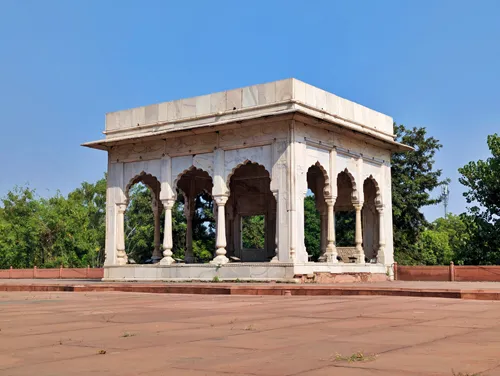
Feature |
Architectural and Historical Significance |
|---|---|
Builder & Date |
Bahadur Shah Zafar, built during the early 19th century (c. 1820s-1830s). |
Context |
Built nearly 200 years after the fort's completion, the Hira Mahal reflects the significantly diminished resources and political power of the late Mughal emperors, particularly Bahadur Shah Zafar, the last Emperor. |
Primary Function |
Recreational Retreat. It was designed simply as a baradari (a pavilion with twelve doors or arches) to serve as a private spot for the Emperor to relax, hold informal gatherings of poets and artists, and enjoy the cool river breeze from the adjacent Yamuna River. |
Architecture & Material |
The structure is a small, rectangular, single-story pavilion built primarily of white marble. In contrast to the heavy inlay and gold work of Shah Jahan’s time (e.g., Diwan-i-Khas), the Hira Mahal relies on minimalist decoration and refined lines. Its beauty is derived from the elegance of the pure marble itself, emphasizing light and open space. |
Location & View |
It is strategically located near the eastern wall of the fort, directly overlooking the river. This placement was essential for its function, maximizing the exposure to the cooling flow of the water and the open view, which was prized by the court. |
The Name Legend |
While the palace is visually simple, the name 'Diamond Palace' is believed to refer to the exquisite quality of the marble used in its construction, or perhaps a small, jewel-like fountain or decorative element that once adorned its center. |
Modern View |
While the Yamuna River has long since shifted its course away from the fort walls, standing at the Hira Mahal still provides a commanding perspective of the walls and the now-dry moat, allowing you to imagine the bustling river traffic the emperors once watched. |
The Shah Burj (Emperor's Tower)
The Shah Burj (meaning 'Emperor's Tower') is arguably the most vital, yet often overlooked, structure in the entire Red Fort complex. Located at the northernmost corner of the palace, this majestic, three-story octagonal tower was the head of the fort's elaborate engineering and a highly restricted area of imperial function.
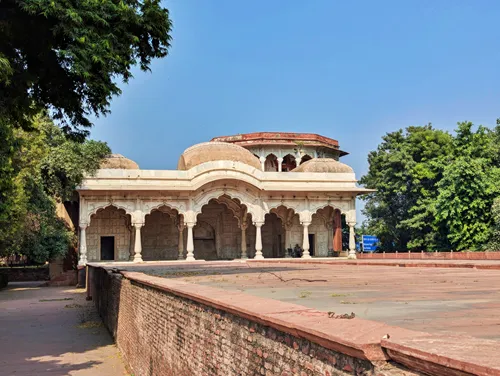

Feature |
Architectural and Technical Significance |
|---|---|
Builder & Date |
Shah Jahan, completed in 1648 CE. |
Primary Function |
Hydraulic Command Center and Private Study. The upper level served as the Emperor’s private study (Taseeh Khana), offering commanding, panoramic views of the Yamuna River, which once flowed right along the fort wall. |
The Hydraulic Head |
Crucially, the Shah Burj was the origin point of the entire Nahr-i-Bihisht (Stream of Paradise). It housed the sophisticated water-lifting system (likely Persian saqiya or waterwheels) that drew water up from the adjacent Yamuna River. |
Water Distribution |
The water was lifted and then channeled through a complex system of ducts and reservoirs in the tower. From the Shah Burj, the Nahr-i-Bihisht began its long, cooling journey, flowing directly south along the eastern wall to supply the Khas Mahal, Rang Mahal, and the rest of the private apartments. This made the tower the life-giving source for the entire palace complex. |
Architecture |
The tower is a beautifully constructed marble and red sandstone structure. The upper chamber features decorative work and marble screens (jalis). Historically, a massive stone waterslide was located nearby, used to cascade the water from the top level into the Nahr-i-Bihisht channel below, adding sound and aeration. |
Ceremonial Significance |
Due to its private, northern location, the Shah Burj was also used for intimate farewells and ceremonies involving the Emperor and the most senior members of the court, far from the public gaze of the Diwan-i-Aam. |
Later Changes |
The original structure was slightly damaged and later modified by Aurangzeb and Bahadur Shah Zafar, but its function as the hydraulic core remained consistent until the river shifted its course centuries later. |
The Shah Burj beautifully illustrates that the Red Fort was not just a collection of palaces but a highly functional, engineered system where the control of water—both practical and symbolic—was paramount to Mughal power and luxury.
Zafar Mahal (The Victory Palace)
The Zafar Mahal (meaning 'The Victory Palace') is one of the latest additions to the Red Fort, commissioned by the last Mughal Emperor, Bahadur Shah Zafar. It provides a poignant counterpoint to the massive structures built by Shah Jahan, reflecting the decline of the empire and a shift toward small, romantic, and purely recreational architecture.
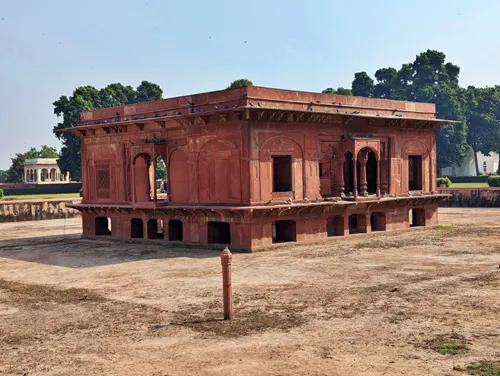
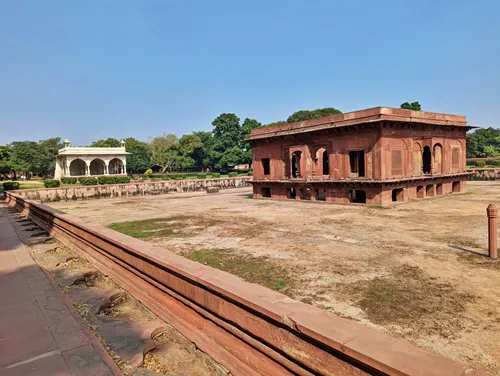
Feature |
Architectural and Historical Significance |
|---|---|
Builder & Date |
Bahadur Shah Zafar (Bahadur Shah II), built during the early to mid-19th century. |
Context |
Built when the Mughal Emperor’s authority was largely symbolic, confined mostly to the walls of the Red Fort and dependent on the rising power of the British East India Company. |
Primary Function |
Leisure and Aesthetics. The palace was designed exclusively as a summer pavilion for relaxation, poetic mushairas (gatherings), and enjoying the beautiful scenery of the surrounding Hayat Bakhsh Bagh (Life-Bestowing Garden). |
Architecture |
The Zafar Mahal is a small, two-story structure built primarily of red sandstone. Its simple baradari (open-sided pavilion) form is characteristic of late-Mughal style, prioritizing openness and air circulation over defensive strength or elaborate inlay. |
Unique Location |
Its most unique feature is its placement: it is located right in the middle of a large central pool (tank) within the Hayat Bakhsh Bagh. This ‘island palace’ design maximized the cooling effect of the water and added a romantic, decorative focal point to the garden complex. |
Access |
The pavilion was accessible only via a thin marble bridge that crossed the pool, underscoring its private and exclusive nature as a retreat for the Emperor. |
Symbolism of Decline |
While beautifully situated, its small scale and use of painted red sandstone (rather than the pure marble and pietra dura of the Diwan-i-Khas) demonstrate the dramatic depletion of the royal treasury and the artistic output of the 19th-century Mughal court. |
Bhadon Pavilion
Standing as the mirror image of the Sawan Pavilion, the Bhadon Pavilion completes the architectural symmetry of the Hayat Bakhsh Bagh. This pavilion focuses on the sensory experience of the monsoon's full intensity, providing a space for the Emperor to appreciate the season's mature phase.
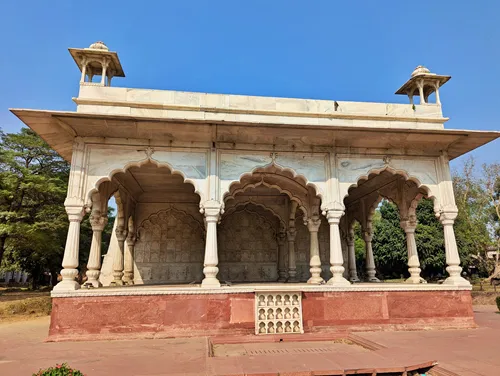

Feature |
Architectural Significance |
|---|---|
Name Meaning |
Named after the Hindu month of Bhadon (approximately August–September), which marks the heavy, sustained period of the late monsoon and agricultural bounty. |
Function |
Used interchangeably with the Sawan Pavilion, this was a sheltered spot where the Mughal court could relax and host intimate gatherings, protected from the rain while still enjoying the cool, humid air. |
Architecture |
A white marble structure that matches the Sawan Pavilion in scale and basic design, emphasizing the Mughal reliance on perfect architectural twins to frame a central view (in this case, the central garden). |
The Water Curtain |
The Bhadon Pavilion is famed for its ingenious use of a central water chute (or slide) and deep basin. Water would cascade down carved marble panels—often referred to as an abshar (waterfall) or ‘water curtain’—that were grooved to create a sound and visual effect akin to heavy, continuous rain. |
Acoustic Detail |
The complex system of spouts, chutes, and shallow pools in and around the pavilion was deliberately engineered not just for cooling, but for the acoustic effect—recreating the therapeutic sound of a downpour, a highly valued luxury in the scorching Delhi heat. |
The Experience: Together with its twin, the Bhadon Pavilion perfectly encapsulates the Mughal pursuit of paradise on Earth, where controlled water flow symbolized both wealth and divine favor.
The Sawan Pavilion: A Symphony of the Early Rains
The Sawan Pavilion is the second half of the celebrated pair of twin pavilions situated at the southern end of the Red Fort's beautiful Hayat Bakhsh Bagh (Life-Bestowing Garden). It is an exquisite example of how Mughal builders used architecture and water engineering to conquer the oppressive Delhi heat and celebrate the arrival of the monsoon.
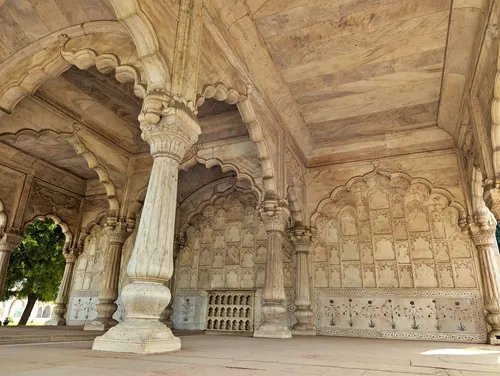
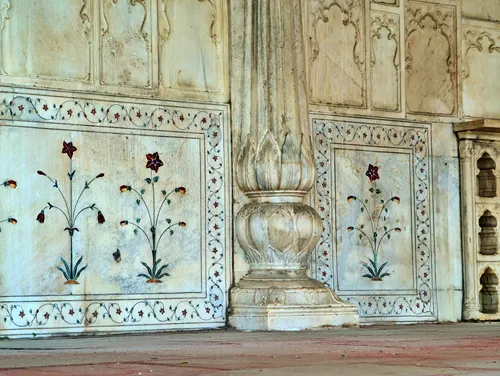
Feature |
Architectural Significance |
|---|---|
Name Meaning |
Named after the Hindu month of Sawan (approximately July–August), which signifies the first, dramatic arrival of the monsoon and is traditionally a time of celebration and romance. |
Function |
This was the Emperor's primary summer retreat. The Diwan-i-Khas was used for dry-weather official business, but the Sawan and Bhadon pavilions served as royal lounges for seasonal pleasure and viewing the garden. |
Architecture |
Built entirely of white marble, the pavilion is characterized by its three elegant, receding arches and flat roof. Its design is virtually identical to its twin, the Bhadon Pavilion, symbolizing the perfect symmetry and balance sought by Shah Jahan. |
Water Engineering |
The Sawan Pavilion was key to the Nahri-Bihisht (Stream of Paradise) water system. When the pavilion was active, water was lifted from the Yamuna River, channeled through the Diwan-i-Aam and the Diwan-i-Khas, and released here. It featured a complex system of perforated screens and cascades that allowed water to spray gently, creating a mist and the illusion of rain. |
Unique Aesthetic |
According to historical accounts, the water channels and carved marble surfaces were sometimes designed or inlaid with material that would create colored light effects (perhaps using colored glass or gems), simulating flashes of lightning or the iridescent glow of the early monsoon sky. |
The Experience: When standing here, try to imagine the roaring sound of the water cascades, the cooling mist, and the lush greenery of the surrounding garden, providing relief from the summer sun.
Hayat Baksh Bagh (The Life- Bestowing Garden)
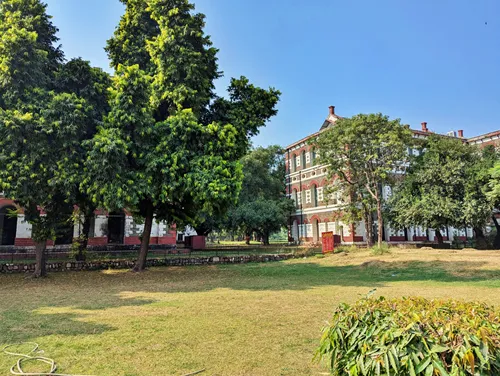
The Hayat Bakhsh Bagh (meaning 'The Life-Bestowing Garden') was the largest and most magnificent Mughal garden within the Red Fort complex, situated at the northern end of the private imperial enclosure. Designed as the ultimate expression of paradise on earth, this extensive garden was crucial to the architectural identity of the fort, providing the vital element of nature amidst the rigid marble palaces.
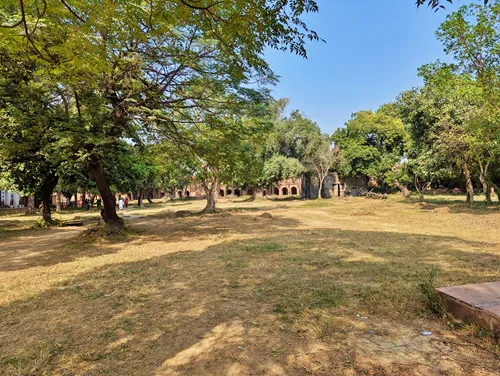
Feature |
Architectural and Symbolic Significance |
|---|---|
Builder & Date |
Shah Jahan, completed in 1648 CE. |
Design Style |
The garden was laid out in the classic Chaharbagh (Four-Part Garden) style. This highly geometric and symmetrical Persian design symbolically represents the four gardens of paradise, divided by four radiating water channels. |
The Water Grid |
The garden served as the aesthetic continuation of the Nahr-i-Bihisht (Stream of Paradise). The main water channel flowed through the garden, feeding hundreds of small fountains, tanks, and shallow water beds, filling the air with sound and providing vital moisture. |
Aesthetic Elements |
The paths were lined with formal plantings of ornamental trees, fragrant flowers, and flowering shrubs. Historical accounts describe marble walkways, raised platforms for relaxation, and carefully manicured lawns, offering a tranquil and climate-controlled retreat from the court’s rigidity. |
The Twin Pavilions |
The garden is architecturally framed by the twin royal residences of Sawan and Bhadon Pavilions, located at the northern and southern ends of the garden's central axis. These white marble structures were named after the monsoon months and were specifically designed to use elaborate water features (cascades and screens) to enhance the illusion of perpetual rain and mist. |
The Zafar Mahal |
In the later Mughal period, the Zafar Mahal was constructed by Bahadur Shah Zafar as an elegant red sandstone pavilion, located right in the middle of a large central pool within the Hayat Bakhsh Bagh, adding a new, recreational focal point to the garden. |
Historical Damage |
Sadly, the garden suffered immense destruction after the 1857 Revolt. The British leveled most of the landscape to make way for barracks and parade grounds. |
Modern Status |
While the complex layout is largely intact, the current garden is a partially restored version of its original glory. Visitors today can still appreciate the grand scale of the original design, the layout of the water channels, and the elegance of the remaining pavilions. |
The Red Fort Baoli (Stepwell)
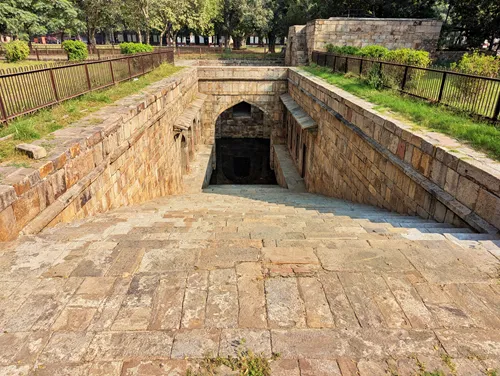
The Red Fort Baoli (Stepwell) is an anomalous and historically complex structure within the Mughal palace. Unlike the pristine white marble pavilions built by Shah Jahan, this large, ancient water system is built of rougher materials and represents a vital continuity with the earlier structures and settlements of the region.
Feature |
Architectural and Historical Significance |
|---|---|
Builder & Date |
Unknown, believed to pre-date the Red Fort (pre-1639 CE). It likely belongs to the earlier Salimgarh Fort structure adjacent to the site. |
Location |
Situated in the highly strategic northwest corner of the fort, near the ramparts and closer to the main defensive walls. |
Primary Function |
Water Security and Storage. The baoli (stepwell) is a traditional Indian architectural solution for accessing and storing groundwater, connecting directly to the local aquifer. It provided a crucial emergency water supply that was secure from siege. |
Architecture |
The baoli is a multi-level construction built primarily from rubble, mortar, and ashlar stone, contrasting sharply with the finely cut red sandstone of the palace walls. Its structure features descending flights of steps that allow access to the water level regardless of the season or water depth. |
Ingenious Cooling |
Like all stepwells, its structure is inherently designed for passive cooling. The thick walls and its underground depth maintain a consistent, cool temperature, preserving the water quality and providing a surprisingly cool resting spot on its upper landings. |
Historical Continuity |
Its survival during Shah Jahan's extensive construction projects suggests its continued vital importance as an essential water source that could not be easily replaced or demolished. It stands as a physical link to the land's history before the Mughals. |
Post-Mughal Use |
Following the 1857 Revolt and the British takeover of the fort, the baoli was heavily utilized by the British garrison as their primary source of safe, cool water, proving its engineering resilience centuries later. |
Modern Status |
Today, the well is protected by a locked gate and is often partially flooded, but its deep, multi-tiered structure remains visible, reminding visitors of the fundamental, crucial need for water that drove all architecture in the region. |
The Delhi Gate
The Delhi Gate is the formidable southern entrance of the Red Fort and serves as the fort's secondary public access point. While the Lahori Gate (facing west) was the ceremonial entrance connecting to the city's main thoroughfare, the Delhi Gate played a vital, more logistical role, connecting the palace complex to the older city settlements to the south.
Feature |
Architectural and Historical Significance |
|---|---|
Builder & Date |
Shah Jahan, completed in 1648 CE. |
Location & Orientation |
Located on the southern wall of the fort, this gate is oriented toward the ancient city of Delhi (specifically, the ruins of Firoz Shah Kotla and Purana Qila). |
Primary Function |
Public and Military Access. The Delhi Gate was the primary point of entry and exit for the Mughal army, common people, court servants, and the movement of goods and supplies, making it a critical, functional gateway. |
Architecture & Scale |
Architecturally, it is similar in scale and defensive design to the Lahori Gate. It is a massive, multi-story structure built of red sandstone, featuring high, thick defensive walls, colossal arched portals, and is flanked by two impressive semi-octagonal towers (burj). |
Ceremonial Distinction |
The key difference between the Delhi and Lahori Gates lay in their use. The Lahori Gate was strictly reserved for the Emperor's formal, ceremonial entries, and processions; the Delhi Gate was used for more public and daily logistical traffic. |
Aurangzeb’s Barbican |
Like the Lahori Gate, the Delhi Gate was later fortified by Emperor Aurangzeb with an outer defensive wall, or barbican, which projects forward. This defensive structure forces any approaching traffic to navigate sharp turns before entering the main gate, severely hindering the approach of any invading force. |
White Marble Details |
The massive structure is crowned with small white marble chhatris (pavilions) and miniature marble elephants, adding a delicate contrast to the rougher red sandstone base. |
Modern Importance |
The area immediately outside the Delhi Gate once contained important administrative offices and the imperial parade grounds. Today, it remains an important functional gateway, though most tourists enter via the Lahori Gate. |
The Evening Red Fort Light and Sound Show (Sone-et-Lumiere)
A highly recommended way to end your day is by attending the Red Fort Light and Sound Show. The show is an engaging evening spectacle designed to bring the nearly 400 years of Mughal history to life against the magnificent backdrop of the fort's main façade. The theatrical narrative captures the rise, zenith, and eventual decline of the Mughal Empire in Delhi.
The Narrative Arc: The story focuses primarily on the lives of the emperors who ruled from the Red Fort, emphasizing figures like Shah Jahan (the builder), Aurangzeb (the puritanical successor), and Bahadur Shah Zafar (the last emperor). It uses poetic language and historical dialogue to convey the grandiosity and the subsequent tragedy of the empire.
Visual Impact: While the technology is generally well-executed, the real star is the fort itself. The lights dramatically highlight the intricate details of the Lahori Gate and the adjacent walls, emphasizing their scale and texture.
Language: The show is presented in both Hindi and English, usually on separate days or at different time slots. Be sure to check the current schedule to attend the show in your preferred language.
Practical Considerations
Booking: It is highly advisable to check the current showtimes and book your tickets in advance, especially during the peak tourist season, as seating capacity is limited and the schedule changes with the seasons (due to sunset times).
Alternatively, you can book tickets via Viator, GetYourGuide and Tripadvisor.Seating: The seating area is outdoors. While the experience is generally comfortable, be sure to bring water and a light jacket, as Delhi evenings can cool down, and the show lasts approximately 60 minutes.
Photography: Given the low light, photography can be challenging, so maybe just enjoy soaking in the atmosphere and history.
Back to the Day 1 Walking Tour
Back to the Day 2 Walking Tour
Where do you want to go now?






Author: Rudy at Backpack and Snorkel
Bio: Owner of Backpack and Snorkel Travel Guides. We create in-depth guides to help you plan unforgettable vacations around the world.

Other popular Purple Travel Guides you may be interested in:
Like this Backpack and Snorkel Purple Travel Guide? Pin these for later: