The Tower of Victory: A Detailed Guide to Exploring Qutub Minar | India Purple Travel Guide
(map, reviews)
This is Premium Content! To access it, please download our
Backpack and Snorkel Purple Travel GuideThe Qutub Minar complex in Delhi is rightfully a UNESCO World Heritage site. While the magnificent tower commands all attention, the minar is only one of many powerful illustrations of early Islamic architecture in India and the literal foundation stone of the Delhi Sultanate. We consider this an absolute must-visit for anyone interested in history, architecture, or the unique cultural confluence that defined North India.
Here at Backpack and Snorkel Travel Guides, we promote self-guided walking tours.
But we realize that not everybody likes to walk by themselves in a foreign city. So, just in case that you rather go with ab guide: NO PROBLEM! Please see the GuruWalk and Viator tours below.
free GuruWalk tours
paid Viator tours
Why You Should Visit
While the Taj Mahal is a monument to love, the Qutub Minar is a monument to power and a literal foundation stone for the Islamic influence in India. It stands as the earliest surviving example of this architectural style in the subcontinent.
Visiting the complex provides a unique journey through time, allowing you to witness the transition from local Hindu and Jain traditions to a new, Persian-influenced aesthetic. The site is also home to the famous Iron Pillar, an enduring scientific mystery.
Admission and Opening Hours
Opening Hours: daily 6:00 AM to 8:00 PM
Admission: ₹35 for Indian Citizens; ₹550 for Foreign Tourists
History: A Monument to Conquest
The complex’s history is rooted in a moment of decisive victory and architectural repurposing:
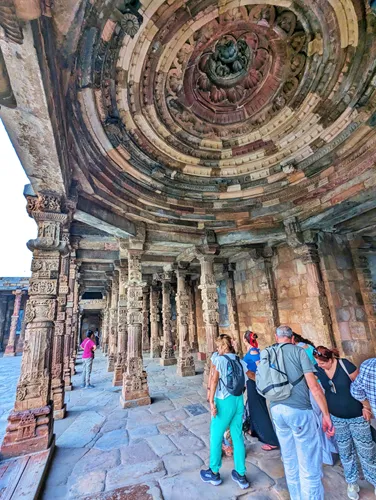
The Early Phase (1192 - 1220 CE): Construction began in 1192 CE by Qutb-ud-din Aibak, the founder of the Mamluk Dynasty and the first Sultan of Delhi, to celebrate his victory over the last Hindu kingdom in the area. This is why the tower is often referred to as a Tower of Victory. Aibak started the minar and built the Quwwat-ul-Islam Mosque (Might of Islam Mosque), the oldest mosque in North India. Crucially, the mosque was built using the materials, columns, and structural elements of twenty-seven Hindu and Jain temples that were deliberately destroyed on the site.
Expansion (1220 - 1369 CE): The tower was significantly enlarged and completed by Aibak’s successor and son-in-law, Iltutmish. Later rulers, like Firoz Shah Tughlaq, continued to repair and add to the structure following damage from lightning strikes.
Modern Importance: The site offers a glimpse into the very beginning of the Delhi Sultanate, demonstrating how early Muslim rulers adapted, repurposed, and transformed existing architectural and religious materials to forge a new capital.
What You Can See: Architectural Marvels
The complex is vast and rich with detail. Allow at least two hours to explore everything.
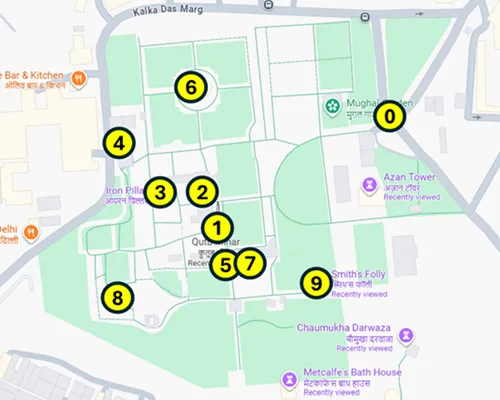
0 = Entrance
1 = Qutub Minar
2 = Quwwat-ul-Islam Mosque
3 = Iron Pillar
4 = Tomb of Sultan Shamsuddin Iltutmish
5 = Alai Darwaza
6 = Alai Minar
7 = Tomb of Imam Zamin
8 = Ala-ud-din Khilji's Madrasa
9 = Smith's Folly
The Qutub Minar
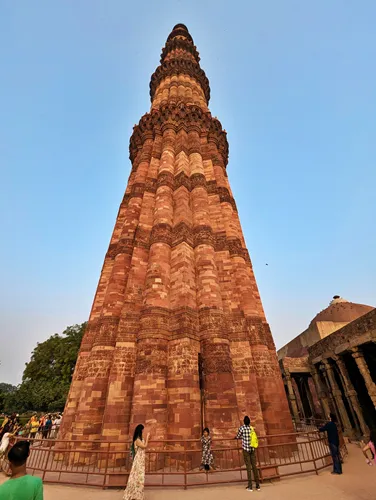
The star attraction is the tallest brick minaret in the world, standing at 240 ft (73 m) high. Its five stories tell a long and complicated story of ambition, repair, and shifting architectural styles across three different reigns.
Construction Timeline and Meaning
Reign |
Construction Details |
Architectural Style & Meaning |
|---|---|---|
Qutb-ud-din Aibak (1192–1199 CE) |
Began construction and completed only the first story (base) of the tower. |
Built as a Minar of Victory (or 'Tower of Triumph') to mark the establishment of Muslim rule in Delhi. It was also used by the muezzin to call the faithful to prayer at the adjacent Quwwat-ul-Islam Mosque. |
Iltutmish (1211–1236 CE) |
Added the second, third, and fourth stories, nearly completing the structure. |
He solidified the tower's architectural language, ensuring the Minar remained a symbol of the flourishing Delhi Sultanate. |
Firoz Shah Tughlaq (1351–1388 CE) |
The original fourth story was damaged by lightning. He repaired the damage and added a fifth and final story. |
Tughlaq added the final story using white marble, differentiating it from the red sandstone base and giving the Minar its distinctive multi-era appearance. |
Architectural Details: The Five Stories
The minar is a fascinating study in layered architecture, with each section visually communicating its builder and era:
The First Three Stories (Aibak & Iltutmish): These sections are constructed entirely from red and buff sandstone. The most striking feature here is the alternating fluting—the vertical projections that line the exterior. The first story features a pattern of alternating angular (star-shaped) and circular flutes. The second story features only circular flutes, and the third only angular flutes. This rhythmic pattern gives the Minar its distinct texture.
The Upper Two Stories (Tughlaq): The fourth and fifth stories, added by Tughlaq after the lightning strike, use a combination of white marble and sandstone. They are cylindrical and relatively plainer, providing a clear visual break from the dense carving of the lower levels.
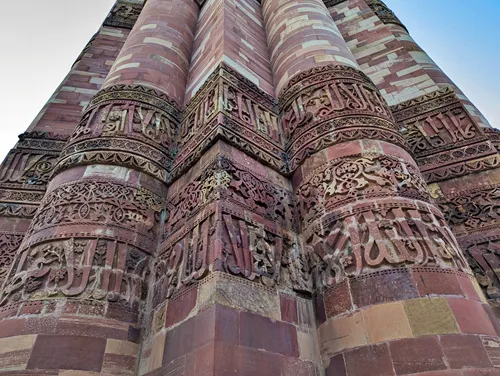
Inscriptions: Look closely at the bands circling the exterior. These contain hundreds of intricate carvings featuring verses from the Quran in the elegant Kufic and Nashk scripts, alongside historical records documenting the tower's construction, repair, and the name of its builder, Qutb-ud-din Aibak, and his successors, Iltutmish and Firoz Shah Tughlaq.
The Quwwat-ul-Islam Mosque (Might of Islam)
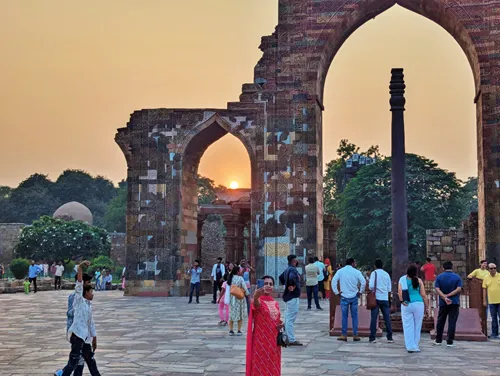
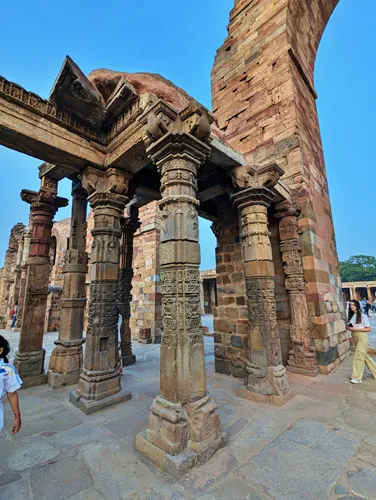
The Quwwat-ul-Islam Mosque (meaning 'Might of Islam') is perhaps the most historically charged structure in the complex. It stands as the oldest surviving mosque in North India and is the location where Hindu and Islamic architectural traditions violently collided.
Feature |
Detail and Significance |
|---|---|
Builder & Date |
Qutb-ud-din Aibak, c. 1193 CE. |
Origin |
Built immediately after Aibak's conquest of Delhi, it served as the primary congregational mosque of the newly founded Delhi Sultanate. |
The Repurposed Pillars |
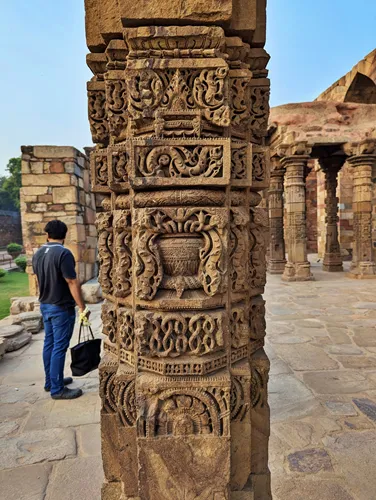
Aibak openly used the materials from twenty-seven Hindu and Jain temples that were destroyed on the site. Walk the perimeter of the courtyard and observe the original temple columns: they are stacked on top of each other and feature traditional Hindu carvings (such as goddesses, bells, and foliage). |
Aniconism & Defacement |
The Hindu carvings were often crudely plastered or defaced in accordance with Islamic tradition, which forbids the depiction of living creatures or idols (aniconism). This defacement is one of the most powerful visual testimonies to the cultural clash of the period. |
Iltutmish’s Great Screen |
The most beautiful feature is the towering, central stone screen constructed by Iltutmish. This screen, built in the classic Islamic style, features exquisite Arabic calligraphy of Quranic verses and magnificent geometric and floral motifs, designed to symbolically face Mecca. It perfectly frames the old Hindu pillars behind it, showcasing the dramatic architectural transition. |
The Iron Pillar (A Scientific Mystery)
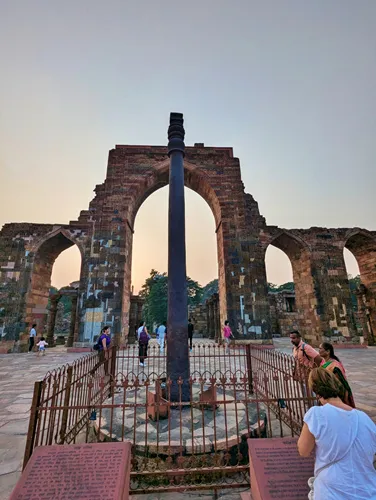
Standing proudly in the courtyard of the Quwwat-ul-Islam Mosque is a metallurgical anomaly—the Iron Pillar—a scientific marvel far older than the monuments surrounding it.
Feature |
Detail and Significance |
|---|---|
Origin & Date |
Originally erected elsewhere (possibly Udayagiri, Madhya Pradesh) in the 4th century CE during the Gupta Empire, a Hindu dynasty. It was moved to Delhi by the Tomar king Anangpal in the 11th century. |
Height & Material |
It stands approximately 23 ft (7.2 m) tall and weighs over six tons. It is composed of 99.72% wrought iron. |
The Scientific Mystery |
The pillar has stood for over 1,600 years without significant rust, defying normal corrosive processes. Scientists determined that the secret lies in the ancient Indian method of iron smelting, which produced a metal with an unusually high phosphorus content. This, combined with specific atmospheric conditions in Delhi, created a protective layer of iron hydrogen phosphate on the surface, preventing further corrosion. |
Inscriptions |
The earliest inscription on the pillar is in Sanskrit (Brahmi script) and is dedicated to a powerful king named Chandra, widely believed to be the great Gupta emperor, Chandragupta II. |
Visitor Tip |
The pillar is fenced off to protect it from the oils and damage caused by human hands. Visitors once attempted to encircle it backward with their arms for good luck. |
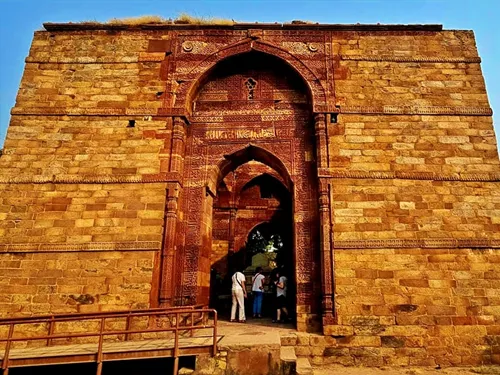
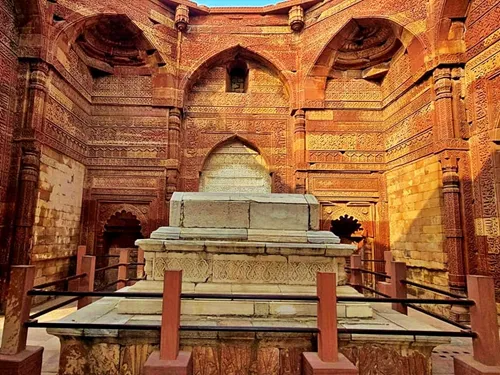
Tomb of Sultan Shamsuddin Iltutmish
Tucked away in the northwest corner of the complex, this tomb (built c. 1235 CE) is an exceptionally important architectural landmark, marking the beginning of the funerary tradition of the Delhi Sultanate.
Feature |
Detail and Significance |
|---|---|
Builder & Date & Date |
Built by Iltutmish for himself around 1235 CE. |
Significance |
This is the first surviving Islamic tomb built in India. Its introduction established a new architectural category in the subcontinent. |
Architecture |
The tomb is a square chamber, entirely built of red sandstone. Critically, the original dome collapsed long ago. likely due to the architect's inexperience with the weight distribution required for a true dome. The absence of the dome allows light to pour directly onto the cenotaph. |
Interior Detail |
The interior is its main marvel. The walls are covered entirely in intricate, deep carvings that demonstrate a beautiful and intense integration of styles. You will find: Quranic calligraphy and geometric patterns (Islamic style) intricately blended with the traditional Indian motifs of lotuses and wheels carved by local artisans. |
The Alai Darwaza
The magnificent southern gateway to the mosque was commissioned much later by the powerful second ruler of the Khilji Dynasty, Ala-ud-din Khilji.


Feature |
Detail and Significance |
|---|---|
Builder & Date & Date |
Ala-ud-din Khilji, completed in 1311 CE. |
Significance |
It is considered one of the finest examples of early Indo-Islamic architecture. It represents a stylistic leap, as it was built by purely Muslim craftsmen (unlike the Quwwat-ul-Islam Mosque), demonstrating their full mastery of Islamic forms. |
Architecture |
The gateway is built primarily of red sandstone, richly inlaid with white marble. It is a perfect square structure, featuring a masterful, almost-perfect true dome—a key architectural achievement that solved the structural problems of earlier attempts like the one over Iltutmish's tomb. |
Arches |
Look for the beautifully symmetrical pointed arches (or horseshoe arches), which are richly decorated with lattice screens. The Darwaza features exquisite carvings that blend geometric precision with floral designs. |
Alai Minar and Other Ruins
Beyond the main attractions, the complex contains significant ruins that showcase the ambitious projects of Ala-ud-din Khilji and other rulers.
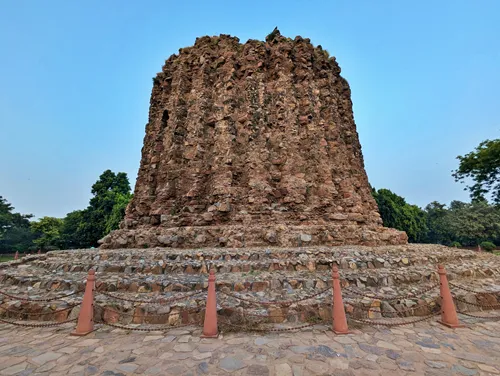
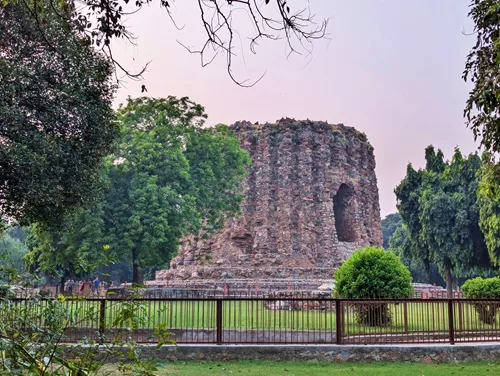
Alai Minar
Builder & Date: Ala-ud-din Khilji, c. 1311 CE.
Detail and Significance: The 'Minar of Ambition.' Khilji aimed to build a tower twice the size of the Qutub Minar. However, only the first massive story (80 ft / 24.5 m) was completed before his death in 1316 CE, and the project was abandoned. It stands as a powerful, rugged stub—a monument to unfinished ambition.
Tomb of Imam Zamin
Builder & Date: Imam Zamin, c. 1539 CE.
Detail and Significance: A beautiful, smaller tomb located just outside the Alai Darwaza. Built during the late Lodhi period, it features elegant white stucco work and is a fine example of later Indo-Islamic architecture.
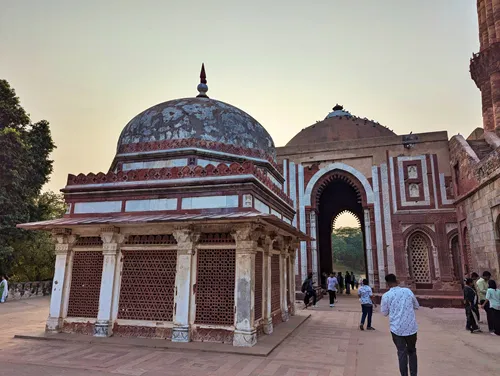
Ala-ud-din Khilji's Madrasa
Builder & Date: Ala-ud-din Khilji, c. 1316 CE.
Detail and Significance: This is a partially ruined religious college (madrasa) attached to the back of Khilji's tomb, providing insight into the educational institutions of the Sultanate.
Smith's Folly
Builder & Date: Major Robert Smith, 1828 CE.
Detail and Significance: A small cupola (dome) that was added to the top of the Qutub Minar during British-era repairs. It was later removed and placed on the lawns of the complex where it now rests, earning the nickname 'Smith's Folly' from locals who thought it looked ridiculous atop the ancient tower.
Back to the Day 1 Walking Tour
Back to the Day 2 Walking Tour
Where do you want to go now?




Author: Rudy at Backpack and Snorkel
Bio: Owner of Backpack and Snorkel Travel Guides. We create in-depth guides to help you plan unforgettable vacations around the world.

Other popular Purple Travel Guides you may be interested in:
Like this Backpack and Snorkel Purple Travel Guide? Pin these for later: