Lodhi Art District: Delhi's Open-Air Gallery | India Purple Travel Guide
(map, reviews, website)
This is Premium Content! To access it, please download our
Backpack and Snorkel Purple Travel GuideThe Lodhi Art District is a relatively new phenomenon in Delhi's urban landscape, transforming a collection of mundane government buildings into India's first-ever dedicated public street art district. It is a stunning display of contemporary creativity, acting as a vibrant canvas for artists from India and around the world.

Here at Backpack and Snorkel Travel Guides, we promote self-guided walking tours.
But we realize that not everybody likes to walk by themselves in a foreign city. So, just in case that you rather go with ab guide: NO PROBLEM! Please see the GuruWalk and Viator tours below.
free GuruWalk tours
paid Viator tours
Gerneral Information About The Lodhi Art District
Admission Fee: Free. The entire district is a public street, and there is no entry fee.
Opening Hours: Always Open (24/7). Since it is a residential area, it is best visited during daylight hours (9:00 AM – 6:00 PM) for the best light and to respect the residents.
Best Time to Visit: Mornings (10:00 AM – 1:00 PM) or Late Afternoons. Early morning light is excellent for photography, and the late afternoon provides cooler temperatures.
Footwear: Comfortable walking shoes are essential, as the best way to explore is by walking block-to-block.
Time Needed: Budget 60 to 90 minutes for a thorough walk-through of the main blocks, or a 10-20 min tuk-tuk ride along the main streets.
Facilities: Public restrooms are scarce. Plan to use facilities at one of the many cafes in the nearby market areas.
Important Tip: Do not rely on a set map, as murals change and fade. The best approach is to simply wander and allow yourself to get visually lost in the vibrant blocks.
Why You Should Visit
A Modern Contrast: After spending time in the ancient, red-sandstone monuments of Old Delhi, the Lodhi Art District provides a necessary cultural palate cleanser, showcasing the city's dynamic, current artistic spirit.
Accessible Art: This is one of the most accessible and democratic art spaces in the city. You don't need to enter a museum or gallery; the art is the street itself, easily viewed by foot or tuk-tuk.
Iconic Photography: The murals are massive, colorful, and unique, making the district an essential stop for photographers and social media enthusiasts looking for Delhi's most vibrant backdrops.
History and Importance
The Lodhi Colony buildings were originally built by the British in the 1940s to house government employees, resulting in rows of identical, uninspired apartment blocks. The transformation began in 2015 as part of the St+Art India initiative. At the time of writing, there were 58 beautiful murals.
The St+Art Project: The non-profit organization St+Art India Foundation collaborated with local authorities to use the blank walls of the colony as giant canvases. Over a period of years, dozens of national and international artists were invited to create murals based on themes relevant to contemporary India, social issues, and environmental protection.
Urban Renewal: This project has successfully used art as a tool for urban renewal, breathing new life into a neglected government housing area and transforming it into a major cultural and tourist hub.
Themes and Message: The murals tell stories, often covering themes like gender equality, environmental sustainability, mental health, and the diversity of Indian culture, making the district a place of profound social commentary as well as beauty.
What Can Be Seen There
The art district primarily covers the area around Lodhi Colony, Blocks 10 to 17. The experience is centered entirely on the monumental murals.
The Murals: There are currently 60 murals scattered across the building walls. Key highlights include:
‘The Eye of the Tiger’: A massive, photorealistic depiction of a Bengal tiger.
‘The Origin of the World’ (by Lady Aiko): A vibrant, Japanese-inspired piece that fuses traditional patterns with street art aesthetics.
‘We Love Delhi’ Installations: Smaller, more frequent pieces that emphasize community pride and connection.
Lodhi Gardens: While not strictly part of the Art District, the historic Lodhi Gardens are located adjacent to the colony. These beautiful Mughal-era gardens, dotted with 15th-century Lodi dynasty tombs, offer a green, quiet contrast to the vibrant streets.
Trendy Cafes and Shops: The surrounding neighborhoods of Khan Market and Lodhi Colony have seen an influx of chic cafes, boutique shops, and trendy restaurants, making it a great place to stop for lunch or coffee after your walk.
The Architecture of the Canvas
The architecture of the buildings is integral to the art itself:
Canvas Type: The district uses mid-20th-century government residential architecture—simple, boxy, three-to-four-story buildings with flat facades.
Impact of Simplicity: This architectural simplicity is precisely what makes the district work. The uniform, unadorned walls act as perfect blank slates, allowing the scale and complexity of the murals to dominate the visual landscape.
Interaction: The artists often incorporate the physical elements of the buildings like windows, ledges, pipes, into their designs, creating a dynamic interaction between the art and the existing structure.
Self-Guided Tour To 27 Fantastic Murals
Here is a self-guided tour that takes you to 27 fantastic murals:
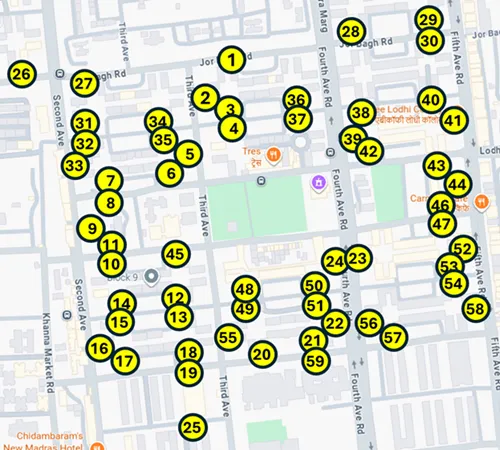
1 = Terracotta
2 = Gracious Heritage
3 = Letters for Lodhi
4 = Cause and Effect
5 = These Rock Pigeons Chose the Trees
6 = The Lava Tree
7 = The Lotus
8 = Colors of the Soul
9 = Swachh Bharat Abhiyan (Clean India Mission)
10 = See Through, See Beyond
11 = Sans Serifs, No Letters
12 = Balance in Mind and in Spirit
13 = Vishvaroopa
14 = Fish Out of Water
15 = Dancing with the Stars
16 = Miniature Painting
17 = Facing Walls
18 = Dreams of India
19 = Untitled
20 = The Colours of the Soul (Trans Lives Matter)
21 = Shakti
59 = Grow Know
22 = The Harvest
23 = Diliwalle
24 = This must be the place
25 = Jungle Lock down
26 = I am here
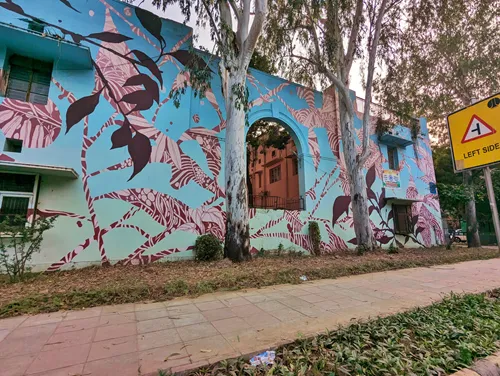
Mural: Terracotta
Artist(s): Tellas (Italy)
Mural Number: 1
Description and Significance: This mural is a striking work that draws inspiration from the intricate block-printing and natural foliage patterns deeply embedded in Indian textile and craft heritage. The mural utilizes a highly restricted color palette, mostly shades of muted terracotta red and white set against a soothing turquoise backdrop, to create a dense tapestry of stylized leaves, vines, and abstract floral motifs. The composition covers the entire building side in repeating, overlapping forms, offering a sophisticated, modern take on traditional design that transforms the otherwise simple wall into a rich, fabric-like piece of public art that celebrates the nation's rich legacy of patternmaking.
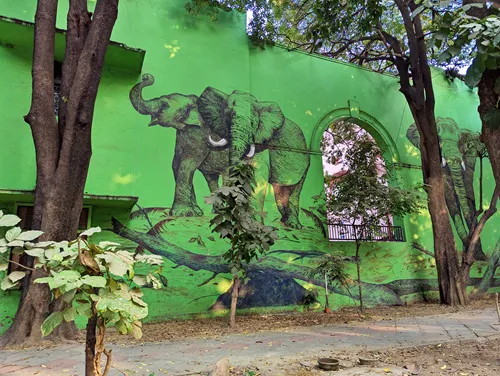
Mural: Gracious Heritage
Artist(s): Majlis Art Forum (India)
Mural Number: 2
Description and Significance: This striking muralis a monumental tribute to India's wildlife and the necessity of conservation, dominated entirely by a monochromatic palette of deep green. The artwork features a pair of magnificent Indian elephants—a revered symbol of strength, wisdom, and heritage—rendered with highly detailed line work that brings out the texture of their skin against the vibrant background. By using just one primary color, Dey focuses the viewer's attention entirely on the grandeur of the animals and the critical importance of preserving the natural world that exists alongside the urban sprawl, making it one of the most visually distinctive and impactful murals in the district.
Mural: Letters for Lodhi
Artist(s): Yok and Sheryo (Australia/Singapore)
Mural Number: 3
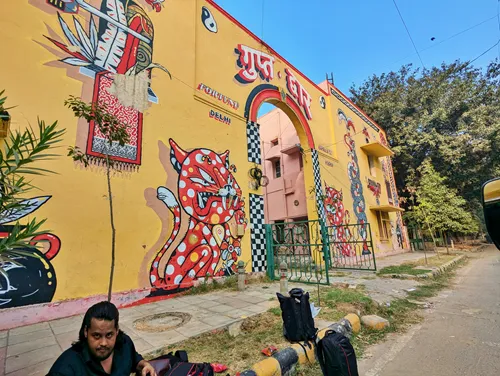
Description and Significance: This bright yellow mural is a highly graphic and playful work inspired by vintage Indian matchbox and pop art aesthetics. The composition is dominated by large, bold imagery, most notably a stylized, spotted, feline-like creature, and features a prominent archway over which the Hindi words ‘गुप्त द्वार’ (Gupt Dwar - Secret Door) are painted. The artists embedded various cryptic English and Hindi words around the arch, including ‘Fortune’ and ‘Health’, drawing inspiration from the traditional matchbox designs, and using the mural to provoke conversation about themes like justice, equality, and the cultural riches of the neighborhood.
Mural: Cause and Effect
Artist(s): Sam Lo (Singapore)
Mural Number: 4
Description and Significance: The mural is a poetic and visually complex reflection on interconnectedness and mindful choice. Across a large façade, the stencil-based work depicts multiple sparrows in flight, which the artist frames as stand-ins for individual people, all of them linked and affected by flowing ribbons and decorative background motifs that visually braid their fates together; the composition strikingly uses the building's arches to frame this imagery. By showing how one action can subtly change another's destiny, the very essence of Cause & Effect, the mural invites viewers to consider their freedom, interdependence, and how decisions are shaped by their environment, ultimately encouraging a practice of calm, mindful decision-making over impulsive reactions.

Mural: These Rock Pigeons Chose the Trees
Artist(s): Adele Renault (Belgium)
Mural Number: 5
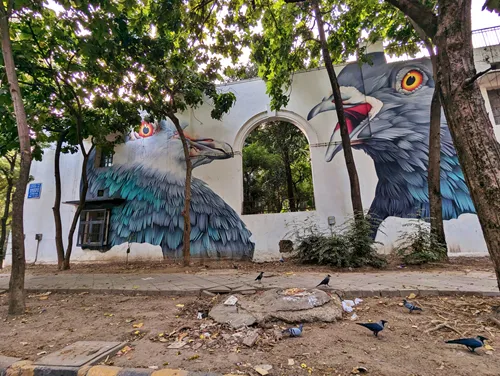
Description and Significance: The massive and hyper-realistic mural provides a dramatic close-up of two rock pigeons. Rendered in stunning detail that captures the texture of their feathers and the fiery intensity of their eyes, the birds are positioned on either side of a natural archway. The mural's scale transforms the common city pigeon from a mundane sight into a magnificent, powerful creature, urging viewers to truly ‘see’ nature that is ignored every day in the urban environment. The title itself is a subtle commentary on the resilience of nature, suggesting that these creatures chose this place, demanding respect and attention in the heart of Delhi.
Mural: The Lava Tree
Artist(s): Anpu Varkey (India)
Mural Number: 6
Description and Significance: This abstract mural uses bold, sweeping lines and saturated colors to represent the fluidity and raw energy of nature. The primary image is a dynamic, tree-like structure, or perhaps an organic flow of life, rendered in powerful shades of deep red and pink that resemble cooling lava or burning life force. The intense colors contrast starkly with the light background, creating an immediate and visceral visual impact. The artwork encourages viewers to reflect on the immense energy and transformative power inherent in natural elements like fire and growth, translating the artist's signature digital aesthetic into a massive, tangible piece of public art.

Mural: The Lotus
Artist(s): Suiko (Japan)
Mural Number: 7
Description and Significance: This mural is as a graphic celebration of India's national flower, symbolizing purity and spiritual strength. Using a bold, signature style that fuses the fluidity of Japanese calligraphy with contemporary graffiti, Suiko rendered the lotus as a powerful, intricate form surrounded by stylized, intertwining natural elements in rich colors. The abstract work's dynamic lines and vibrant geometric patterns transformed the flat wall into a highly textured, dimensional canvas, creating an artistic dialogue between the ancient symbolism of the flower and the modern language of street art.

Mural: Colors of the Soul
Artist(s): Senkoe (Mexico)
Mural Number: 8
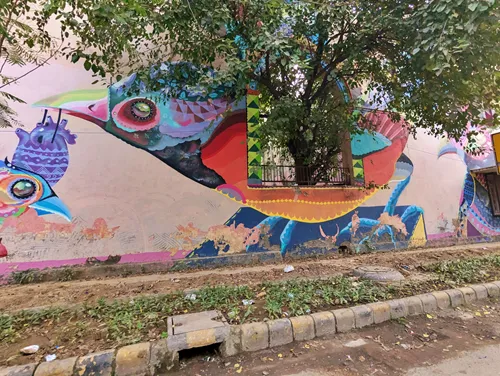
Description and Significance: This mural is a dazzling, large-scale depiction of a stylized bird, serving as a powerful symbol of diversity, identity, and freedom. The bird's feathers are rendered in a riot of intricate geometric patterns and vibrant colors, seamlessly blending design elements inspired by both traditional Indian and Mexican motifs. Senkoe chose the bird as a subject because, like migratory travelers, birds see and experience multiple places, and their souls become rich with stories. The mural thus stands as a celebration of the colorful diversity of the people who inhabit the city, encouraging communication and the sharing of unique personal narratives among the residents of the colony.
Mural: Swachh Bharat Abhiyan
Artist(s): Painter Kafeel (India)
Mural Number: 9
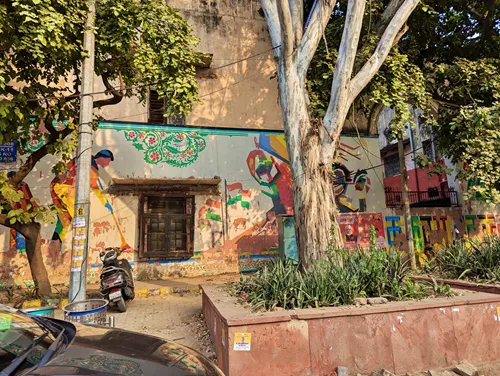
Description and Significance: The bright and busy mural uses bold, graphic elements and a dynamic color palette, including large blocks of the Indian flag's saffron and green, to depict figures engaging in civic duties like sweeping and cleaning. It skillfully incorporates recognizable symbols of the mission, transforming the otherwise plain government building wall into a public service announcement. Placed within the art district, this mural showcases how street art can be leveraged not just for social commentary or personal expression, but also as a powerful and vibrant tool for government-led public awareness campaigns aimed at promoting cleanliness and community responsibility.
Mural: See Through, See Beyond
Artist(s): Nevercrew (Switzerland)
Mural Number: 10
Description and Significance: This abstract and mesmerizing muralis uses intense color and texture to explore the boundary between the known and the unseen. The composition features bold, swirling shapes that appear to be of both planetary and organic matter, resembling craters, clouds, and cosmic dust, rendered in vibrant shades of pink, black, blue, and yellow. Crucially, the mural's central form utilizes the building's arched gateway as a frame or portal, creating the illusion that the viewer is looking through to another dimension. This spatial effect perfectly captures the artist's intent: to encourage the audience to look past the surface of the physical world and contemplate the deep, abstract realities that lie beyond.

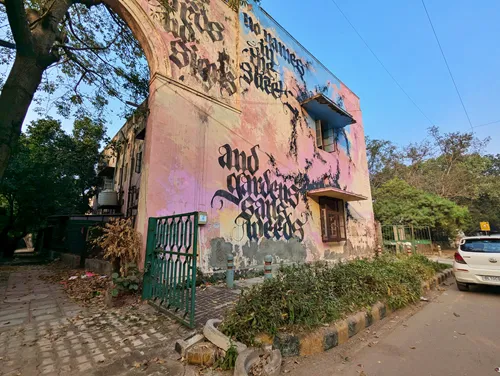
Mural: Sans Serifs, No Letters
Artist(s): Shoe (Netherlands)
Mural Number: 11
Description and Significance: This striking mural is an example of Calligraffiti, the artist's signature fusion of calligraphy and street art. Instead of painting a figurative image, the mural features a powerful, flowing poem written in an expressive, traditional script that reads, ‘no names in the streets... and gardens sans weeds’. The text is deliberately abstract and difficult to read at first glance, compelling the viewer to engage with the form rather than just the content. The poem itself is a critique of the mundane and uniform nature of urban spaces, advocating for a city free of labels and signage, making it a unique and profound commentary on language, public space, and anonymity.
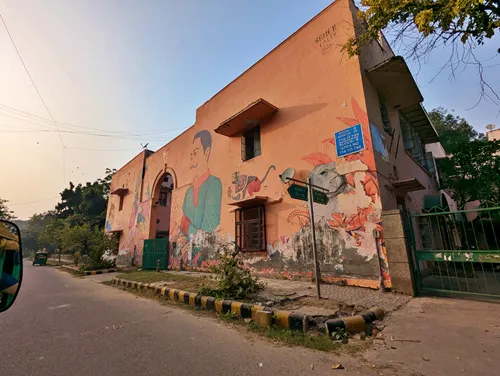
Mural: Balance in Mind and in Spirit
Artist(s): Saner (Mexico)
Mural Number: 12
Description and Significance: This mural is a vibrant, figurative piece that explores the essential quest for harmony between our inner emotional state and our external environment. Utilizing the artist's distinctive style, which draws heavily from Mexican folk art, the mural features a large, pensive human figure alongside other elements—such as a monkey and falling leaves—all rendered in warm, earthen tones against a pink wall. The figures and motifs, reminiscent of traditional masks and indigenous cosmology, collectively represent the complex interplay of human nature, consciousness, and the animal world, urging viewers to seek equilibrium and mindfulness amidst the chaos of urban life.
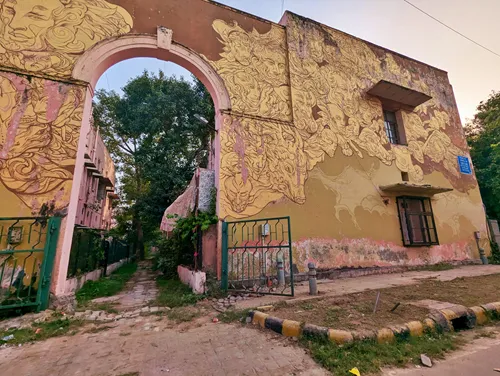
Mural: Vishvaroopa
Artist(s): Inkbrushnme (India)
Mural Number: 13
Description and Significance: This massive mural is an awe-inspiring interpretation of the ‘Universal Form’ of Krishna, a key concept from the Bhagavad Gita. Rendered almost entirely in flowing gold lines on an earthen, brown background, the artwork depicts countless interconnected faces, figures, and cosmic elements swirling out from a central form. This visually dense composition is designed to represent the concept of Vishvaroopa: the all-encompassing, terrifying, and beautiful form of the divine that contains all existence, urging viewers to contemplate the infinite unity and interconnectedness of everything in the universe.
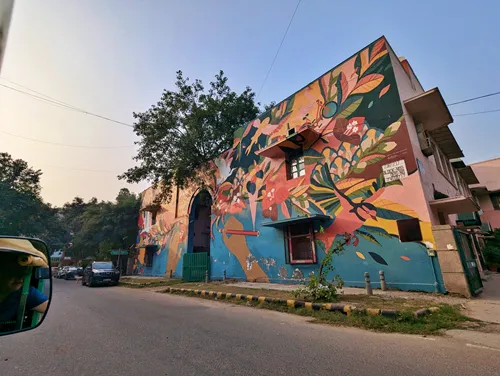
Mural: Fish Out of Water
Artist(s): Greta von Richthofen (Germany)
Mural Number: 14
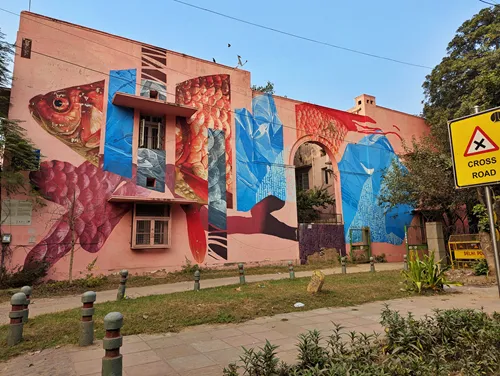
Description and Significance: This mural is a powerful visual meditation on displacement, adaptation, and the feeling of being an outsider. The artwork features a massive, detailed, and often fantastical marine creature—typically a stylized fish or shark—suspended unnaturally in a stark, unfeeling urban environment, completely removed from its element. This stark contrast between the vulnerable, vivid marine life and the mundane cityscape physically embodies the idiom ‘a fish out of water,’ representing the internal struggle of navigating unfamiliar territories, the emotional experience of being disoriented, or the difficulty in adapting when stripped of one's familiar context. The mural poetically yet forcefully prompts viewers to reflect on the universal experience of being outside of one's comfort zone, struggling to find a space where one belongs.
Mural: Dancing with the Stars
Artist(s): Nevercrew (Switzerland)
Mural Number: 15
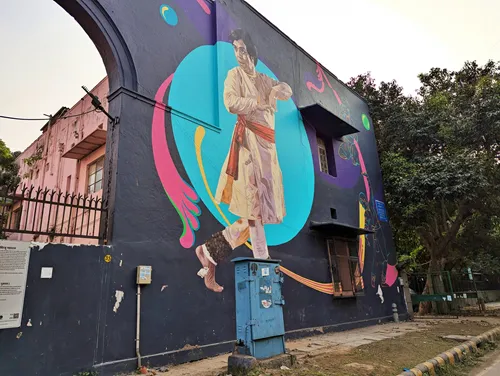
Description and Significance: This mural is a powerful homage to the legendary Indian dancer Uday Shankar. The artwork features a large, dynamic depiction of Shankar captured mid-movement in his flowing white and saffron costume, complete with ankle bells. This figure is set against a vibrant, abstract background of swirling turquoise, pink, and yellow cosmic spheres, which visually connects his earthly dance with the celestial, universal themes he explored. As one of the most recognizable pieces in the Lodhi Art District, the mural celebrates Uday Shankar's pivotal role as the father of modern Indian dance and a cultural ambassador who introduced Indian performance art to a global audience.
Mural: Miniature Painting
Artist(s): Mahendra Pawar (India)
Mural Number: 16
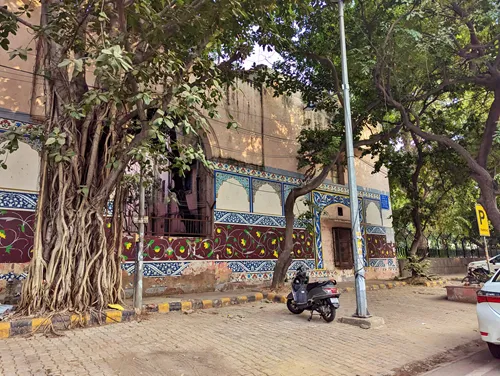
Description and Significance: This mural transforms the refined art of traditional Indian miniature painting into a monumental urban canvas in the Lodhi Art District. Inspired by the delicate brushwork once used to illustrate royal manuscripts and mythological tales, the mural magnifies those intricate floral motifs, ornate borders, and Mughal-style arches onto the façade of a residential block. The result is a fusion of ancient craftsmanship and contemporary scale, where patterns that once adorned small pieces of parchment now envelop an entire building. By translating a meticulous, centuries-old technique into a public art form, Pawar bridges the worlds of heritage and modernity, celebrating India’s artistic legacy while making it accessible to everyone passing through the vibrant streets of Lodhi Colony.
Mural: Facing Walls (murals north and south of the street)
Artist(s): Bicicleta Sem Freio (Brazil)
Mural Number: 17
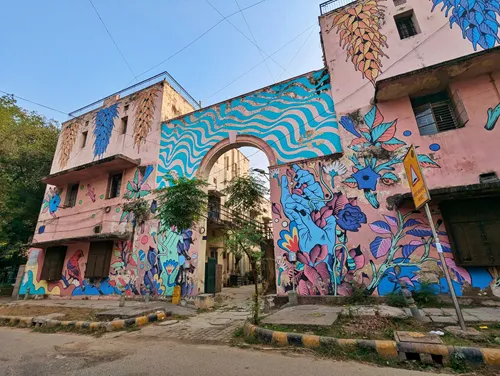
Description and Significance: This is one of the most poetic murals in Delhi’s Lodhi Art District, transforming a residential archway into a vibrant dialogue about connection and understanding. Painted in soft pinks, blues, and greens, the artwork features large intertwining flowers, graceful leaves, and two expressive hands reaching across the divide between buildings. Flowing wave patterns unite both sides of the arch, symbolizing energy and continuity. Through this visual conversation, Anpu explores the idea that walls, often seen as barriers, can instead become bridges for empathy and exchange. Her mural invites viewers to pause, reflect, and imagine a world where boundaries foster connection rather than separation, embodying the Lodhi Art District’s larger mission of turning everyday urban spaces into shared canvases of creativity and hope.
Mural: Dreams of India
Artist(s): Gabriel Specter (USA)
Mural Number: 18
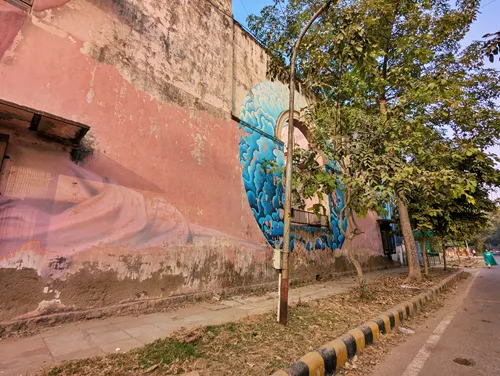
Description and Significance: The mural shows an abstract dream-like composition of red and blue draped fabrics on the side panels, with the celestial blue ring at the center.
Mural: Untitled
Artist(s): Corin Kennignton and Harry Fieber (UK)
Mural Number: 19
Description and Significance: This piece is abstract, using bright colors and dynamic shapes to create a feeling of movement. It focuses on how light interacts with the wall's surface, challenging the static nature of the architecture.
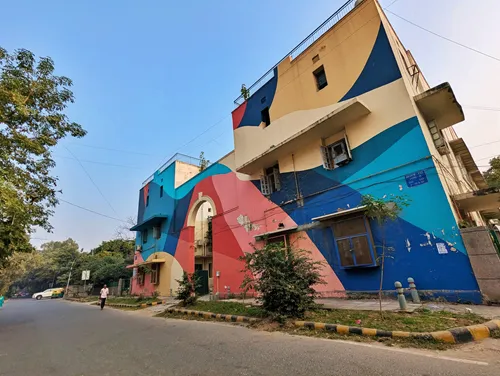
Mural: The Colours of the Soul (Trans Lives Matter)
Artist(s): Aravani Art Project (India)
Mural Number: 20
Description and Significance: This mural was painted by Mexican artist Senkoe in collaboration with the Aravani Art Project. It is a powerfully emotive and vibrant piece in the Lodhi Art District. The mural serves as a celebration of diversity and identity, featuring a dense arrangement of colorful, stylized portraits layered against rich pink, orange, and blue patterned backgrounds. While Senkoe's theme was initially about the collective strength of 'birds' representing travelers, the involvement of the Aravani Art Project, an influential collective of trans women, gives the work profound social meaning. The mural thus acts as a highly visible public statement, using its rich colors and engaged faces to encourage dialogue, respect, and acceptance for the marginalized communities it portrays.
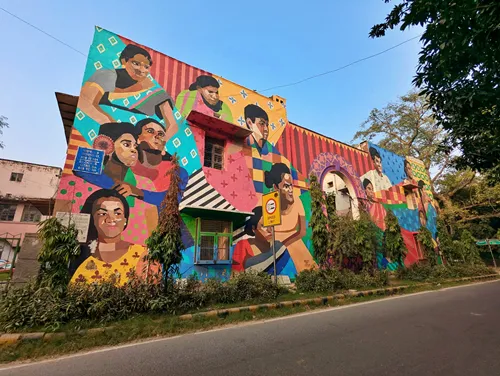
Mural: Shakti
Artist(s): Sajid Wajid Shaikh (India)
Mural Number: 21
Description and Significance: This mural is a vibrant celebration of Indian womanhood. Spanning an entire wall, the artwork depicts bold, colorful portraits of women, capturing the multifaceted nature of femininity, both nurturing and powerful, delicate yet unyielding. The mural draws inspiration from the predominantly female staff and mothers at a nearby school, honoring the everyday strength and resilience of women. With its striking colors, intricate detailing, and expansive scale, ‘Shakti’ stands as a dynamic public tribute to empowerment, community, and the transformative force of feminine energy.
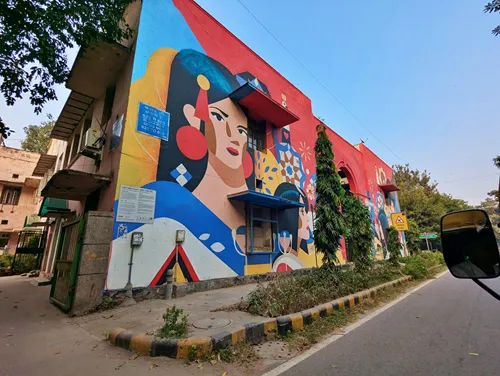
Mural: Grow Know
Artist(s): Neelima Sheikh and Zarina Hashmi
Mural Number: 59
Description and Significance: The mural, painted on a long boundary wall in the Lodhi Art District, is a sequential piece focused on social messaging and community awareness. The mural uses simple, accessible cartoon-like illustrations and clear text to convey important messages about personal space, consent, and self-respect. It features several panels depicting everyday scenarios, such as figures standing apart and a young girl working on a computer, accompanied by short, declarative sentences. Key phrases like ‘GROW KNOW’ and ‘My body is my home, my choices are my own. Respecting my decisions is the only way to go’ anchor the work, making it a functional piece of art designed to educate and promote healthy boundaries within the community.
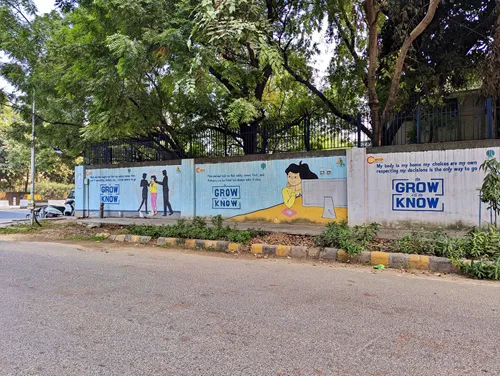
Mural: The Harvest
Artist(s): Do & Khatra (India)
Mural Number: 22
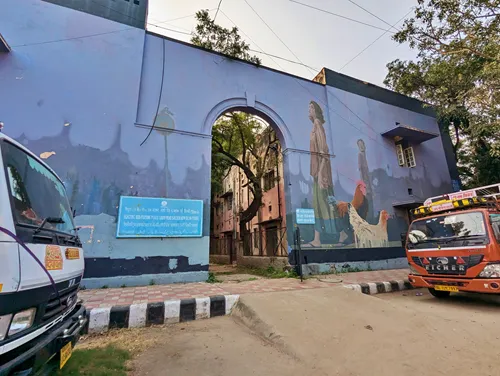
Description and Significance: This is a narrative mural positioned over an archway that evokes a feeling of quiet rural life and the dignity of labor within the urban environment. The central figure is a woman in traditional attire, painted in soft, earthy tones, who stands watch over a pair of large, detailed roosters and a hen. The overall mood is nostalgic and gentle, with the artist using a style that resembles a large watercolor or chalk drawing. The mural is a tribute to Indian farmers and domestic life, celebrating the simple, foundational connections to the land and nature that persist even in a bustling city like New Delhi.
Mural: Diliwalle
Artist(s): Bhajju Shyam (India)
Mural Number: 23
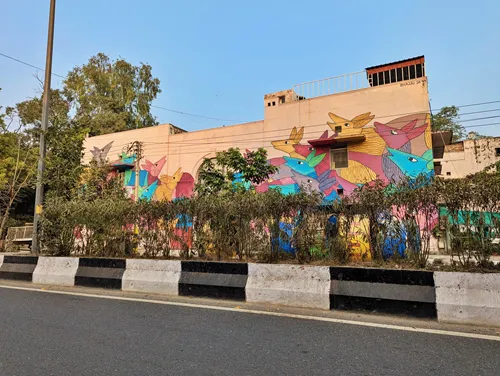
Description and Significance: This mural brings the rich, traditional complexity of Gond tribal painting to the urban facade. The mural is a dense tapestry of stylized, mythical creatures, primarily colorful animals with intricate, patterned bodies, rendered in a bright, festive palette of yellows, blues, pinks, and greens. The painting style, characterized by its detailed lines, dots, and internal patterns, is typical of Gond art, where every surface is filled with meaningful designs. The title, which means 'People of Delhi,' celebrates the chaotic and vibrant essence of the city itself, using the stylized animals and their interaction to symbolize the energy and interconnected diversity of Delhi's inhabitants.
Mural: This must be the place
Artist(s): Georgia Hill X Hanif Kureshi (Australia/India)
Mural Number: 24
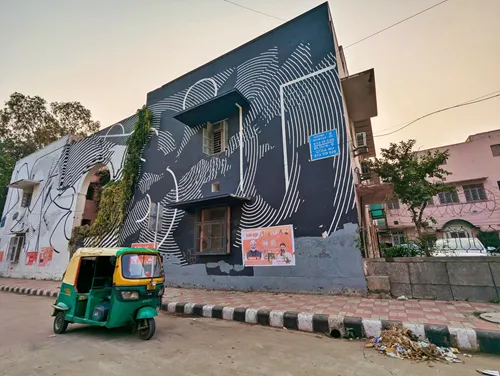
Description and Significance: This monochromatic mural is one of the most distinctive works in the district due to its dramatic black-and-white palette. The mural relies entirely on abstract forms, flowing lines, and geometric patterns to create a sense of movement and rhythm. The dynamic composition guides the viewer’s eye across the wall, evoking feelings of energy, presence, and connection to the surrounding space. Through its interplay of shapes and contrasts, the artwork transforms the urban wall into a vibrant canvas, inviting contemplation of place and the subtle interactions between structure, space, and perception.
Mural: Jungle Lock down
Artist(s): ZERO (India)
Mural Number: 25
Description and Significance: This is a visually stunning mural that uses surrealism and photo-realistic painting to explore themes of nature, instinct, and urban confinement. The work is split across an archway, where the figures are juxtaposed against a dense, tropical backdrop of vivid green foliage. Key elements include a large, stylized fox mask on one side and a woman on the other, often with her eyes obscured by butterflies, symbolizing a reliance on internal, primal sight rather than human vision. ZERO's masterful technique creates a sense of both the wild's beauty and its capture, reflecting on the fate of instinct and nature in the city.
Mural: I am here
Artist(s): H11235 (Nepal)
Mural Number: 26
Description and Significance: The mural addresses the ecological issue of invasive species in the Yamuna River, specifically focusing on the introduction of pet goldfish into the ecosystem. The artist was inspired by reports of these non-native fish disrupting the local aquatic environment. The mural features a goldfish rendered in soft pastel tones, with subtle hints of red and purple, symbolizing the contrast between the fish's innocent appearance and its potentially harmful impact on the ecosystem. The artist aimed to highlight this contradiction through the mural's design and color palette.
Other Murals
There are lots of other murals. The tables below list the murals that are not part of our self-guided murals tour, sorted by Theme, so that it is easier for you to decide if you are interested in seeing them:
Themes of Nature and Environment
These works often use flora, fauna, and elements to comment on the relationship between humanity and the planet, focusing on environmental challenges and natural beauty.
# |
Mural |
Artist |
Description and Significance |
|---|---|---|---|
32 |
The Sacrosanct Whole |
Aaron Glasson (New Zealand) |
A complex, ecological mural that focuses on interconnectivity, often depicting human figures, animals, and natural patterns merging to emphasize the sacred relationship between all life forms. Glasson uses vibrant colors and Polynesian-influenced motifs to represent planetary unity. |
35 |
Reclaim Air and Water |
Andreco (Italy) |
A climate-focused mural using geometric and scientific imagery to represent the pollution cycle and the necessity of restoring Delhi's air and water quality. It directly addresses local environmental challenges, often using blue and grey tones to suggest water and smog. |
43 |
Dead Dahlias |
Amitabh Kumar (India) |
A vibrant yet somber piece that often uses surreal elements and dark humor to explore mortality and decay. The large, stylized dahlias serve as a beautiful, yet dying, centerpiece, commenting on environmental decline in the urban setting. |
51 |
How is Global Warming |
Gaia (USA) |
A strong, issue-driven mural using graphic realism or symbolism to directly depict the environmental crisis, serving as a powerful, public challenge to address global warming. Gaia is known for integrating political and social commentary into his large-scale public works. |
53 |
From Your Strength, I Weave Beauty |
Shilo Shiv Suleman (India) |
A feminine-centric, vibrant mural often featuring flowing hair and floral elements. It celebrates the quiet strength and resilience of women, visually weaving beauty from their internal power, and often uses nature imagery as a metaphor for feminine energy (Shakti). |
Themes of Identity, Culture, and Spirit
These murals celebrate humanity, cultural heritage, and social movements, highlighting individual and collective identity in modern India.
# |
Mural |
Artist |
Description and Significance |
|---|---|---|---|
27 |
Essential |
Fearless Collective (India) |
This collective focuses on social justice and artivism. The mural typically features female figures and text that affirm the essential strength and importance of women and marginalized communities, using a collaborative, community-based approach. |
28 |
Community Wall Saath Saath |
Various Artists |
A community-focused piece (Saath Saath means 'Together') often created collaboratively, celebrating local Lodhi residents, their history, and shared neighborhood life, promoting unity through local imagery. |
30 |
Delhi |
NeSpoon (Poland) |
This unique mural uses the visual language of traditional lace and geometric patterns, often echoing the intricate jali (stone latticework) found in Mughal and Islamic architecture. It is a cross-cultural homage to Delhi's history and craftsmanship, bringing soft texture to a hard urban wall. |
38 |
Mera Rang Mein |
BOND (Germany) |
Meaning ‘In My Color,’ this vibrant, dynamic abstract piece uses bold color blocks and fluid shapes to represent emotion, music, and the celebration of individual expression and identity, encouraging self-acceptance. |
39 |
Flowers of Dharavi |
Alaniz (Argentina) |
This work features realistic, poignant portraits of working-class people. It focuses on human dignity and the beauty found in everyday lives, drawing inspiration from essential workers and celebrating the overlooked members of the community. |
40 |
Unity |
Priyesh Trivedi (India) |
This conceptual piece often uses simple but powerful imagery to promote harmony and brotherhood, featuring figures or symbols coming together to form a cohesive whole, commenting on India's vast cultural and linguistic diversity. |
41 |
Lavanya |
Hendrik ‘ECB’ Beikirch (Germany) |
A massive, photorealistic black-and-white portrait. Lavanya (Beauty/Grace) focuses on the striking detail and emotion of the human face, celebrating the individual character of a local Delhi person. Beikirch is famous for painting colossal, sensitive portraits worldwide. |
44 |
Original Aboriginal |
Reko Rennie (Australia) |
An energetic piece that incorporates the geometric patterns and bold lines of contemporary Aboriginal Australian art. It is a striking cultural exchange that highlights indigenous identity and heritage on the Indian urban canvas. |
46 |
Amma |
Blaise (France) |
Amma means ‘Mother’ in many Indian languages. This mural is a touching, often larger-than-life portrait dedicated to motherhood or a strong maternal figure, emphasizing love and nurturing within the community. |
58 |
Padma |
Chifumi (France/Vietnam) |
A powerful piece often depicting a woman intertwined with the Padma (Lotus). The work celebrates feminine strength and purity, using bold, graphic lines common to the artist's style, blending Asian cultural motifs. |
Themes of Abstract, Typography, and Narrative
These murals explore abstract concepts, use text as art, or tell a story about urban life, movement, and technology.
# |
Mural |
Artist |
Description and Significance |
|---|---|---|---|
29 |
The Tourist |
Avinash & Kamesh (India) |
A humorous or thoughtful commentary on the modern traveler, often depicting a figure interacting with the environment or local culture, forcing the viewer to reflect on their own tourist role and relationship with the city. |
31 |
The Light Fort |
Yoh Nagao (Japan) |
Characterized by a whimsical, sometimes surreal style, this mural often features fantastical creatures or scenes. The title suggests a dreamlike, idealized version of Delhi's forts and architecture, blending reality and fantasy. |
33 |
Fusion Art |
Rakesh Kumar Memrot (India) |
A piece that explicitly merges different styles, likely combining traditional Indian motifs (like miniature painting or block print) with contemporary street art techniques, creating a true hybrid visual language. |
34 |
Social Media Friendly Plants |
Sameer Kulavoor (India) |
A sharp commentary on the digital age. This work uses stylized plants or objects to critique the culture of performing for social media, where objects are only valued for their share-ability or digital presence. |
36 |
Mars |
Eugene Soh (Singapore) |
A conceptual piece contrasting the red hue of the building's brick with the red planet. It often features astronauts or space-age themes, linking Delhi's historical red construction to themes of exploration and future possibility, usually rendered in a pixelated or digital style. |
37 |
Impressions of Lodhi |
Yip Yew Chong (Singapore) |
Known for evocative, nostalgic scenes, this mural provides a glimpse into the ordinary, daily life of the Lodhi Colony residents, preserving memories of the neighborhood's past with a classic, illustrative style. |
42 |
Belly Dance - The Reincarnation of R, G and B - 2019 |
Daan Botlek (Netherlands) |
A conceptual, abstract work featuring simple, often cartoon-like figures interacting in surreal ways. The R, G, and B title refers to the primary colors of light, exploring color theory and digital life. |
45 |
The Origin of the World |
Borondo (Spain) |
A powerful figurative piece that often uses classical, evocative imagery. The title suggests a focus on primal themes of creation, birth, or human connection, usually rendered with a raw, emotional, and sometimes blurred or scratched style. |
47 |
Don't Let This Symbolism Kill You |
Nafir (Iran) |
A provocative piece that uses vivid colors and figurative imagery to criticize the rigid cultural or political symbolism that can sometimes stifle individual freedom and expression. Nafir often uses masks or veiled faces in his work. |
48 |
We Love Dilli |
Lek & Sowat and Hanif Kureshi (France/India) |
A collaborative piece centered on bold, graphic typography (the ‘We Love Dilli’ text), surrounded by abstract elements, serving as a direct and vibrant love letter to the city of Delhi. |
49 |
Visions of Altered Landscapes |
Aaron Li Hill (Canada) |
This piece typically uses fragmented images of nature and architecture, creating dynamic, windswept scenes that explore movement, change, and the constant reshaping of the environment, often featuring animals caught mid-flight. |
50 |
Time Changes Everything |
Daku (India) |
An iconic, conceptual piece where the visibility of words is often dependent on the sun's shadow or the time of day, making time itself part of the art and embodying the mural's profound message. It is a famous example of time-based street art. |
52 |
Order in Chaos |
DALeast (China) |
Known for his distinctive wire-frame style, this mural depicts animals (often birds or predatory beasts) using complex, geometric lines that seem to pull themselves out of the wall, capturing a sense of powerful, organized motion within turbulence. |
54 |
Untitled |
David Leitner (Austria) |
This piece typically relies on complex, geometric abstraction, and clean lines. It aims to manipulate the perception of space and surface, transforming the mundane architecture into a field of depth and optical illusion. |
55 |
Moving Cities |
Marc Lee (Switzerland) |
This mural often incorporates technology or digital aesthetics, perhaps showing fragmented urban landscapes or digital overlays, reflecting the ceaseless motion and complexity of a hyper-connected city like Delhi. |
56 |
Wall is Transparent |
M Pravat (India) |
This mural uses architectural drawing and perspective to create the illusion of a transparent wall, challenging the viewer's sense of depth and the solidity of the building itself, playing on the building's own structure. |
57 |
About Dreams and Reality |
Manolo Mesa (Spain) |
This mural often features realistic, faded portraits of people or old objects painted onto textured walls, blurring the line between history, memory, dreams, and the physical reality of the Lodhi street. |
Back to the Day 3 Walking Tour
Where do you want to go now?

Author: Rudy at Backpack and Snorkel
Bio: Owner of Backpack and Snorkel Travel Guides. We create in-depth guides to help you plan unforgettable vacations around the world.

Other popular Purple Travel Guides you may be interested in:
Like this Backpack and Snorkel Purple Travel Guide? Pin these for later: