Gandhi Smriti: The Sacred Site of Mahatma Gandhi’s Martyrdom | India Purple Travel Guide
(map, reviews, website)
This is Premium Content! To access it, please download our
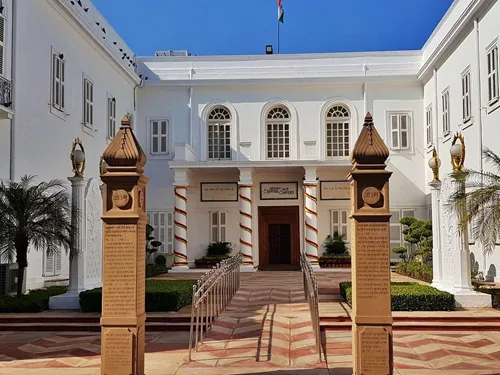
Backpack and Snorkel Purple Travel GuideGandhi Smriti Museum is a sacred pilgrimage site that marks the final, tragic chapter of Mahatma Gandhi’s life and the birthplace of modern independent India. Located on what was formerly Birla House in New Delhi, the sprawling colonial-era residence has been preserved as a poignant memorial to the man who led India to freedom through non-violence.
Here at Backpack and Snorkel Travel Guides, we promote self-guided walking tours.
But we realize that not everybody likes to walk by themselves in a foreign city. So, just in case that you rather go with ab guide: NO PROBLEM! Please see the GuruWalk and Viator tours below.
free GuruWalk tours
paid Viator tours
Opening Hours and Admission Fee
Entry Fee: Admission is free to all visitors.
Opening Times: daily from 10:00 AM to 6:30 PM but closed on Mondays and National Holidays.
History and Profound Significance
The site's history is crucial to understanding its emotional weight:
The Final Residence: The mansion belonged to the industrialist Birla family. From September 9, 1947, until his death on January 30, 1948, Mahatma Gandhi stayed here. This period was one of the most tumultuous in Indian history, following the trauma of the Partition and resulting in vast refugee crises and communal violence.
A Center of Dialogue: During these last 144 days, Birla House was the nerve center for political and social dialogue, where Gandhi met with global leaders, Indian politicians, and desperate citizens struggling to cope with the aftermath of independence.
The Assassination: On the evening of January 30, 1948, as Gandhi walked to his daily prayer meeting on the lawn, he was assassinated by Nathuram Godse. The event instantly transformed the residence into a site of martyrdom. The government acquired the house in 1971 and opened it to the public as a national memorial.
Nathuram Vinayak Godse was a Hindu nationalist and journalist from Pune, Maharashtra.
The Assassination: On January 30, 1948, Godse approached Gandhi at the prayer grounds of Birla House (now Gandhi Smriti). He bowed to Gandhi before shooting him three times in the chest at close range.
The Motive: Godse vehemently disagreed with Gandhi's political views, particularly his efforts to foster communal harmony between Hindus and Muslims in the wake of the devastating Partition of India. Godse and his co-conspirators felt that Gandhi was unfairly favoring the Muslims and undermining Hindu interests, a belief that ultimately led to the assassination.
Godse was later tried, convicted, and executed for the murder in 1949.
Architecture and The Pilgrim's Path
The architecture is typical of a large, early 20th-century Delhi mansion, but the way the memorial is laid out guides the visitor through a deliberate and emotional narrative:
The Memorial Museum: The main house has been converted into a series of exhibition halls. These feature extensive photo displays, models, sculptures, and artifacts that chronicle Gandhi’s entire life, from his childhood in Gujarat and his years as an activist in South Africa to his leadership of the Indian independence movement.
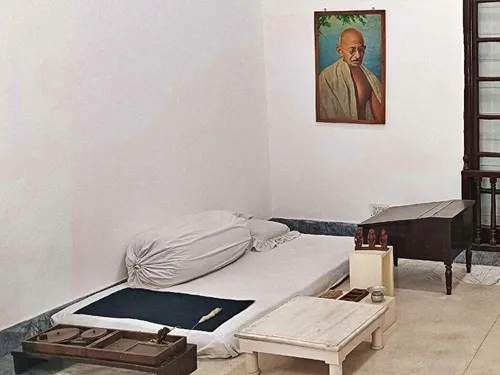
Gandhi's Last Room (Preserved): The most intimate and affecting spot is the preserved room where Gandhi lived. The room is Spartan, containing only his simple bed, his spinning wheel (charkha), a few books, and his writing desk. A single window overlooks the garden. It is maintained exactly as it was when he left it for the final time.
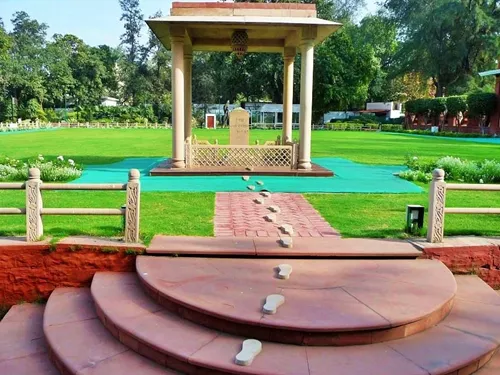
The Martyr's Path and Column: The emotional climax of the visit is outside on the lawn. A short, enclosed stone footpath marked with footprints leads from his preserved room to the spot where he was shot.
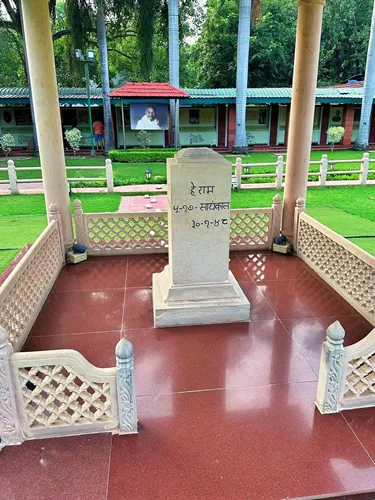
The Martyr's Column: At the end of this path stands a simple, elevated stone memorial known as the Martyr's Column or the Hutatma Chowk. It marks the precise spot where Gandhi fell.
Inscription: The column bears the Devanagari inscription Hey Ram (Oh God), which are widely regarded as his last words.
Why Every Traveler Should Visit
Gandhi Smriti offers a historical tour, and an encounter with the ideological soul of India.
Emotional Weight: The simplicity of the exhibits and the preserved authenticity of the site create a profound and sobering atmosphere. Visitors often feel the palpable weight of the history that occurred there.
Understanding Non-Violence: It offers the most comprehensive look at the philosophy of Satyagraha (truth force) and non-violence that shaped India's destiny and inspired movements worldwide.
Serene Grounds: Despite its grim history, the memorial complex is kept quiet and beautifully maintained, offering a tranquil space for reflection away from Delhi’s constant noise.
The Name 'Mahatma'
The title Mahatma is not Gandhi's name, but an honorific title bestowed upon him. It is a compound Sanskrit word that carries deep spiritual significance:
Maha: Means ‘Great’.
Atma: Means ‘Soul’ or ‘Spirit’.
Therefore, Mahatma literally translates to ‘Great Soul’.
Origin of the Title
The title was first used to address Gandhi by the famous Bengali poet, philosopher, and Nobel Laureate Rabindranath Tagore, likely around 1915, soon after Gandhi returned from South Africa.
Tagore recognized in Gandhi a unique purity of purpose, tremendous spiritual strength, and a moral authority that transcended mere political leadership. The name stuck because it perfectly captured the public's view of Gandhi: a leader whose political actions were rooted in deep ethical and spiritual conviction.
While Gandhi himself reportedly disliked the title, feeling unworthy of it, the name became permanently associated with him, distinguishing him as an exceptional figure in world history.
Brief history of Mohandas Karamchand Gandhi’s Life
Mohandas Karamchand Gandhi's life (1869–1948) was a journey of personal and philosophical transformation, moving from a shy, British-trained lawyer to the internationally revered leader of India's independence movement. His principles of Satyagraha (non-violent resistance) reshaped modern political protest.
- Early Life and Education (1869–1893)
Born in Porbandar, Gujarat, Gandhi received a relatively conservative Indian education before traveling to England in 1888 to study law at the Inner Temple in London. Despite his initial struggles with English society and his reserved nature, he qualified as a barrister. He returned to India in 1891, attempting unsuccessfully to establish a law practice. This period was marked by professional failure and personal uncertainty. - South Africa: The Birth of Satyagraha (1893–1915)
The turning point in Gandhi's life came when he accepted a legal contract in Durban, South Africa. He was immediately exposed to severe racial discrimination, the most famous incident being his forcible removal from a first-class train carriage in Pietermaritzburg. This galvanized him.- Political Activism: He spent two decades fighting against the anti-Indian laws imposed by the British and Boer authorities.
- Satyagraha: It was here that he developed and refined his powerful philosophy of Satyagraha (literally ‘truth force’). This technique involved organized, non-violent mass resistance (civil disobedience) against unjust laws, a method that would define his future leadership.
- Return to India and the Champaran Movement (1915–1920)
Upon returning to India at age 45, Gandhi initially toured the country to understand the plight of the common people. He quickly became involved in local struggles:- Champaran: In 1917, he successfully used civil disobedience to challenge the exploitative system under which poor farmers in Champaran, Bihar, were forced to grow indigo for British planters. This victory established him as a powerful national leader who could successfully challenge colonial authority.
- Leadership and Non-Cooperation (1920–1930)
Following the horrific Jallianwala Bagh Massacre in 1919, Gandhi shifted the focus of the Indian National Congress to complete self-rule. He launched the Non-Cooperation Movement in 1920. - Core Tactics: This movement involved the withdrawal of Indian people from government institutions, courts, and educational systems. It emphasized the boycott of foreign goods and the promotion of Khadi (hand-spun cloth), turning the spinning wheel (charkha) into a potent symbol of economic self-sufficiency and resistance against British textiles.
- 5. The Salt Satyagraha (1930)
Gandhi's most famous act of non-violent protest was the Dandi March (or Salt Satyagraha) of 1930. - The Protest: To protest the British tax on salt, a daily necessity for the poorest Indians, Gandhi and dozens of followers walked over 240 miles from his ashram to the coastal village of Dandi. There, he symbolically manufactured salt from seawater, defying the law.
- Global Impact: This act of civil disobedience was covered globally and triggered mass resistance across India, cementing Gandhi's status as a world figure and shaking the foundations of the British Raj.
- 6. Quit India and Final Days (1942–1948)
In 1942, as the world was gripped by WWII, Gandhi launched the Quit India Movement, demanding an immediate end to British rule. Although the movement was suppressed, it solidified the demand for independence. - Partition and Sorrow: The final years of his life were spent not in triumph, but in sorrow. He vehemently opposed the Partition of India on religious lines, but his counsel was ultimately overruled. He spent the last months walking between riot-torn areas, desperately trying to restore communal harmony.
- Martyrdom: He spent his final 144 days at Birla House in Delhi, working for peace, before his assassination on January 30, 1948.
His legacy rests on the demonstration that political change can be achieved through disciplined, non-violent mass action.
Where do you want to go now?





Author: Rudy at Backpack and Snorkel
Bio: Owner of Backpack and Snorkel Travel Guides. We create in-depth guides to help you plan unforgettable vacations around the world.

Other popular Purple Travel Guides you may be interested in:
Like this Backpack and Snorkel Purple Travel Guide? Pin these for later: