Amber Palace (Amer Fort): Self-Guided Walking Tour, Jaipur | India Purple Travel Guide
(map, reviews, website)
This is Premium Content! To access it, please download our
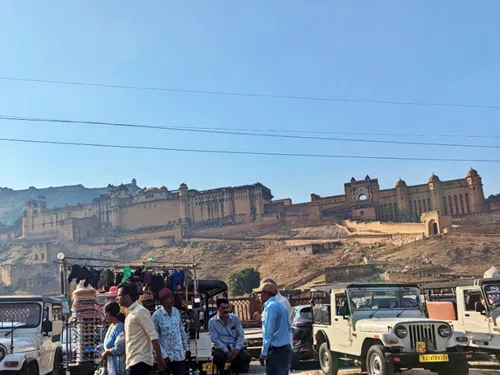
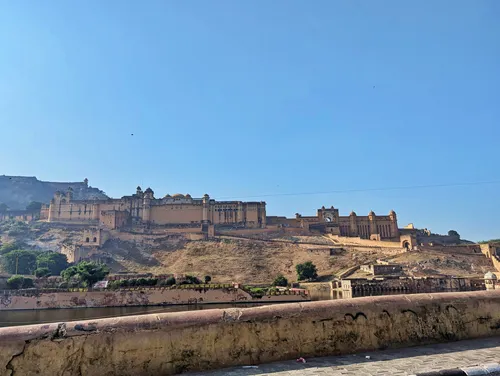
Backpack and Snorkel Purple Travel GuideAmber Palace, often referred to as Amer Fort, is a majestic hill fortress situated in the town of Amer, just 7 miles (11 km) outside of Jaipur. As a spectacular fusion of Rajput and Mughal architectural styles, this sprawling complex is built from red sandstone and white marble and stands as a recognized UNESCO World Heritage Site. A visit here is essential for understanding the power, artistry, and political maneuvering that defined the golden age of Rajasthan.
Here at Backpack and Snorkel Travel Guides, we promote self-guided walking tours.
But we realize that not everybody likes to walk by themselves in a foreign city. So, just in case that you rather go with ab guide: NO PROBLEM! Please see the GuruWalk and Viator tours below.
free GuruWalk tours
paid Viator tours
Why ‘Amer’ and ‘Amber’?
The fort is most accurately named Amer Fort, as it is located in the ancient town of Amer. The name Amer is widely believed to be derived from the Amba Mata Temple, dedicated to the Mother Goddess, located within the town.
However, over time, the pronunciation shifted. The common English spelling and pronunciation became Amber, likely due to colonial-era mispronunciation or simplification. Many locals and official documents still use Amer, but Amber is the name that gained popularity among tourists and is often used interchangeably today.
Opening Hours and Admission Fee
Opening Hours:
daily from 8:00 AM to 5:30 PM, arriving earlier in the morning is highly recommended to avoid both the heat and the crowds.
daily from approx. 6:30 PM to 9:00 PM for the Light and Sound Show; the English show starts between 6:30pm and 7:30pm depending on the season; the show does not take place inside the fort, but at Kesar Kyari Garden in front of the fort.
Admission:
Daytime visitors: ₹500 for foreign adults (at the time of writing)
Light and Sound Show visitors: ₹200 for foreign adults (at the time of writing)
Time needed:
The fort is immense, plan to spend at least three hours or 2h with a guide.
Where to Enter the Fort
There are three ways of entering the fort.
- Entering through Surajpol dwaar (Sun Gate). Start at the bottom of the hill; to reach the entrance, you will need to:
Walk: An approximately 15-minute uphill walk.
Jeep: Shared or private jeeps are readily available at the base for a quicker, more convenient ride.
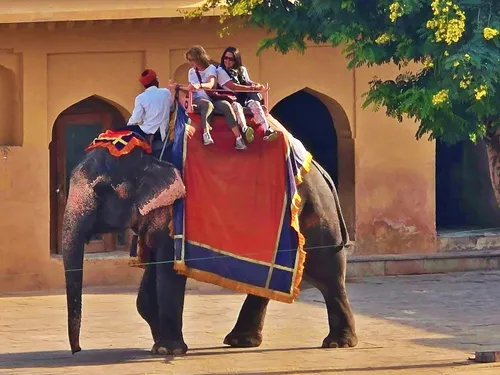
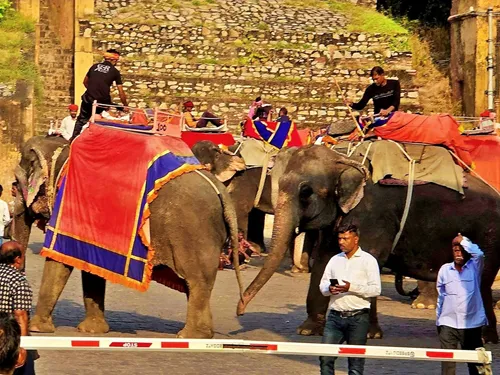
Elephant Ride: While traditional, the ethical use of elephants is debated, and many tourists now prefer jeeps or walking.
- Entering through Chand Pol (Moon Gate)
Your taxi will bring you to the main parking lot, which is a short slight walk uphill from Moon Gate.
- Entering through Jaigarh Fort
If you want to explore Jaigarh Fort too, then you can enter there, explore the fort, and then walk uphill through the tunnels and partially covered walkway up to Amber Fort.
History, Importance, and Architecture of Amber Fort
daily from 8:00 AM to 5:30 PM, arriving earlier in the morning is highly recommended to avoid both the heat and the crowds.
daily from approx. 6:30 PM to 9:00 PM for the Light and Sound Show; the English show starts between 6:30pm and 7:30pm depending on the season; the show does not take place inside the fort, but at Kesar Kyari Garden in front of the fort.
Daytime visitors: ₹500 for foreign adults (at the time of writing)
Light and Sound Show visitors: ₹200 for foreign adults (at the time of writing)
Time needed:
The fort is immense, plan to spend at least three hours or 2h with a guide.
Where to Enter the Fort
There are three ways of entering the fort.
- Entering through Surajpol dwaar (Sun Gate). Start at the bottom of the hill; to reach the entrance, you will need to:
Walk: An approximately 15-minute uphill walk.
Jeep: Shared or private jeeps are readily available at the base for a quicker, more convenient ride.
Elephant Ride: While traditional, the ethical use of elephants is debated, and many tourists now prefer jeeps or walking.
- Entering through Chand Pol (Moon Gate)
Your taxi will bring you to the main parking lot, which is a short slight walk uphill from Moon Gate.
- Entering through Jaigarh Fort
If you want to explore Jaigarh Fort too, then you can enter there, explore the fort, and then walk uphill through the tunnels and partially covered walkway up to Amber Fort.
History, Importance, and Architecture of Amber Fort
The fort is immense, plan to spend at least three hours or 2h with a guide.
- Entering through Surajpol dwaar (Sun Gate). Start at the bottom of the hill; to reach the entrance, you will need to:
Walk: An approximately 15-minute uphill walk.
Jeep: Shared or private jeeps are readily available at the base for a quicker, more convenient ride.
Elephant Ride: While traditional, the ethical use of elephants is debated, and many tourists now prefer jeeps or walking.
- Entering through Chand Pol (Moon Gate)
Your taxi will bring you to the main parking lot, which is a short slight walk uphill from Moon Gate.
- Entering through Jaigarh Fort
If you want to explore Jaigarh Fort too, then you can enter there, explore the fort, and then walk uphill through the tunnels and partially covered walkway up to Amber Fort.
History, Importance, and Architecture of Amber Fort
The palace's core structure visible today was initiated by Raja Man Singh I in 1592 AD. It was built primarily to serve as the royal residential palace and capital of the Kachwaha kingdom. Successive rulers expanded and enhanced the complex over two centuries, adding new palaces and courtyards until the capital was moved to the newly founded city of Jaipur in 1727.
The fort’s architecture is a flawless marriage of cultures. The exterior is robust and fortress-like, befitting a Rajput stronghold, while the interiors are characterized by delicate Islamic-style marble inlays, frescoes, and lattice work, reflecting the Mughal influence. The entire complex is ingeniously designed to harmonize with the rugged landscape of the Aravalli hills, where the fortifications and watchtowers follow the contours of the mountain.
The Kachwaha Rajputs: Architects of an Empire
To understand Amber Palace, one must first appreciate the architects of its greatness: the Kachwaha Rajputs. They were a powerful Rajput clan (Rajput means ‘Son of a King’) who established their rule in the region of Dhundhar (present-day Jaipur and surrounding areas) beginning in the 11th century.
The Kachwahas derived their strength from warfare, and from strategic political alliances. Unlike some other Rajput kingdoms that constantly clashed with the powerful Mughal Empire, the Kachwahas of Amer formed a beneficial relationship with the Mughals, particularly during the reign of Emperor Akbar.
The most famous Kachwaha ruler, Raja Man Singh I, was a respected general and one of the Navratnas (nine jewels) in Akbar’s court. This strategic alliance was cemented through marital ties and ensured that the Kachwaha kingdom enjoyed relative peace, immense wealth, and political leverage within the Mughal court. This stability and wealth were the foundational elements that allowed them to commission and build monuments of such grandeur and architectural sophistication as Amer Fort, and later, the meticulously planned city of Jaipur. The palace is therefore a physical testament to the blending of two great North Indian cultures—Rajput pride and Mughal refinement.
The term Navratnas (meaning ‘Nine Jewels’) refers to a group of nine extraordinary courtiers who were celebrated for their diverse talents and wisdom during the reign of the great Mughal Emperor Akbar the Great (r. 1556–1605).
Akbar was known for his policy of religious tolerance and his patronage of arts, science, and intellect. By surrounding himself with these nine brilliant minds, who were experts in fields ranging from poetry and music to finance, warfare, and administration, he ensured the stability and cultural flourishing of the Mughal Empire.
The Nine Jewels were not merely advisors; they were Akbar's inner circle, responsible for some of the most innovative and far-reaching policies of the era.
Key Members of the Navratnas
The nine main figures generally recognized as the Navratnas included:
Birbal: The witty court jester, known for his wisdom, proverbs, and legendary cleverness.
Tansen: A revolutionary musician and composer whose ragas are still revered today.
Abul Fazl: Akbar's chief advisor and the author of the Akbarnama (the official history of Akbar's reign) and the Ain-i-Akbari (a detailed document on the administration of the empire).
Faizi: Abul Fazl's brother, a Persian poet laureate and scholar.
Raja Todar Mal: The Minister of Finance, who introduced a revolutionary system of land revenue and taxation that stabilized the empire's economy.
Abdul Rahim Khan-i-Khana: A celebrated Hindi and Persian poet and military commander.
Faqi Aziao-Din: A Sufi mystic and religious advisor to the Emperor.
Mullah Do Piyaza: Known for his wit and quick, often humorous, responses.
Raja Man Singh I: The Kachwaha Ruler
The Special Role of Raja Man Singh I
Raja Man Singh I, the builder who initiated the core structure of Amber Palace, was arguably the most powerful and important of the nine jewels from a military and political perspective.
Commander-in-Chief: Man Singh was the Commander-in-Chief of the Mughal army. He led numerous successful military campaigns across the empire, significantly expanding and protecting Mughal territories.
Political Bridge: As a Rajput ruler who submitted to and formed an alliance with the Mughal Emperor, he represented the successful unification of Hindu and Muslim power in India. His position as a trusted Hindu general within the Mughal court was a powerful symbol of Akbar's tolerant policies.
Source of Wealth and Power for Amer: His high rank meant constant access to imperial wealth and resources. This prestige and money were poured back into his home capital, Amer, allowing him to construct the magnificent fort and the exquisite Sheesh Mahal we see today, blending the best of Mughal and Rajput architectural traditions.
In essence, Man Singh I’s inclusion in the Navratnas gave the Kachwaha clan extraordinary imperial backing, which ensured their kingdom's prosperity and survival for centuries.
Self-Guided Walking Tour of Amber Palace
Amber Palace is a maze and it is easy to get lost. You can either explore the site by yourself or hire one of the many guides that will surround you as soon as you enter.
Your journey through Amer Fort begins at the foot of the hill and progresses through four ascending courtyards, moving from public spaces to the intimate royal quarters.
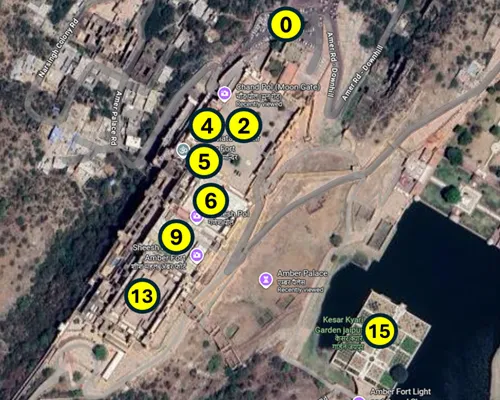
0 = Parking Lot near the top
1 = Chand Pol (Moon Gate)
2 = Jaleb Chowk (The First Courtyard)
3 = Suraj Pol (Sun Gate)
4 = Ticket Office
5 = Sinh Pol (Lion Gate)
6 = The Second Courtyard
7 = Diwan-i-Aam (Hall of Public Audience)
8 = Ganesh Pol (Ganesh Gate) and Suhag Mandir
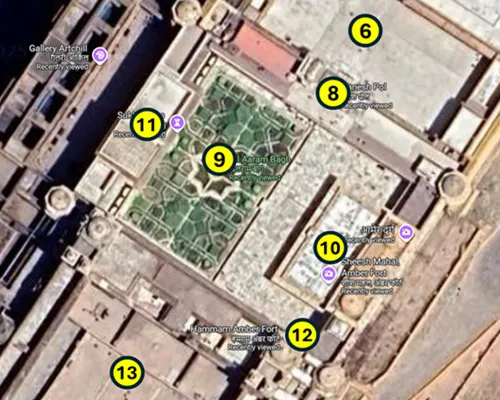
9 = Third Courtyard (Mansingh Palace Section)
10 = Diwan-i-Khas (Hall of Private Audience)
11 = Sukh Niwas (Hall of Pleasure)
12 = Hammam (Royal Bathhouse)
13 = Palace of Man Singh I (The Fourth Courtyard)
14 = Baradari (The Twelve-Door Pavilion)
15 = Kesar Kyari Garden (Light and Sound Show)
Chand Pol (Moon Gate): The Functional Western Exit
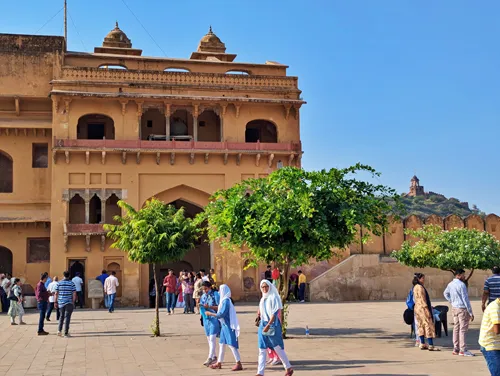
If your taxi/Uber driver brings you to the big parking lot, then you will enter Amber Palace through Moon Gate.
While the Suraj Pol (Sun Gate) claims all the glory as the ceremonial royal entrance, the Chand Pol, or Moon Gate, is the strategically important secondary gate of the Amber Fort complex. Located on the western side of the complex, this gate is crucial to the fort’s defense and functional logistics.

Function and Symbolic Contrast
The Chand Pol serves as the counterbalance to the Suraj Pol, both physically and symbolically:
Practical Exit: This gate primarily served as an exit and secondary entry point for those arriving from the western side of the complex. It was vital for the movement of supplies, military troops, and daily traffic not tied to the grand royal parades.
Symbolic Balance: In Hindu mythology, the Sun and the Moon represent perfect symmetry. Although the Kachwaha dynasty claimed descent from the Sun, the presence of the Moon Gate ensures the architectural and cosmological balance of the fort complex.
Access to the Palace: The gate leads directly into the Jaleb Chowk (the main courtyard) from the west, providing an alternate means of reaching the fort's main palace buildings.
Architectural Characteristics
Architecturally, the Chand Pol is built with the same defensive integrity as the Suraj Pol, but its purpose is less about public display and more about control and utility:
Design and Material: Like the rest of the fort, it is constructed from sturdy red sandstone. It features a substantial arch and is built deeply into the defensive walls, designed to be heavily guarded.
Defensive Turns: The Chand Pol, like the main gate, is positioned to control the flow of traffic, making it difficult for a large, coordinated attacking force to breach quickly.
Water Supply Route: Historically, this western location may have been important for logistics, perhaps connecting the fort to certain water reservoirs or supply roads on the reverse slope of the hill.
The Chand Pol is a powerful reminder that while Amber Fort was a glorious royal residence, it was first and foremost a functional military fortress that required multiple, heavily secured access points to manage its complex logistical needs.
Jaleb Chowk (The First Courtyard): Muster Ground and Military Hub
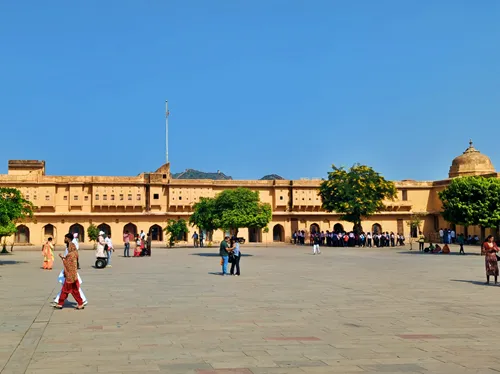
The Jaleb Chowk, often called the First Courtyard, is the massive public square that immediately greets visitors after they pass through the Suraj Pol (Sun Gate) or Chand Pol (Moon Gate) into the Amber Fort. Far from being just an open space, this courtyard served as the central military, ceremonial, and commercial hub of the entire complex.
Access to Jaleb Chowk is free, but you need to buy a ticket at the Ticket Office to explore the rest of Amber Palace.
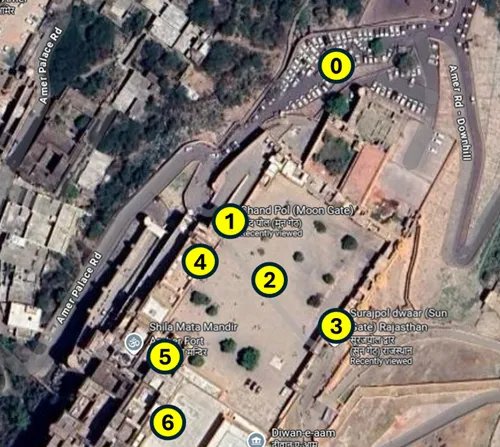
0 = Parking Lot near the top
1 = Chand Pol (Moon Gate)
2 = Jaleb Chowk (The First Courtyard)
3 = Suraj Pol (Sun Gate)
4 = Ticket Office
5 = Sinh Pol (Lion Gate)
6 = The Second Courtyard

Function: The Heart of Military Operations
The name Jaleb Chowk literally means ‘place where soldiers assemble’, and its primary purpose was military:
Parade Ground: This vast area was the muster ground where the Maharaja's army and cavalry assembled for inspections, parades, and military drills. Its size allowed for hundreds of soldiers and their horses to be mobilized efficiently.
Royal Processions: All royal processions, whether entering through the Suraj Pol or departing for the city of Amber below, were organized and launched from this square.
Elephant Parking: In historic times, and today for tourists, this courtyard served as the main staging area for elephants. It was here that the Maharaja's stable masters would keep the royal elephants ready for travel or battle.
The Architecture of Defense and Commerce
The architecture of the Jaleb Chowk is designed for both security and utility:
Secured Perimeter: The Chowk is enclosed by high, fortified walls. Entrances and exits were strictly controlled by guards, especially the main archways of the Suraj Pol and the Chand Pol.
Soldiers’ Quarters: The surrounding structures and arcades were used as stables for the horses and quarters for the Maharaja's personal guards and cavalry. This allowed the military force to be mobilized at a moment's notice.
Marketplace: During peaceful times, and especially on religious festivals, parts of the Jaleb Chowk also functioned as a basic marketplace, supporting the economic needs of the military and royal retinue living within the fort walls.
The Jaleb Chowk is the essential link between the outside world and the private, opulent palace complex above. From here, visitors ascend the next flight of steps through Lion Gate to reach the second courtyard, which contains the formal public halls.
Suraj Pol (Sun Gate): The Royal Entrance of Amber Fort
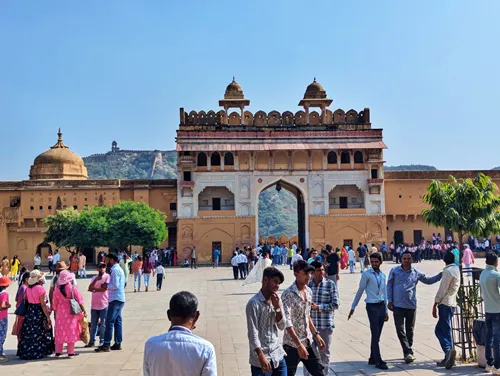
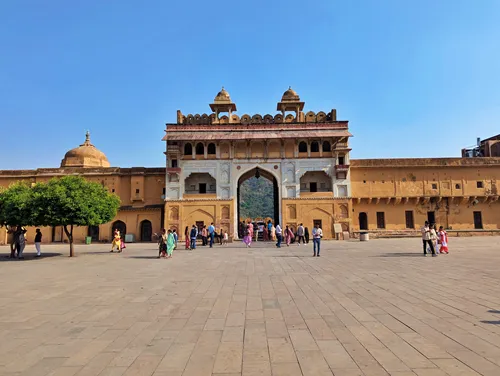
The Suraj Pol is the gate you will pass through if your driver drops you off at the bottom of the hill and not on the parking lot behind the fort. You will arrive on the traditional elephant ride (or jeep ride or walk) up the hill, instantly immersing you in the history of the royal procession.
The Suraj Pol, or Sun Gate, is the grand, primary eastern entrance to the Amber Fort (or Amer Fort) complex in Jaipur. This gate is the ceremonial entry point tied directly to the history, mythology, and religious beliefs of the ruling Kachwaha dynasty.
Alignment and Symbolism
The gate's name and placement are deeply symbolic, reflecting the Hindu heritage of the Rajput rulers:
Solar Dynasty: The Kachwaha Rajputs of Jaipur claim descent from the sun god, Surya. The name Suraj Pol is a direct nod to their lineage.
Eastern Orientation: The gate faces the east to greet the rising sun. Every morning, the royal procession of the Maharaja would leave the fort through this gate to offer prayers to the sun god, symbolizing the dynasty's perpetual connection to their divine ancestor.
The Royal Path: The Suraj Pol leads directly into the Jaleb Chowk (the main courtyard), which was the site for royal parades, military reviews, and public greetings. All high-ranking officials, visiting nobles, and conquering armies entered through this single, magnificent arch.
Architectural Characteristics
The Suraj Pol embodies the defensive strength and aesthetic grandeur expected of the primary royal access point:
Design: It is a large, massive structure built of red sandstone and fortified to withstand a siege. Its archway is wide enough to allow elephants and elaborate royal carriages to pass through.
Fortification: The gate is strategically positioned at a sharp turn, preventing enemy armies from gaining momentum and providing a clear defensive position for archers and guards located high up in the walls.
The Chowk: Once through the Suraj Pol, you enter the vast Jaleb Chowk, where the royal guards and cavalry maintained their horses. This area served as the military staging ground and the public assembly space.
The Suraj Pol vs. Chand Pol
While the Suraj Pol is the main, ceremonial entrance, Amber Fort also features a Chand Pol (Moon Gate) on the western side.
Chand Pol: This gate was less frequently used and was symbolically associated with the Moon Dynasty, though the Amber rulers were Solar Rajputs. It was primarily used as a secondary, private exit by the royal women and those needing quick access to the western side of the complex.
Ticket Office
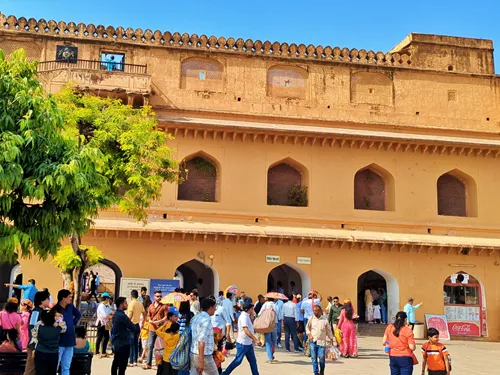
Jaleb Chowk serves as the visitor's first functional stop inside Amber Fort. Crucially, the main ticket office and counter for purchasing admission to the Amber Fort complex is located right here near Moon Gate in the Jaleb Chowk. Visitors arriving by foot, jeep, or the traditional elephant ride will purchase their entry tickets before proceeding up the steps to the palace's subsequent courtyards.
Sinh Pol (Lion Gate): The Barrier of Royalty
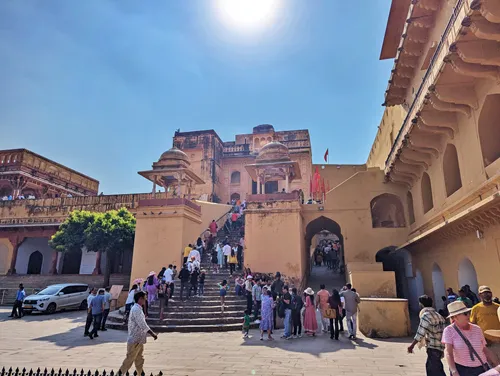
The Sinh Pol, or Lion Gate, is the heavily guarded and architecturally intricate gate that serves as the official, main entrance to the inner palace complex of Amber Fort. Unlike the Suraj Pol, which admits people into the public square, the Sinh Pol controls access from the Jaleb Chowk (1st Courtyard) into the Diwan-i-Aam complex (2nd Courtyard) and the private residential areas beyond.
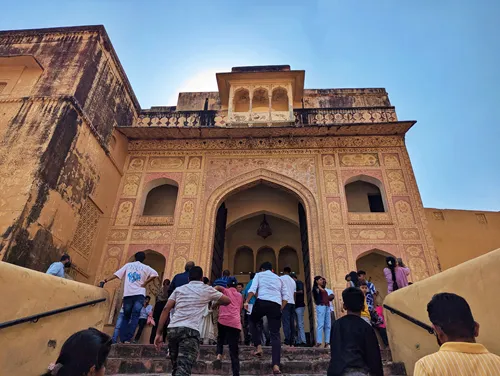
Function: Separation of Spheres
The primary function of the Lion Gate was to enforce the strict separation between the military and public domain and the royal and private domain:
Controlled Access: Only authorized officials, petitioners, and dignitaries were permitted to pass through this gate after the necessary formalities in the Jaleb Chowk.
Royal Ceremonial Entry: It was the gate through which the Maharaja would pass to conduct his daily business in the Diwan-i-Aam (Hall of Public Audience), making it highly symbolic of his direct presence.
Symbolism and Security
The gate's name and its winding design emphasize the two most important features of the inner palace: power and protection.
The Lion (Sinh): The lion is a universal symbol of strength, courage, and sovereignty. Naming the gate the 'Lion Gate' was a powerful statement that the area beyond was the private domain of the fierce and sovereign ruler.
Defensive Design: Architecturally, the gate is designed with security in mind. It is purposefully angled and built at a curve to prevent a direct, high-speed cavalry charge. An enemy force that breached the Suraj Pol would still be severely hampered by the tight defensive lines and turns of the Sinh Pol.
Guard Posts: Its massive walls contain hidden guard posts and defensive loops, ensuring that the entire area was under constant surveillance.
The Sinh Pol is the definitive threshold that marks the end of the public area and the beginning of the intimate, artistic, and administrative sections of the palace.
The Second Courtyard: The Administrative and Public Hub
The Second Courtyard marks the first truly royal space within the Amber Fort. After ascending from the Jaleb Chowk and passing through the heavily guarded Sinh Pol (Lion Gate), visitors arrive in this spacious courtyard, which is dedicated entirely to the Maharaja's public and administrative duties.
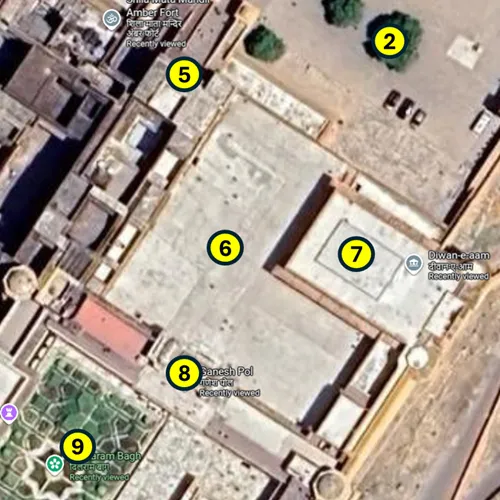
Function: Government and Justice
This courtyard was the epicenter of the kingdom's governance. Its primary feature is the magnificent Diwan-i-Aam (Hall of Public Audience), which faces the main entrance of the court.
Public Audience: This is where the Maharaja held his formal court sessions. He would sit on his throne, listen to petitioners, issue royal decrees, and receive tributary payments from subordinate rulers.
Military Parades: While the Jaleb Chowk was the muster ground, high-status military parades and the presentation of victorious armies often took place in this courtyard, right before the Maharaja in the Diwan-i-Aam.
Administrative Center: The surrounding buildings and arcades were used by scribes, treasury officials, and military commanders to manage the daily affairs of the state.
Architectural Characteristics: Public Grandeur
The design of the Second Courtyard is one of controlled, stately grandeur, intended to impress the public and visiting dignitaries with the Raja's authority.
The Diwan-i-Aam: This large, open pavilion is supported by a double row of ornate sandstone columns. The pillars feature exquisitely carved elephant brackets and intricate floral motifs, demonstrating the wealth and artistic refinement of the Rajput court.
Vantage Point: The courtyard is slightly elevated from the Jaleb Chowk, giving the impression that the Maharaja, when seated in the Diwan-i-Aam, was literally looking down upon his realm.
The Gates: While the Sinh Pol is the main entry, the courtyard also contains the entrance to the third and most private courtyard (the Ganesh Pol), further establishing its role as a transitional hub.
Diwan-i-Aam (Hall of Public Audience): The Seat of Justice
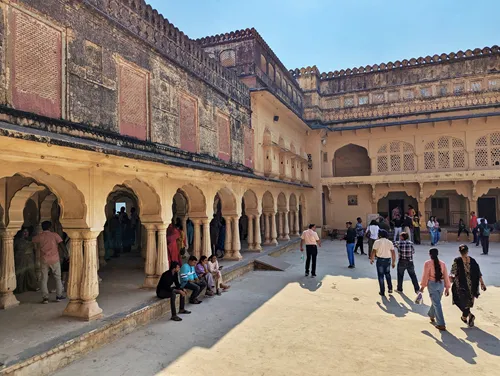
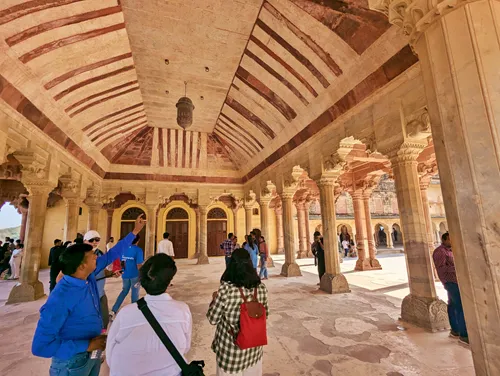
The Diwan-i-Aam, or the Hall of Public Audience, is the centerpiece of the Second Courtyard at Amber Fort. This grand, open-sided pavilion served as the nerve center of the kingdom, the place where the Maharaja formally met with his subjects, dispensed justice, and conducted the essential administrative business of the state.
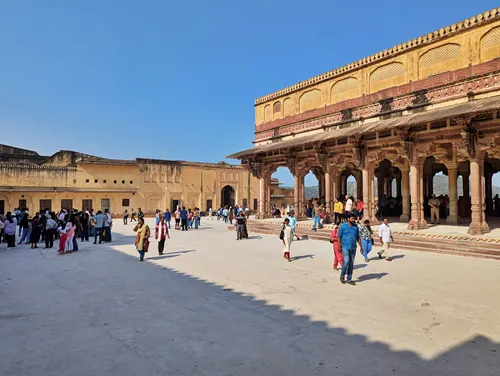
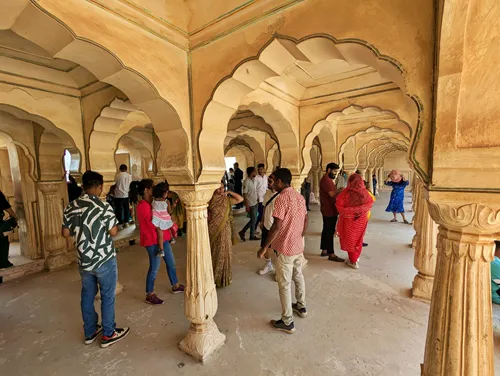
Function: The King's Public Duty
This hall was designed to showcase the transparency and accessibility of the Rajput rule, while still emphasizing the sovereign's authority:
Public Court: The Maharaja would sit upon a marble throne facing the courtyard, allowing common people and military officials to present their petitions, grievances, or reports. The proceedings were public, lending legitimacy and accountability to the ruler's decisions.
Ceremonial Hub: During festivals or victory celebrations, the Hall served as the stage for royal ceremonies. It was here that visiting dignitaries were formally received and high-ranking officials were honored.
Architectural Characteristics: Sandstone Grandeur
The Diwan-i-Aam is a magnificent example of the blend of traditional Rajput and Mughal architectural elements, designed for both aesthetic beauty and functional openness.
Pillared Pavilion: The Hall is an open pavilion supported by a double row of beautifully carved columns. This open design ensured that the maximum number of people could witness the court proceedings from the courtyard below.
The Elephant Brackets: The most striking feature is the elaborate carving on the column capitals. The pillars feature incredibly intricate, detailed elephant-head brackets that appear to support the massive roof and the deeply shaded eaves (chhajjas). These brackets are a classic example of indigenous Rajasthani artistic flair.
Material: The structure is predominantly built from rich red sandstone, which provides a warm backdrop for the carved decoration and historical patina.
The Diwan-i-Aam is a powerful space that reminds visitors that while the Rajputs were fierce warriors, they were also meticulous administrators who honored the tradition of meeting with their people.
Ganesh Pol (Ganesh Gate) and Suhag Mandir: The Private Threshold
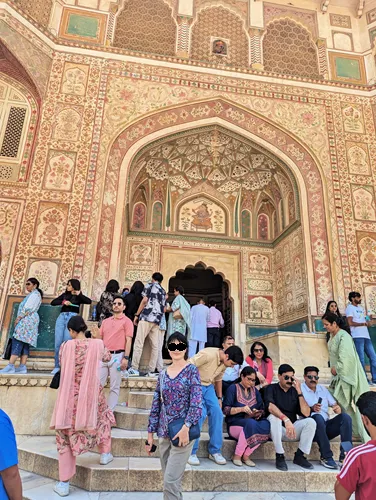
The Ganesh Pol is the stunning, multi-story gateway that acts as the entrance to the Third Courtyard of Amber Fort. This portal is often considered the most beautiful structure in the entire palace, marking the shift from the public administration (Diwan-i-Aam) to the private, exclusive residential quarters of the Maharaja and his family.

The Gateway of Auspiciousness
The gate is named after the Hindu deity Lord Ganesha, the remover of obstacles, whose image traditionally adorns the top of the archway. This dedication makes the gate ritually and symbolically important:
Sacred Barrier: The gate served as a powerful barrier. Once a person passed through the Ganesh Pol, they were entering the Mardana Mahal (Men's Quarters) and the Zenana (Women's Quarters), areas absolutely forbidden to commoners.
Architectural Climax: Unlike the plain, defensive exterior gates, the Ganesh Pol is a masterpiece of art. It is famous for its vibrant fresco paintings and intricate plasterwork using natural vegetable dyes, adorned with delicate geometric and floral patterns. The colors and motifs remain remarkably preserved.
The Suhag Mandir (Temple of Good Fortune)
High above the arch of the Ganesh Pol, visitors will notice a delicate, balcony-like structure: the Suhag Mandir.
Function: This small chamber was reserved exclusively for the Maharani and other senior royal women (the Zenana). Because they were bound by the strict custom of purdah (seclusion), they could not appear publicly in the lower courtyards.
Royal Viewing Box: From the Suhag Mandir, the women could secretly watch the grand royal ceremonies, processions, and military parades that took place in the courtyard below, observing the public life of the palace without being seen.
Symbolism: Suhag means ‘good fortune’ or ‘married life,’ underscoring the spiritual and domestic significance of this royal viewing area.
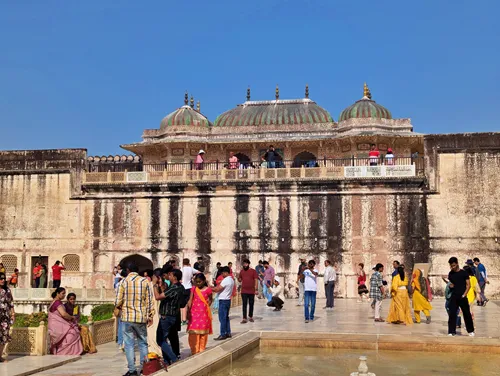
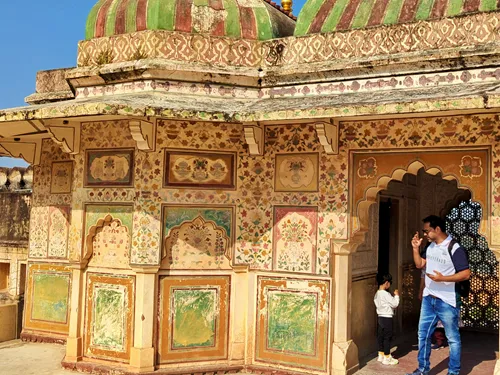
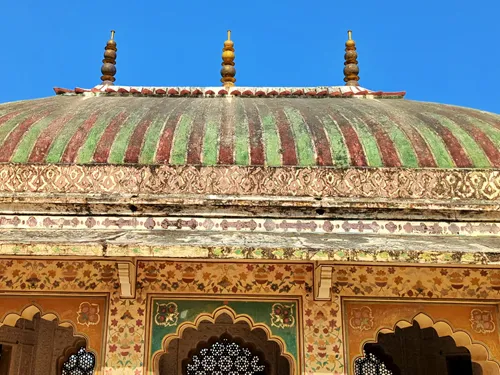

The Ganesh Pol, with the subtle elegance of the Suhag Mandir above it, is the true architectural and social gateway to the private life of the Amber dynasty.
Third Courtyard (Mansingh Palace Section)
The Third Courtyard, accessed exclusively through the magnificent Ganesh Pol, represents the final threshold into the private, residential world of the Amber royalty. It is the most exquisite and luxurious section of the palace, primarily dedicated to the Maharaja's personal and private audiences (Diwan-i-Khas), pleasure gardens, and the oldest royal quarters.
Spiritual Anchor: The Man Singh Temple
The most distinctive feature of the older northern section of this courtyard is its historical devotional area, often referred to as the Man Singh Temple or the Man Singh Palace courtyard.
Oldest Section: This area is part of the original palace built by Raja Man Singh I (Akbar's general and father-in-law) in the late 16th century, making it the oldest standing part of the fort complex.
The Temple: Integrated into the palace structure, the courtyard housed a Hindu temple used for the daily private worship of the royal family. This integration of the temple directly into the residential architecture is typical of early Rajput palace design.
Residential Quarters: The surrounding chambers were the original Zenana (women's quarters) and living spaces before the later annexes were constructed.
Architectural Grandeur: Diwan-i-Khas and Sheesh Mahal
While the Man Singh section provides the historical background, the main attraction of the Third Courtyard is its breathtaking splendor, dominated by the buildings of later Maharajas:
Diwan-i-Khas (Hall of Private Audience): This is where the Maharaja held private consultations with his ministers, foreign ambassadors, and highly select nobles. It is more intimate and richer in decoration than the public Diwan-i-Aam.
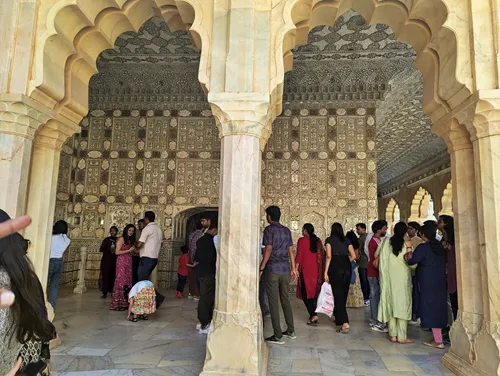
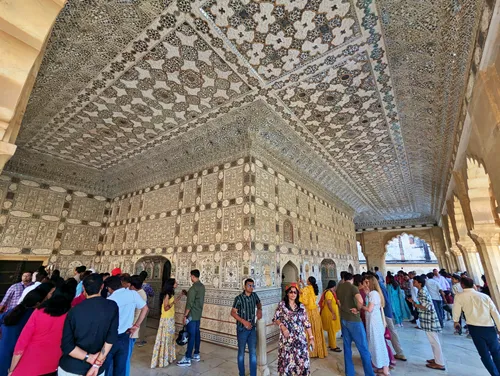
Jai Mandir (Sheesh Mahal): This section is entirely devoted to pleasure and aesthetic brilliance. The Sheesh Mahal (Hall of Mirrors) is located here, famous for its dazzling mosaic of tiny mirrors that reflect any light source, creating a celestial effect.
Charbagh Garden: The center of the courtyard features a small, formal Charbagh-style garden, divided into four symmetrical sections. This garden design, adopted from Mughal tradition, provided a cooling and aesthetic oasis for the private palace residents.
The Third Courtyard is where the military strength of Amber Fort gives way to its artistic and domestic genius, offering a window into the luxurious and devotional life of the Rajput kings.
Diwan-i-Khas (Hall of Private Audience): The King's Inner Council
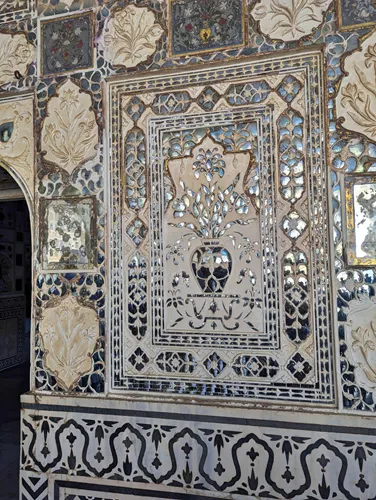
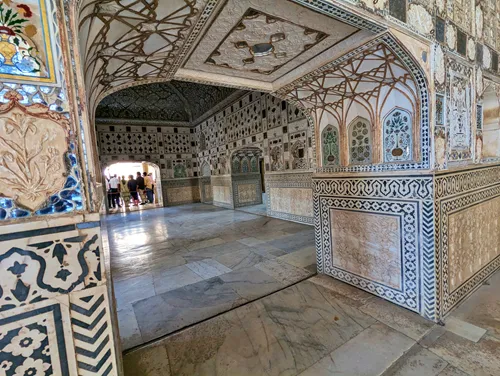
The Diwan-i-Khas, or the Hall of Private Audience, is one of the most structurally and politically significant pavilions in the Third Courtyard of Amber Fort. Located strategically near the private royal quarters and adjacent to the Sheesh Mahal, this hall was the exclusive domain where the Maharaja conducted confidential meetings, held private consultations, and received the most elite visitors and ambassadors.
Function: Confidential Governance
The purpose of the Diwan-i-Khas was to create an intimate and secure setting, contrasting sharply with the public spectacle of the Diwan-i-Aam:
Select Gatherings: Access to this hall was severely restricted. Here, the Maharaja met only with his inner circle—the Prime Minister, the Chief Military Commander, trusted Brahmin scholars, and high-level foreign envoys.
Secrecy and Diplomacy: All confidential matters of state, military strategy, treaty negotiations, and sensitive judicial issues were discussed within these walls. It was the true center of political power.
The Second Name: This structure is also often referred to as the Jai Mandir (Hall of Victory), underscoring its role in celebrating important military and diplomatic successes.
Architectural Characteristics: Opulence and Intimacy
The Diwan-i-Khas is intentionally smaller and more lavishly decorated than its public counterpart, reflecting the status of the individuals permitted inside.
Elaborate Decoration: While the exterior may appear to be simple marble and sandstone, the interior features rich plasterwork, fresco paintings, and intricate mirror work that set a tone of exclusive luxury.
Central Throne Platform: The hall typically contains an elevated platform where the Maharaja's cushioned seat would be placed, ensuring he was visually higher than his counselors, even in this intimate setting.
Proximity to Zenana: Its location in the Third Courtyard—the private sector—meant that the royal family could easily access it without having to traverse the public squares, maintaining the separation required by royal custom.
The Diwan-i-Khas represents the high point of Rajput administration, showcasing an environment built for governance, luxury, secrecy, and concentrated power.
Sukh Niwas (Hall of Pleasure): The Summer Retreat
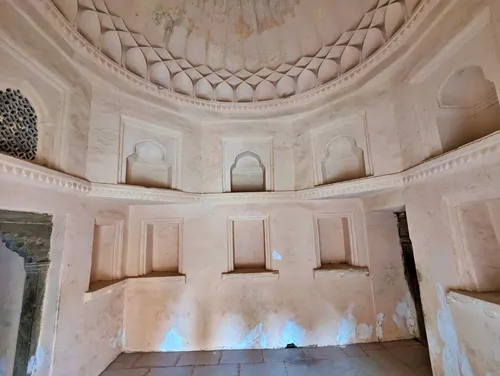
The Sukh Niwas, meaning the ‘Abode of Happiness’ or ‘Hall of Pleasure’, is located in the most private part of the Amber Fort, usually situated opposite the iconic Sheesh Mahal across from the beautiful formal garden (Charbagh) of the Third Courtyard. This pavilion was designed as the Maharaja's private residential retreat, built specifically to provide comfort and escape from the scorching heat of the Rajasthani summer.
Function: A Naturally Cooled Residence
The primary function of the Sukh Niwas was to serve as a summer palace and a personal residential block for the Maharaja. Every architectural feature was oriented toward maximizing cool air and providing a serene environment.
Private Retreat: This was the Maharaja’s personal space for rest, relaxation, and intimate social gatherings. Only the closest royal family members and personal attendants were permitted entry.
A Sanctuary from Heat: The palace's design is an ingenious example of traditional Indian passive cooling. It was constructed facing the cool prevailing breeze and utilized a sophisticated water system to regulate the temperature.
Architectural Characteristics: India's Early Air Conditioning
The design of the Sukh Niwas is less about dazzling visual wealth (like the Sheesh Mahal) and more about functional comfort and refined aesthetics:
The Water Channel: The most defining and innovative feature is the marble water channel that runs through the interior of the pavilion. Water, drawn from the nearby reservoirs, was channeled here.
The Waterfall Effect: The water then flowed and cascaded down the wall outside the pavilion, spilling into the garden below. As the water evaporated, the surrounding air was significantly cooled.
Sandalwood Doors: The large, heavy doors and windows were traditionally made of sandalwood. These provided insulation and released a pleasant fragrance when the cool, moist air passed over them.
Aesthetic: The interior is finished in white marble and stucco, with simple geometric and floral motifs, offering a soothing contrast to the highly decorated halls.
The Sukh Niwas beautifully demonstrates how the Rajput rulers skillfully blended architectural engineering with luxurious living to create a comfortable environment even in the harshest climate.
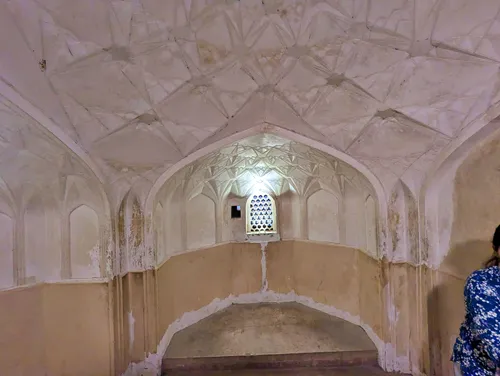
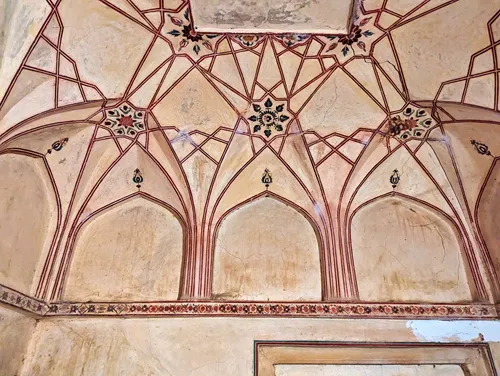
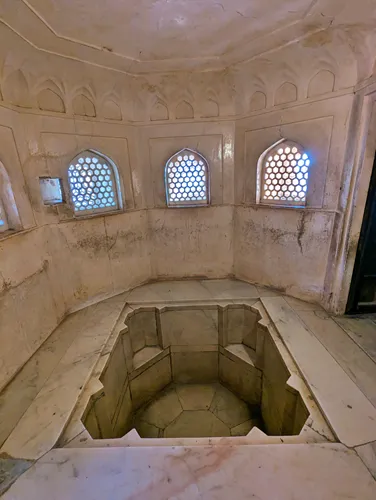
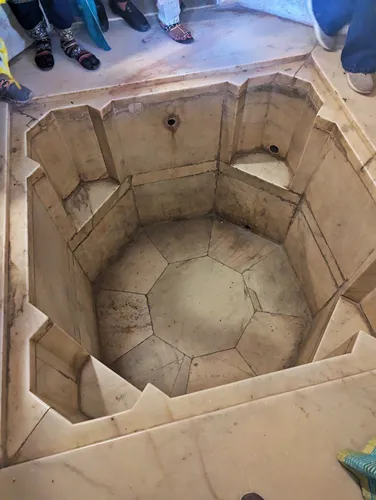
Hammam (Royal Bathhouse): The Private Sanctuary
The Hammam (or Turkish/Mughal Bathhouse) at Amber Fort is a series of enclosed chambers located within the most private residential quarters of the palace, often near the Sukh Niwas. This structure showcases the sophisticated approach to personal hygiene, comfort, and luxury maintained by the Rajput royalty, influenced by the Mughal architectural and social traditions.
Function: Ritual and Relaxation
The Hammam was far more than just a place to wash; it was a private retreat reserved for the Maharaja and, sometimes, his most trusted inner circle.
Hot and Cold Rituals: The complex was built for a layered bathing ritual, involving transitions between cool, tepid, and hot rooms, similar to Roman or Turkish baths. This was believed to be beneficial for health and detoxification.
Luxury and Privacy: The entirely private nature of the Hammam provided a secure and quiet space for the Maharaja to relax, receive massages, and sometimes hold very private, informal meetings with ministers.
Architectural Characteristics: Engineering for Comfort
The design of the Hammam is highly functional, focusing on engineering principles to regulate temperature and steam in a controlled, dark environment.
Curved Roofs and Vaults: The rooms feature heavy, curved, and vaulted ceilings to contain the heat and steam. Unlike the open audience halls, the Hammam rooms are kept intentionally dim and small to maintain the high temperature.
Hypocaust System: The most important feature is the concealed heating system, known as the hypocaust. Hot water was heated in external boilers and channeled through hidden pipes under the marble floors. Small vents and perforations in the floor would allow steam to rise, heating the air and water of the inner bathing chambers.
Marble Flooring and Walls: The entire interior is typically lined with white or light-colored marble and sealed with thick plaster to handle the constant moisture. The floors are often decorated with simple, functional geometric inlay patterns which also helped to prevent slipping.
Light Vents: Natural light enters through small, star-shaped, or circular openings in the dome and roof, illuminating the steam-filled rooms with diffused light.
The Hammam stands as a testament to the fact that Rajput luxury extended far beyond the glittering Diwan-i-Khas, incorporating sophisticated climate and comfort engineering into the private life of the ruler.
Palace of Man Singh I (The Fourth Courtyard): The Historic Zenana
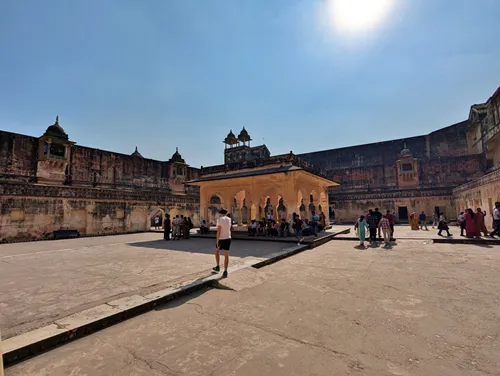
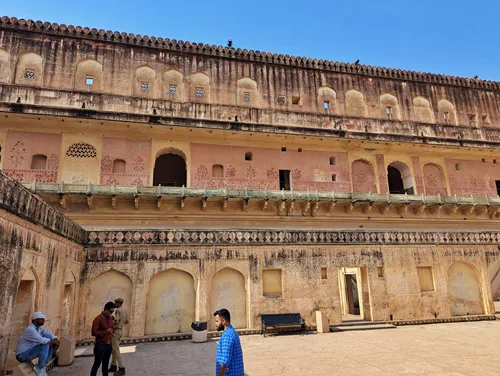
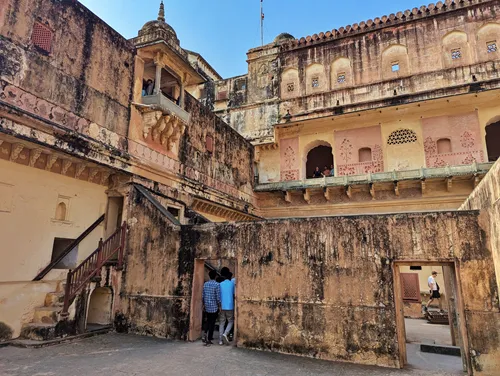
The section known as the Palace of Man Singh I, often designated as the Fourth Courtyard, is the most historically significant part of the entire Amber Fort complex. Built by Raja Man Singh I (c. 1594), this is the oldest surviving residential area of the fort and served as the original royal Zenana (the women's quarters).

Historical Significance: The Original Foundation
Before the later, more opulent sections like the Sheesh Mahal were added by successive rulers, the palace built by Raja Man Singh I (who was one of Emperor Akbar’s most trusted generals) was the center of life at Amber.
Age: It predates the grandeur of the later Diwan-i-Khas and the intricate mirror work, representing the architectural style of the late 16th century.
A Self-Sufficient World: As the primary residence for the royal family, this section was designed to be entirely self-sufficient, incorporating residential blocks, devotional spaces, and inner courtyards.
Function: The Private Women's Quarters (Zenana)
The palace was meticulously designed to adhere to the custom of purdah (seclusion), ensuring the privacy of the royal women:
Residential Complex: The entire area functioned as the Zenana, housing the Maharaja’s numerous wives, concubines, children, and their accompanying female staff.
Separate Apartments: The most unique architectural feature is the division of the residential space into twelve distinct apartments. Each of the Raja’s primary wives had her own private, self-contained apartment, which surrounds a central, communal pavilion. This clever design helped to maintain harmony and separate living arrangements for the large royal household.
Architectural Characteristics: Symmetry and Privacy
The layout of the Man Singh Palace prioritizes functional symmetry and maximum seclusion over public display.
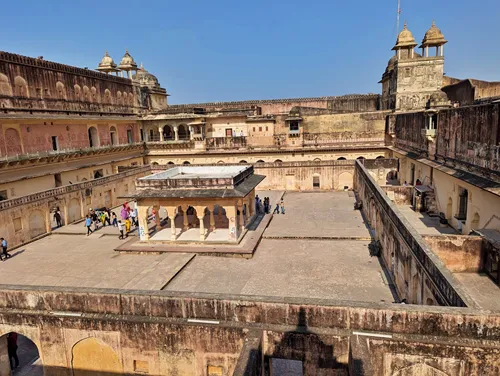
Central Baradari (Pavilion): The apartments are built around a raised, open-sided central pavilion. This structure served as a communal gathering place for the royal women, particularly during festivals and family celebrations, allowing them to interact within their private sphere.
Pillars and Stone: The architecture here is simpler and more robust than the highly decorated later courts. It features sturdy pillars, stone carvings, and delicate jalis (stone screens) on the windows of the upper stories, which allowed the women to look out without being seen.
Kesar Kyari (Saffron Garden): Although technically part of the Third Courtyard, the famous Kesar Kyari garden in the Maota Lake visible below the palace was designed to be enjoyed primarily by the residents of the Man Singh Palace, offering beautiful views from the top residential windows.
Baradari (The Twelve-Door Pavilion): Centerpiece of the Zenana
The Baradari, literally translating to a ‘structure with twelve doors’ or openings, is the raised, open-sided pavilion that forms the symmetrical centerpiece of the Palace of Man Singh I (Fourth Courtyard)—the oldest and most private residential area (the Zenana). As the core of the women's quarters, the Baradari was the focal point of the royal family’s domestic life.
Function: A Private Social Hub
Reserved exclusively for the women of the royal household, the Baradari served as the primary communal space within the heavily secluded Zenana:
Communal Gathering: Surrounded by the private apartments of Raja Man Singh I’s various wives, the Baradari was the only place where the women could gather freely. It hosted private celebrations, family rituals, and social interactions away from the eyes of the public and male courtiers.
Central Viewing Point: Its elevated position provided the royal women a vantage point, allowing them to look down upon the courtyard activities and occasionally the beautiful Kesar Kyari garden in the lake below, all while remaining securely behind the walls of the palace.
Architectural Characteristics: Design for Comfort
The Baradari design is centered on providing maximum light and airflow, essential for comfort in the hot Rajasthani climate:
Open Structure: The pavilion is supported by pillars and features twelve open bays—four on each side (or three on a side for smaller structures but maintaining the open concept). This design ensures cross-ventilation, making it the coolest spot within the inner palace complex.
Raised Platform: The Baradari is built upon a high platform, lending it importance and protecting its occupants from the dust and heat of the ground level.
Simple Elegance: Unlike the highly decorated halls of the Diwan-i-Khas, the Baradari's structure is generally simpler, focusing on sturdy columns and graceful arches, allowing the natural light and breeze to be the main architectural features.
Kesar Kyari Garden (Light and Sound Show)
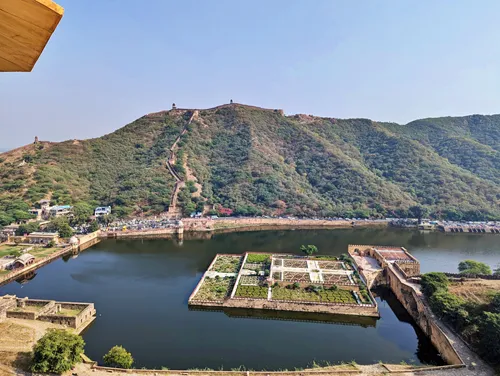
The Kesar Kyari Garden is an exquisite, small island garden situated in the center of the Maota Lake below the ramparts of Amber Fort. This area serves two distinct but equally important purposes: historically, it was a beautiful, fragrant oasis for the royal family; today, it is the magnificent stage for the fort's renowned Light and Sound Show.
Historical Function: The Saffron Oasis
Location: The garden is strategically located in the middle of the artificial Maota Lake, which was the main reservoir for the palace complex. The garden is connected to the mainland by a narrow causeway.
Design: Built in the formal Charbagh style (a four-part garden layout common in Mughal and Rajput architecture), the Kesar Kyari features symmetrical pathways and small beds.
The Name: Kesar Kyari translates to ‘Saffron Garden.’ While it is doubtful that saffron (which requires a very specific cool climate) thrived here, the name likely refers to the precious flowers or spices that were grown here, whose scent was carried up to the palace by the cool lake breeze.
Royal View: The garden was designed primarily to be viewed from above. The royal women in the Zenana and the Maharaja in the upper palace courtyards (especially the Sukh Niwas) enjoyed the scenic symmetry of the garden and the shimmering waters of the lake, which provided a natural cooling effect.
The Modern Spectacle: Light and Sound Show
Location: The garden is strategically located in the middle of the artificial Maota Lake, which was the main reservoir for the palace complex. The garden is connected to the mainland by a narrow causeway.
Design: Built in the formal Charbagh style (a four-part garden layout common in Mughal and Rajput architecture), the Kesar Kyari features symmetrical pathways and small beds.
The Name: Kesar Kyari translates to ‘Saffron Garden.’ While it is doubtful that saffron (which requires a very specific cool climate) thrived here, the name likely refers to the precious flowers or spices that were grown here, whose scent was carried up to the palace by the cool lake breeze.
Royal View: The garden was designed primarily to be viewed from above. The royal women in the Zenana and the Maharaja in the upper palace courtyards (especially the Sukh Niwas) enjoyed the scenic symmetry of the garden and the shimmering waters of the lake, which provided a natural cooling effect.
In modern times, the Maota Lake and the surrounding fortification walls of the fort are transformed into the canvas for one of Jaipur's most popular evening attractions: the Light and Sound Show.
Content: The show narrates the glorious history of Amber Fort and the Kachwaha dynasty, recounting tales of love, loyalty, and valor. It covers centuries of history, from the early rulers through Raja Man Singh I to the establishment of modern Jaipur.
The Venue: The stunning illumination highlights the colossal architecture of the fort, including the intricate details of the gates and ramparts, creating a dramatic, immersive backdrop for the historical narrative. The sound and lighting effects are synchronized with the music and narration, bringing the massive stone walls to life.
Logistics: The seating area for the show is typically located on the mainland banks of the lake, facing the brightly illuminated fort.
The Kesar Kyari and Maota Lake provide the perfect blend of natural beauty and historical theater, connecting the serene life of the Rajput rulers with the dramatic history of their empire.
Where do you want to go now?

Author: Rudy at Backpack and Snorkel
Bio: Owner of Backpack and Snorkel Travel Guides. We create in-depth guides to help you plan unforgettable vacations around the world.

Other popular Purple Travel Guides you may be interested in:
Like this Backpack and Snorkel Purple Travel Guide? Pin these for later: